
The Insurance Regulatory and Development Authority of India (IRDAI) has cleared the way for health insurance claims on hospitalisations as short as two hours, ending decades of ambiguity around the old "24-hour rule" that pushed hospitals and patients into avoidable overnight stays. As reported by Whalesbook via Google News, insurers must now honour claims for procedures and treatments that legitimately conclude in under a day. For hospital owners, MDs and administrators, the change is less a clinical event and more an operations event — one that touches admission workflows, billing rules, TPA reconciliation and the software you already run.
Under the earlier convention, most cashless and reimbursement claims required a minimum 24-hour stay unless the treatment fell into a named "day care" list. That created two operational headaches. First, hospitals routinely admitted patients to inpatient beds for observation stays that clinically did not need a bed, purely to protect the insurance claim. Second, patients undergoing genuinely short procedures — cataract, dialysis, chemotherapy cycles, minor endoscopy, some cardiac interventions — were forced into paperwork gymnastics because their case did not fit either bucket cleanly.
The new position from IRDAI, in line with the shift in clinical practice towards day-care and short-stay medicine, decouples claim eligibility from an arbitrary time floor. That is good for patients and for insurer loss ratios, but it introduces three immediate P&L questions for hospital operators. One, how many current 24-hour observation admissions will now be billed as short-stay, changing the average revenue per bed-day. Two, how will bed turnover, and therefore throughput, shift once patients are no longer parked overnight for insurance reasons. Three, how do you re-price short-stay packages so the topline is not silently eroded when the length-of-stay component of your tariff collapses.
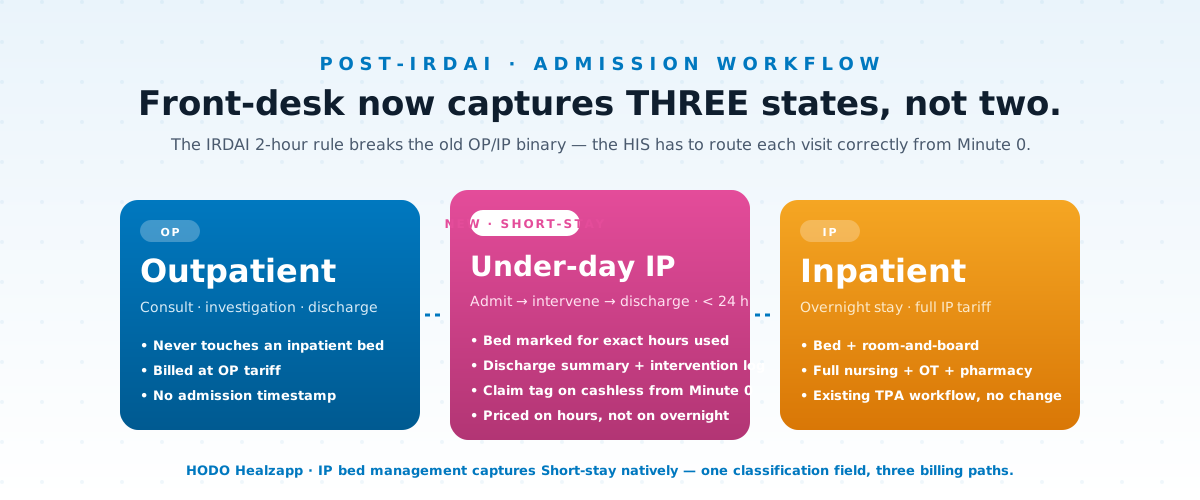
Most Indian hospital HIS deployments still model the admission decision as a binary: OP or IP. The 2-hour rule breaks that model. Front-desk staff now have to capture a third state — a documented short-stay episode that is clinically inpatient in intent but is discharged within hours — and route it through billing with the correct claim tag from the very first data entry. If that classification is done on paper or in a spreadsheet outside the HIS, the claim will bounce at the TPA end.
Owners should audit the admission-to-billing chain against a specific test: can a receptionist admit a patient at 10am, complete the intervention by 1pm, discharge by 2pm, and generate a compliant claim packet without any manual re-entry of case data into the insurance module? If the answer is no, the software is holding the finance team back, not the clinical team. Watch also for how case sheets, consent forms, and time-stamped observation notes flow out of nursing and back into the discharge summary. TPAs will now scrutinise the clinical clock much more closely, and every gap in the timeline is a claim rejection waiting to happen.
Shorter admissions mean shorter documentation cycles, and, in principle, faster claim submission. The bottleneck that will decide whether your outstanding-from-TPA number falls or rises is documentation completeness at the point of discharge. In the old world, hospitals had the buffer of a 24-hour stay to complete notes, chase signatures and finalise investigations before the claim went out. In the new world, that buffer is gone.
Practically, this means the discharge summary, the investigation reports, and the pharmacy line items must all be locked and reconciled within the same short window as the clinical visit. Hospitals that already run tightly integrated pharmacy and lab modules inside the HIS will find this transition manageable. Hospitals that still export data between systems will find their DSO from insurers stretching, not shrinking, because incomplete claim packets get rejected and re-worked. The single highest-leverage change an administrator can make in the next quarter is to move discharge sign-off into the same screen as claim submission, so nothing leaves the building half-documented.
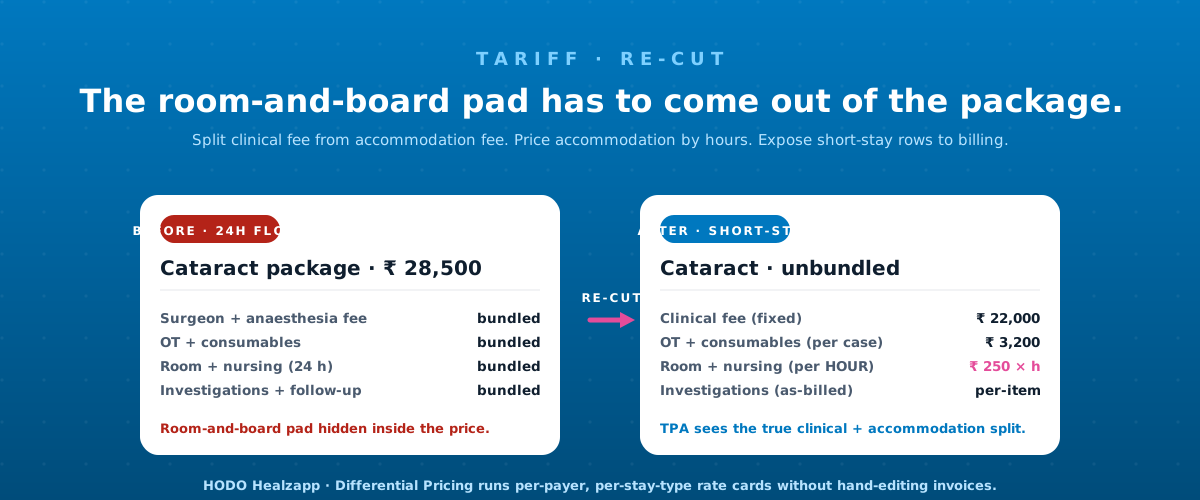
Chain hospitals and multi-outlet groups usually run tariffs that bundle a room-and-board component into surgical and interventional packages, on the assumption of at least one overnight stay. Once a meaningful share of those cases moves to under-day admissions, the room-and-board pad disappears from the invoice while the fixed clinical cost stays the same. Finance heads will need to re-cut packages: separate the clinical fee from the accommodation fee, price the accommodation on actual hours, and expose short-stay pricing rows to the billing team.
The same discipline applies to corporate and TPA-negotiated rate cards. If your rate card still assumes 24-hour minimums, expect insurers to start negotiating downward for cases that no longer need overnight beds. The hospitals that win this round will be the ones whose HIS can maintain distinct price lists per payer and per stay-type without hand-editing every invoice. For groups scaling to new outlets, this also means the pricing model has to travel cleanly from the flagship to every new centre without a fresh negotiation with the billing vendor each time.
A shorter stay does not reduce the documentation requirement — it compresses it. Every short-stay claim will need a clean digital record: admission time, procedure time, discharge time, clinical justification, and linked prescriptions. ABDM-compliant records make this easier because the structure is already standardised for external consumption, whether by insurers, TPAs or auditors. Hospitals still running paper case sheets alongside a partial EMR will find themselves manually reconstructing timelines for every disputed claim, and manual reconstruction is where the margin leaks out.
Owners running HODO Healzapp already have the pieces needed to absorb this change without a systems overhaul. Three modules do most of the heavy lifting. First, IP bed management lets the front desk mark a short-stay episode against a bed for the exact hours used, so bed-turnover reporting and revenue-per-bed dashboards reflect reality instead of the old 24-hour fiction. Second, Billing with Differential pricing allows finance to run distinct rate cards for short-stay, day-care and full-IP episodes, and to segment those cards further by TPA or corporate partner without editing invoices line-by-line. Third, the ABDM-compliant EMR ensures that the compressed clinical timeline — admission, intervention, discharge — is captured with time stamps that survive TPA scrutiny and audit. Together, these are the difference between the 2-hour rule improving your cashflow and quietly eroding it.
See how Healzapp handles this — book a 30-min demo.
Source of the news hook: Read the source article →
See how Healzapp, Labzapp and EReazy fit your speciality in a free 30-minute demo.
Book a Free Demo