
Moneylife reported this week on IRDAI's fresh round of health insurance claim-settlement reforms, framed as a game-changing push to shorten cashless approval cycles, standardise reimbursement documentation, and put a hard clock on insurers. For hospital owners, the headline is not the consumer-side relief — it is the operational load that shifts back onto the billing floor.
The reforms tighten three points that hospital finance teams already lose sleep over. First, cashless authorisation windows are being compressed — insurers now face a public-facing deadline to respond to pre-auth and discharge requests, with the industry moving towards a one-hour pre-auth and a three-hour discharge-clearance benchmark. Second, the definition of complete documentation is being standardised across TPAs, which cuts down on the loop of query-response-query that used to eat 48-72 hours per claim. Third, denial reasons must now be itemised and shared in a structured format, which lets hospitals contest rejections instead of writing them off.
For a 200-bed hospital doing 30-40 cashless discharges a day, the practical translation is straightforward: the billing and insurance desk is now on the insurer's clock, and any slack in the discharge workflow shows up as a payment-cycle delay, not just a patient satisfaction issue. The reforms reward hospitals that already treat claims processing as an assembly line and penalise those that treat it as a series of individual escalations.
Most Indian hospitals sit with 45-90 days of receivables tied up in TPA and PSU-scheme claims. The IRDAI push, if enforced, structurally moves that window inward — but only for hospitals whose paperwork is airtight on submission. Every additional query costs three to seven days, and a hospital that averages 1.4 queries per claim will not see the promised cashflow benefit even if the insurer is honouring the new SLAs.
The finance-side action item is to instrument the claim lifecycle end-to-end: time from admission to pre-auth submitted, time from discharge to final bill submitted, time from submission to first insurer response, time to settlement. Without those four numbers on a weekly dashboard, administrators cannot tell whether the bottleneck is inside the hospital or at the TPA — and both need different fixes. Treating claim-cycle time as a board-level KPI, not a back-office nuisance, is the first cultural shift the reforms demand.
The reforms lean heavily on structured, standardised documentation. That sounds procedural, but it hits the clinical-notes workflow directly. Consultants who dictate rushed discharge summaries, nursing notes that skip vitals-frequency logging, and OT notes without implant sticker traceability are the three most common triggers for query-loops.
Administrators should treat documentation quality as a claims-recovery metric, not just a medico-legal one. A weekly review of the ten claims that took the longest to close, tagged by which document was missing or ambiguous, will surface patterns within a month — usually two or three consultants and one ward. The fix is workflow, not exhortation: the EMR should force structured entry for the fields TPAs query most, and discharge summaries should assemble from that structured entry rather than being re-typed at the last minute by a house officer under time pressure.
Most hospital insurance desks are staffed for the old world of paper, faxes, and phone escalations. Under the new regime, the workflow needs fewer handoffs and more automated checks. A typical claim touches five to eight hands between the ward and the TPA portal — front-office, treating consultant, insurance coordinator, billing, medical records, and back to insurance for submission. Every handoff is a place where the packet loses a document.
The redesign question is: which of these handoffs can be replaced by a system-enforced checklist? If the HIS won't allow a discharge summary to be finalised without ICD codes, implant details, and consultant sign-off, the insurance coordinator's job shrinks from chasing documents to submitting and tracking. That is the operational shift the IRDAI reforms reward — and penalise hospitals for missing. It also frees senior insurance-desk staff to spend time on the ten percent of claims that need genuine negotiation, rather than the ninety percent that should have been paid on first submission.
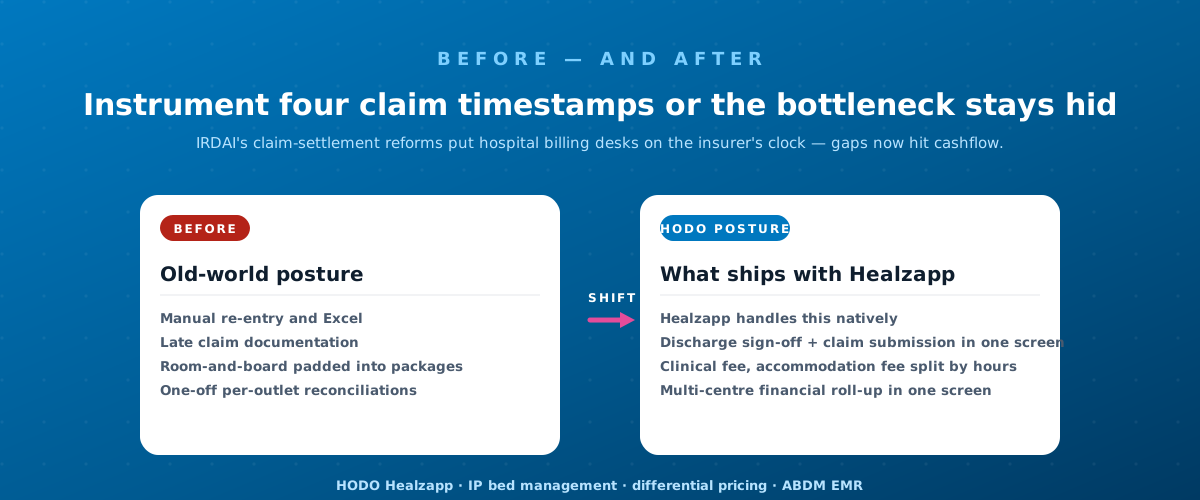
Before the enforcement teeth kick in, three audits are worth commissioning. First, a claim-cycle time audit: pull the last 200 claims, map the four timestamps mentioned earlier, and identify the P90 delay driver. Second, a denial reason audit: categorise the last quarter's rejections by IRDAI's new structured reason codes and see which are systemic versus one-off. Third, a document-completeness audit at the point of submission — sample 50 claims and check whether every mandatory field was present on first submission.
These three numbers — median cycle time, denial rate by reason category, and first-time-right submission rate — separate hospitals that benefit from the reforms from those that get squeezed by them. They are also the numbers a competent HIS should surface without a data analyst in the loop, and any vendor that cannot produce them from the existing data is worth a hard conversation.
HODO Healzapp customers already have most of the primitives to respond to the IRDAI shift without a major project. The Billing module ties bill lines back to structured EMR entries, which is what TPAs increasingly demand for pre-auth and final claim submission — no re-typing, no reconciliation gaps between the clinical narrative and the itemised bill. The EMR (AI-condensed history) produces discharge summaries that pull structured fields — diagnoses, procedures, implant details, medication reconciliations — into a format that satisfies the new documentation standard, which is what cuts the query-loop that inflates claim-cycle time. And because Healzapp runs an ABDM-compliant EMR, records are already stored and shared in the structured formats that TPAs and insurers are being pushed towards under IRDAI's broader digital-health alignment.
The near-term work for administrators is to switch on the claim-cycle timestamps, run the three audits above, and hold a weekly review with the insurance desk on the three KPIs. The tooling to do this already sits inside the HIS.
See how Healzapp handles this — book a 30-min demo.
Source of the news hook: Read the source article →
See how Healzapp, Labzapp and EReazy fit your speciality in a free 30-minute demo.
Book a Free Demo