
India's insurance regulator is preparing to tighten oversight of the National Health Claims Exchange and related claims portals, in a bid to curb rising healthcare premiums, according to a Reuters report citing sources close to the matter. For hospitals, clinics and diagnostic chains, the message is direct: claims that were once processed on trust and paperwork will now sit under a sharper regulatory lens, and any operational slack in billing, coding or documentation will translate into slower TPA settlements and thinner cashflow.
The regulator's stated concern is the price gap between what hospitals charge insured patients and what uninsured patients pay for the same procedure. Reuters' source indicates IRDAI wants tighter monitoring of the claims portal, standardised procedure pricing, and better visibility into how each claim is built - line item by line item. In practice, this pushes the compliance burden downstream to the hospital's billing desk. Every discharge summary, every implant invoice, every pathology report attached to a claim will need to be defensible against a standardised benchmark.
For a 200-bed hospital pushing 400-600 claims a month, this is not a minor administrative shift. It changes the economics of the billing team - claims cannot be dispatched with placeholder codes, clarification-pending attachments, or mismatched consumable pricing. Rejection and query rates, already a drag on TPA cycles that routinely stretch past 45 days, will climb further for any hospital that has not tightened its documentation-to-claim workflow.
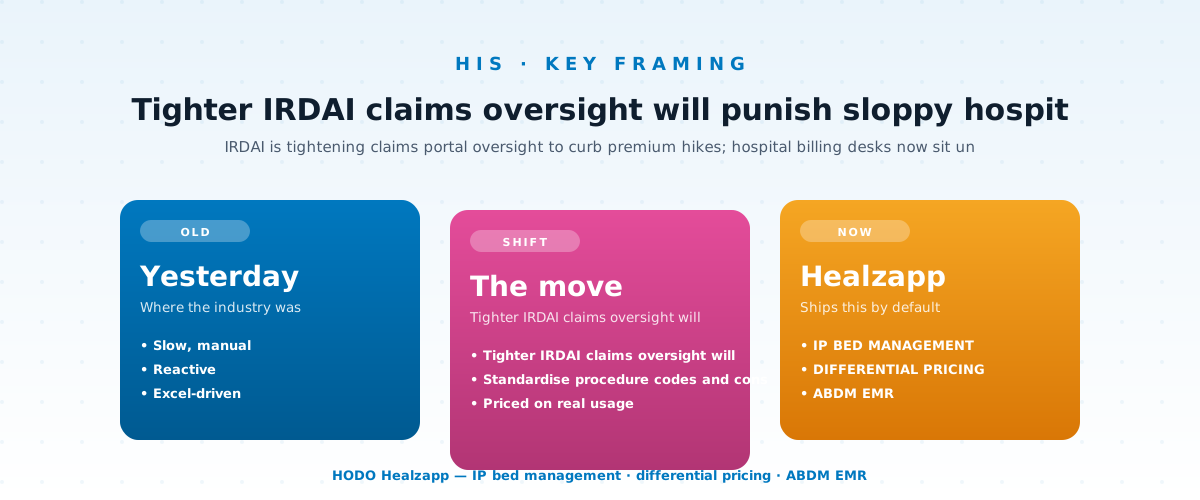
Most hospitals in the 50-500 bed range still handle insurance claims through a mix of the HIS billing module, spreadsheets and a dedicated TPA desk that manually stitches documents together. The leaks are predictable: mismatch between the pharmacy issue slip and the final bill; missing consultant notes in the discharge packet; consumables billed under general categories rather than the exact HSN or procedure-linked code; and duplicated line items when procedures move between OT, ICU and ward.
These leaks surface in three places. First, in the claim rejection rate - typically 8-15% at Indian mid-sized hospitals. Second, in the query cycle, where a partially rejected claim takes another 20-30 days to resolve. Third, in patient friction, where the balance falls back on the patient after discharge because the TPA short-settled. Tighter portal oversight will surface all three with less tolerance than before.
The single biggest defence against a tightened claims regime is a documentation trail that starts at admission and ends only when the claim is fully settled. Every consultant note, nursing chart, medication administration record, OT log and diagnostic report needs to sit inside one patient record - retrievable in one click when a TPA asks. Hospitals that still print, scan and re-upload documents into the claims portal will find themselves outpaced by peers running EMR-native billing.
The other overlooked lever is coded, condensed clinical history. TPAs increasingly reject claims where the pre-existing condition timeline is unclear or where the admitting diagnosis does not thread cleanly into the discharge summary. An EMR that produces a condensed, chronological patient story - rather than 40 pages of scanned handwritten notes - reduces the back-and-forth that eats into margin.
Sharper portal scrutiny will lengthen the working capital cycle before it shortens it. Hospitals should assume the first two quarters after any IRDAI tightening will see higher query rates as TPAs recalibrate. That means the finance office needs live visibility into three numbers at all times: claims raised versus claims cleared, average days in TPA, and rejection reasons by category. A monthly MIS pulled from the billing team is too slow.
Multi-outlet groups have an additional problem. A claim raised at the Kochi centre and one raised at the Coimbatore centre may follow different documentation practices, and consolidated cashflow visibility usually collapses at the group level. Tally reconciliation done once a month is not enough when the regulator is watching claim-level data in near real time. The finance function needs claim-level, centre-level and TPA-level dashboards that reconcile to the ledger without manual export.
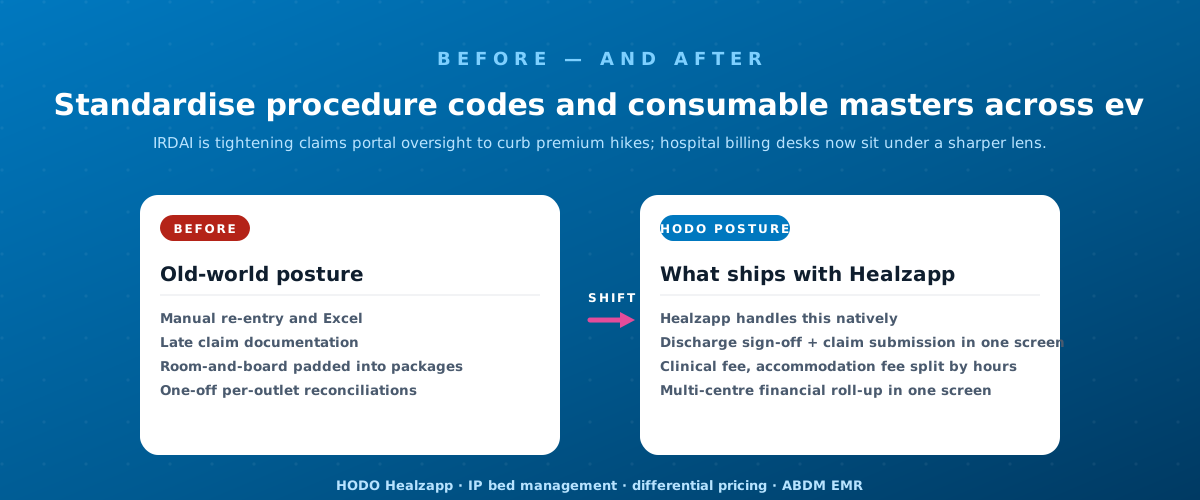
Hospitals that will absorb this regulatory shift with least pain are the ones that have already standardised billing practice across outlets - the same procedure code list, the same consumable master, the same discharge template, the same claim packet checklist. Groups adding a fifth or tenth centre this year should treat billing standardisation as a pre-opening requirement, not a post-launch clean-up.
Audit readiness also means being able to reconstruct any claim, on any date, in under a minute. If a TPA or the regulator asks why a specific implant was billed at a specific rate to a specific patient on a specific date, the answer should be a query, not a two-day file hunt. Hospitals that treat audit trails as an IT problem rather than an operations problem tend to discover the gap only when the query letter arrives.
The IRDAI shift lands squarely on the billing and documentation side of hospital operations - which is where HODO Healzapp is built to carry weight. The Billing module ties every charge back to the source document - pharmacy issue, OT log, machine-interfaced diagnostic report - so a claim packet assembled for a TPA does not depend on a staff member remembering where a note lives. That single provenance chain is what shortens rejection cycles.
Second, the ABDM-compliant EMR with AI-condensed history produces the kind of coherent clinical narrative that TPAs increasingly demand - admitting complaint, investigations, treatment, discharge - stitched into one readable timeline rather than a scan pile. That directly reduces the insufficient-documentation query, which is the largest single cause of claim delay at mid-sized hospitals.
Third, for groups running more than one outlet, Multi-outlet scale-up with one-click new-centre setup pushes the same billing masters, procedure codes and claim templates into every new centre from day one - so a tenth outlet does not become the compliance weak link that drags the group's TPA cycle. Combined with Tally integration, the finance team gets claim-to-ledger visibility without a monthly reconciliation sprint.
See how Healzapp handles this — book a 30-min demo.
See how Healzapp, Labzapp and EReazy fit your speciality in a free 30-minute demo.
Book a Free Demo