The health insurance sub-committee of IRDAI's Insurance Advisory Committee has constituted working groups to recommend common standards for reporting claims and grievances, along with a system to keep policyholders informed about the progress of their claims, ETHealthworld reports. The consumer headline is transparency. The operational headline, for any hospital running a sizeable cashless and TPA book, is that claim delays are about to become attributable — and the attribution will frequently point back to the provider.
What the working groups are actually standardising
Two threads matter here. The first is common standards for reporting claims and grievances — a shared vocabulary for what a claim is, which stage it sits at, and why it is held up. The second is policyholder-facing visibility into claim progress. Read together, they describe a clocked pipeline rather than a black box.
Standardised reporting means claim status shifts from free-text correspondence and phone follow-ups to codified stages with timestamps. Grievance standardisation means the reasons a claim stalls get classified rather than merely described. Once reasons are classified, they can be counted; once they are counted, they get benchmarked across insurers, TPAs and hospitals.
That is the part providers should read closely. A tracking screen does not create delays, but it makes them legible. When a patient's app shows "awaiting documents from provider" with a date stamp against it, the conversation at the billing counter changes shape. Discharge-time disputes, pre-authorisation follow-ups and deduction arguments all acquire a public timeline that the patient is watching alongside the hospital.
The groups are at the recommendation stage and no implementation date has been announced. But the regulatory direction has been consistent for several years — standard formats, faster cashless settlement, less discretion in between. Hospitals that treat documentation hygiene as a problem for a later financial year will spend that year explaining their own status codes to patients.
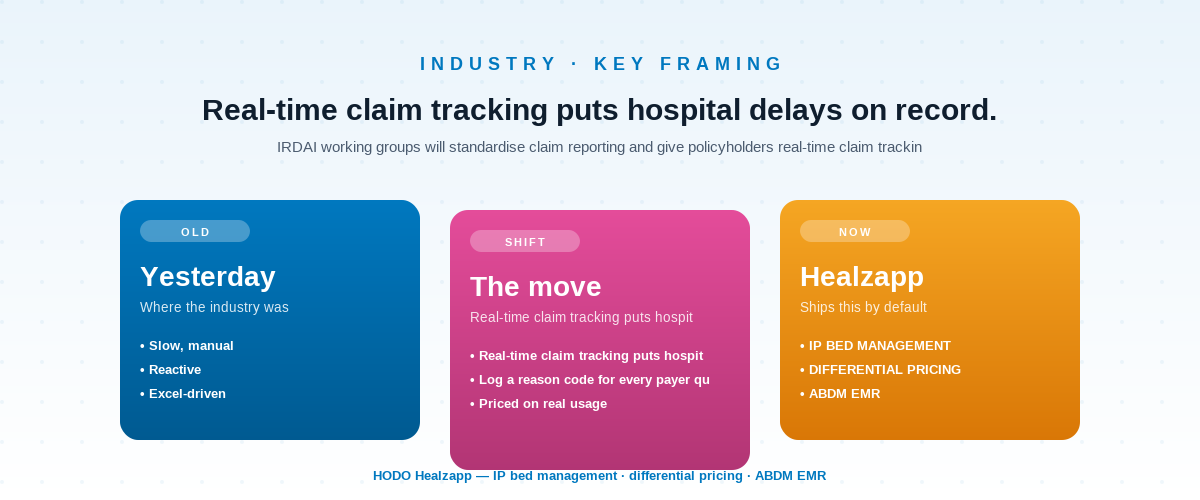
Real-time claim tracking puts hospital delays on record.
Why claim delays are usually a hospital data problem
Query and deduction patterns in Indian hospitals are boringly consistent. The bulk of held claims trace back to a short list of causes: a discharge summary that does not document a clear indication for admission; bill line items that map to nothing in the clinical record; investigation reports referenced in the summary but not attached to the file; implant and high-value consumable invoices missing; a tariff applied that does not match the contracted rate card; a pre-authorisation approved for one line of treatment and billed for another.
None of these is a clinical failure. Each is a record-keeping failure, and it happens for a structural reason — the clinical record, the billing record and the claim file sit in three different places and get reconciled manually by one or two people at the end of the episode. In a 100-bed hospital discharging 25 to 40 IP cases a day, that reconciliation is the bottleneck, and it fails quietly.
Under the current arrangement, a quiet failure costs the hospital receivable days and some goodwill. Under a tracked pipeline with standard reason codes, the same failure gets stamped, dated and shown to the patient who is still within warranty of a Google review. The cost of sloppy documentation moves from the finance department to the front office.
Worth noting that this cuts both ways. Hospitals that document well currently have no way to prove that an insurer sat on a clean file for eleven days. Standard reason codes and timestamps give the provider side an evidence base it has never had in rate negotiations.
The documentation discipline that survives an audit trail
A handful of practices separate hospitals with a 5 per cent query rate from those running at 20 per cent. None of them require new staff.
First, generate the discharge summary from the clinical record at discharge, not three days later from memory and a nurse's notes. A summary assembled retrospectively is where indications go missing. Second, make every billed line traceable to an order placed in the system — if a drug, investigation or procedure was billed, the order and the result should be attached to the same episode. Third, load payer rate cards into the system rather than maintaining them in a spreadsheet on the billing supervisor's desktop; tariff mismatch is the single most avoidable deduction category.
Fourth, log a reason code against every query and every deduction, then review the top three causes monthly. Most hospitals treat each query as an individual fire. Counted over a quarter, queries resolve into two or three fixable process gaps — usually one consultant's documentation style and one missing attachment type.
Fifth, give every claim a named owner and an internal clock per stage: pre-auth raised, pre-auth approved, bill finalised, file submitted, query received, query answered, payment received. If the regulator is going to measure stage-wise turnaround, hospitals should be measuring it first, against their own numbers rather than a TPA's.
The cashflow arithmetic nobody runs
Receivable days are the clearest way to value this work. Consider an illustrative 100-bed hospital billing ₹2 crore a month on credit across cashless, TPA and scheme payers, with an average collection period of 55 days. Roughly ₹3.6 crore is parked in receivables at any moment. Pulling ten days out of the cycle releases close to ₹65 lakh of working capital — money that otherwise arrives as an overdraft with interest attached.
The metrics that drive those ten days are measurable today. First-pass acceptance rate per payer, query rate per 100 claims, average days from discharge to file submission, average days from query to response, deduction value as a percentage of billed value, and ageing buckets split by payer rather than pooled. Hospitals that track only total receivables cannot tell whether a problem belongs to a payer, a department or a single step in their own process.
Discharge-to-submission is usually the fastest win because it is entirely within the hospital's control. A file that leaves on the day of discharge instead of day four removes four days from every claim in the book, with no negotiation and no insurer cooperation required. Standardised reporting will eventually make that interval visible to everyone — better to have compressed it beforehand.
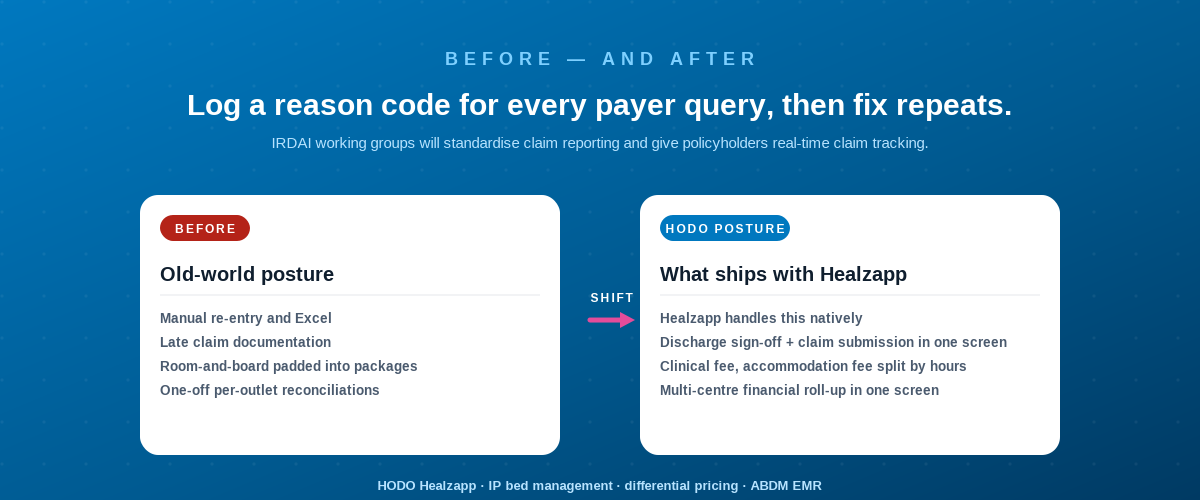
Log a reason code for every payer query, then fix repeats.
Multi-outlet groups and the diagnostics arm
Groups running a flagship hospital plus satellite clinics and collection centres carry a sharper version of this problem. Corporate and insurer-funded diagnostics typically run on partner-specific rate cards, and when those rates live in local spreadsheets at each centre, billing drift is guaranteed. A test billed at list price against a contracted rate becomes a deduction two months later, by which time nobody remembers who entered it.
Referral and outsource arrangements add another layer. Samples sent to a partner lab, tests referred in from a nearby nursing home, and corporate health-check panels all need their own pricing, their own documentation trail and their own reconciliation — and each one is a place where revenue leaks without anyone making a mistake they would recognise as a mistake.
Centralised rate cards, one patient identity across outlets, and partner-facing logins that let the referring entity see its own orders and dues directly are what keep this manageable as centres get added. The alternative is a monthly reconciliation exercise that grows linearly with outlet count and absorbs a finance executive per three centres.
What this means for HODO customers
Nothing in the IRDAI brief asks hospitals to buy software. It asks the industry to standardise how claim status and grievances are reported — which, in practice, rewards hospitals whose clinical and financial records already reconcile to each other without manual effort.
In Healzapp, that reconciliation is the job of three things working together. Billing ties every line item back to the order that generated it, so a bill and a case sheet tell the same story. Differential pricing holds payer, corporate and partner rate cards centrally, which removes the tariff mismatch category from the deduction list. ABDM-compliant EMR (India) with AI-condensed history makes the discharge summary a product of the record rather than a document typed afterwards. Tally integration closes the loop on the finance side, and Multi-outlet scale-up with one-click new-centre setup carries the same rate cards and identities into each new centre instead of restarting the problem.