
The Economic Times reports that IRDAI's common empanelment drive is picking up pace, with insurers now actively onboarding hospitals under a shared framework for cashless treatment. For hospital owners and administrators, the shift is less about clinical scope and more about the operational discipline required to survive on multiple payer contracts at once — with the billing desk, EMR, and TPA coordination all under fresh scrutiny.
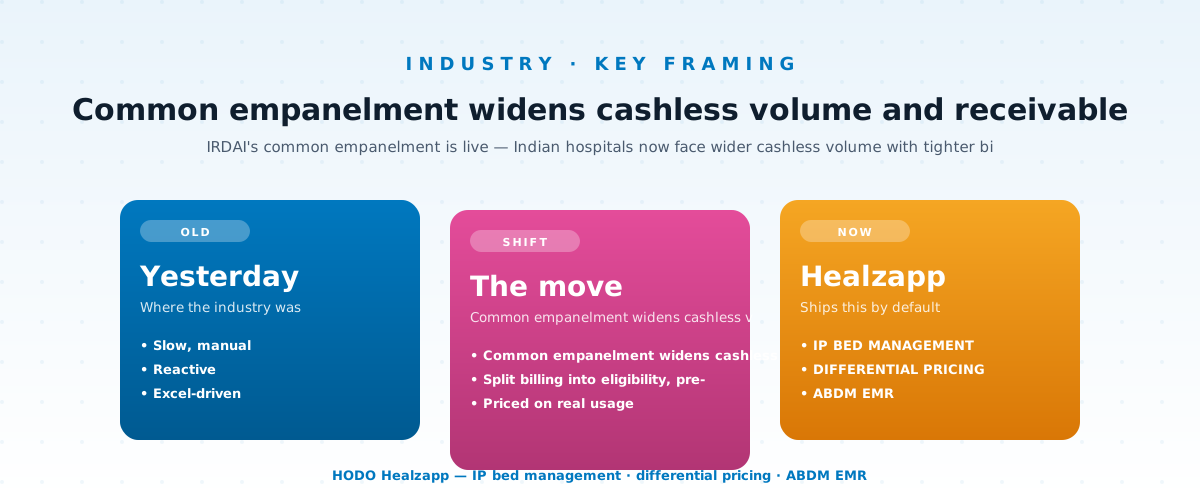
Under the older model, a hospital signed one-on-one with each insurer, each TPA, and separately with PMJAY. Rates, pre-authorisation formats, and turnaround expectations varied by contract. Common empanelment collapses much of that variability into a shared onboarding pipeline — which is good for reach, but harsher on hospitals whose billing and case-file systems were built around a handful of bespoke workflows.
The immediate impact on cashflow is twofold. First, patient volumes under cashless will rise as more insurers accept a common panel. Second, the working-capital exposure grows: a single documentation slip now blocks receivables across a wider set of payers, not just one. Hospitals that were quietly cross-subsidising rejected claims from one insurer with faster-paying cash patients will find that cushion thinner as the payer mix tilts.
Indian hospitals already sit on receivable cycles of 45-90 days from TPAs. Common empanelment does not shorten that on its own — but it does mean the volume of parallel claims moving through pre-auth, discharge, and query response goes up. The finance office needs to see that pipeline in one place, not spread across ten Excel trackers.
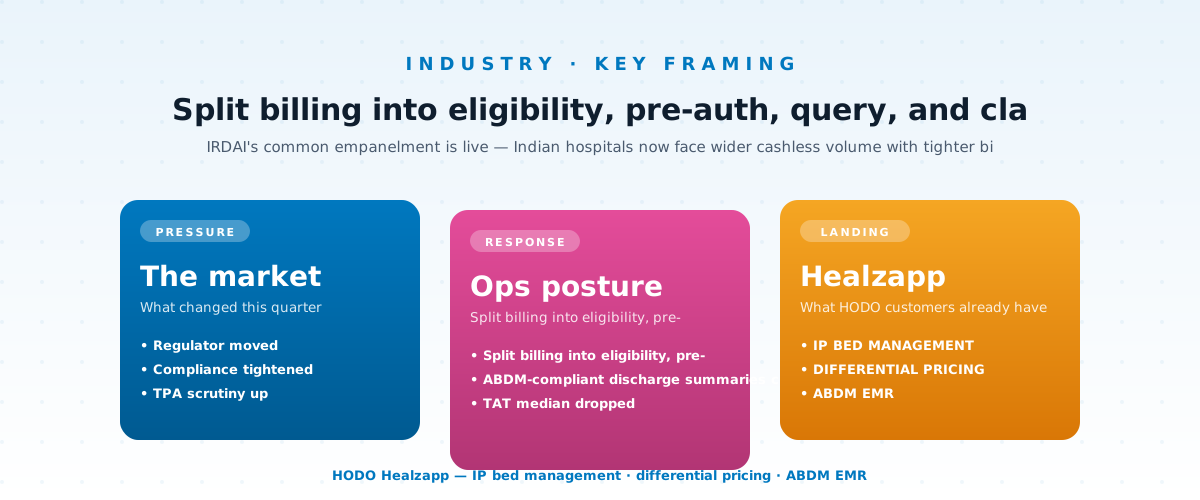
Most 100-300 bed hospitals in India still handle TPA billing as a semi-manual process: paper pre-auth forms, WhatsApp scans to the TPA, and a discharge summary typed the night before. That workflow tolerates 30-40 cashless cases a day. Push it to 80-100 with common empanelment, and the queue at the billing counter becomes the reason patients get discharged 18 hours late.
The fix is not more staff. It is structural — separating the tasks of eligibility check, pre-authorisation submission, query handling, and final claim upload into distinct roles with clean handoff points. Each step must carry a timestamp and an owner. Otherwise the mid-cycle 'who is following up on Bed 402's approval' question consumes half the shift.
Hospitals that already run integrated IP and OP billing with role-based queues will absorb the volume without visible strain. The ones that do not will find their discharge lounge full at 8 pm every day, and their MRD staff working weekends to close open cases.
Cashless denials in India are dominated by two causes: incomplete discharge summaries and missing investigation justifications. Common empanelment does not relax those requirements — if anything, insurers will lean on shared clinical audit norms once the panel widens.
The uncomfortable truth is that most rejection cycles start not at the TPA desk but at the bedside, where a consultant's handwritten note fails to record a critical differential diagnosis. By the time the billing team catches it, the patient has been discharged and the trail is cold.
An EMR that produces a structured, ABDM-compliant discharge summary — with investigations, diagnoses, procedures, and consumables all linked to the case sheet — turns claim submission into a byproduct of routine clinical work. It also gives the medical superintendent a way to audit weak documentation before the claim goes out, rather than after it comes back rejected.
PMJAY package rates, corporate contract rates, cash-patient rates, and IRDAI-common-panel rates will now coexist in the same casualty. A single knee replacement can carry four different sanctioned prices depending on which door the patient walks in through. Manual price selection at the billing counter is where margin leaks — usually in the hospital's favour on cash, and against the hospital on TPA cases.
The operational answer is a pricing engine that recognises the payer at admission and locks the tariff before the first investigation is ordered. That way, the billing sheet, the pharmacy dispense record, and the OT consumables log all draw from the same package-rate table. The finance team stops reconciling three ledgers at month end.
For multi-outlet chains, the challenge multiplies: rates that vary by outlet, by consultant, and by payer. Standardising this without freezing local flexibility is the actual scaling problem.
Chains that are adseesing a new hospital or a new day-care centre every quarter face a specific version of the empanelment problem. Each new outlet must go through PMJAY listing, IRDAI common-panel onboarding, and individual insurer verification. If the master data — rates, doctor list, bed inventory, consumables — is not clean from day one, the new centre will spend six months in payer-verification limbo while running only cash patients.
The playbook here is to treat empanelment as a checklist that runs alongside the physical setup: bed masters, doctor NMC IDs, department mapping, and tariff sheets should all be locked before the first patient is registered. A centralised HIS with a repeatable new-centre configuration takes days off that curve, and prevents each new administrator from reinventing the master-data structure.
Hospitals running HODO Healzapp already have the operational scaffolding this shift demands. The Billing module carries payer-aware queues that separate cashless from cash workflows without cluttering the counter view, and Differential pricing lets a single outlet run PMJAY, IRDAI-common-panel, corporate, and cash tariffs concurrently — locked at admission, applied automatically through pharmacy and OT.
The ABDM-compliant EMR produces structured discharge summaries that reduce the documentation gaps behind most TPA rejections — meaning the claim submission at the end of the case becomes a byproduct of clean clinical work, not a scramble on discharge day. For chains, the same architecture repeats across outlets, so the empanelment checklist for the next hospital ships with the software rather than as a six-month manual cleanup.
See how HODO Healzapp handles this — book a 30-min demo.
See how Healzapp, Labzapp and EReazy fit your speciality in a free 30-minute demo.
Book a Free Demo