The chief of the Insurance Regulatory and Development Authority of India (IRDAI) has flagged regulatory gaps between health insurers and hospitals, as reported by Telegraph India under the headline “Checkup for health ecosystem”. For a 100-bed private hospital, this is not abstract policy. It describes the exact space where cashless approvals stall, deductions pile up and receivables age past 90 days, and until a rulebook closes that space, the hospital that documents, prices and bills cleanly is the one that gets paid on time.
The gap, in plain terms
IRDAI regulates insurers and TPAs. Hospitals answer to a different set of authorities: state health departments, the Clinical Establishments Act in states that have adopted it, and voluntary accreditation such as NABH. No single regulator governs how a hospital sets its tariff for a procedure, how that tariff is communicated to an insurer, or how disputes over non-payable items are settled. The result is a negotiation that repeats, admission after admission.
IRDAI's 2024 Master Circular on health insurance tightened the insurer side of the clock: a cashless authorisation decision within one hour of request, and final discharge authorisation within three hours. Those timelines matter, but they start only when the hospital's request is complete. An incomplete case sheet, a tariff line that does not match the empanelment agreement or an investigation report that arrives late sends the file back to the hospital, and the delay then sits on the hospital's books rather than the insurer's.
For a mid-sized hospital where a large share of IP revenue arrives through insurers, TPAs and schemes such as PMJAY, the regulatory gap is a cashflow problem first and a compliance problem second.
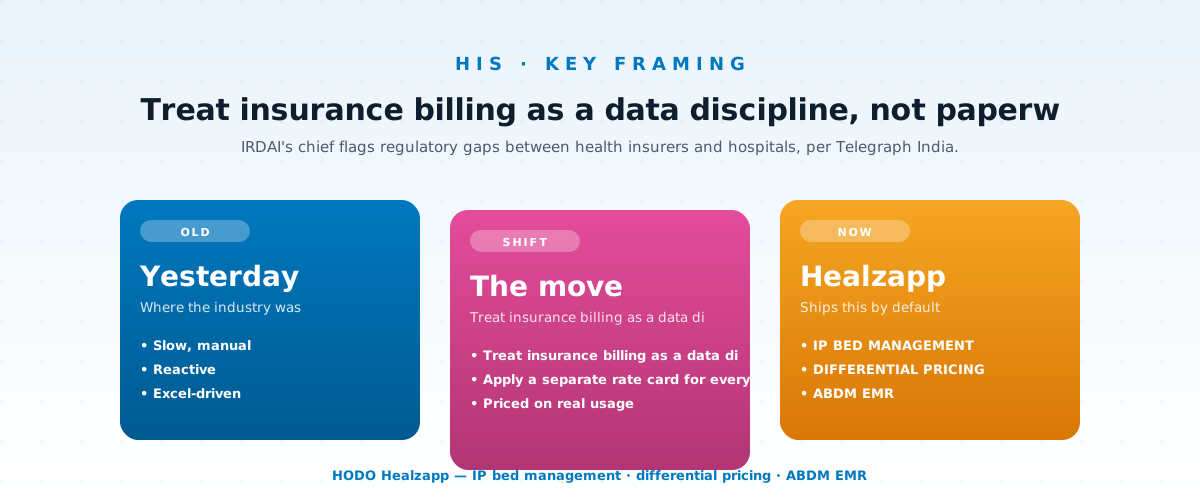
Treat insurance billing as a data discipline, not paperwork.
Where the money actually leaks
Most revenue loss in insured admissions is not dramatic claim rejection. It is steady erosion across five points:
Tariff mismatch. The bill is raised at rack rate while the insurer pays per its agreed rate, and the difference is either written off or pushed to the patient at discharge, which generates complaints.
Non-payable items. Consumables and administrative charges bundled into room rent or package lines invite deduction of the whole line, not just the non-payable part.
Documentation gaps. Diagnosis and treatment decisions not supported by clinical notes trigger queries that add days to settlement.
Discharge delays. A patient waiting for final approval blocks a bed that could take the next admission, dragging down the occupancy figure management watches most closely.
Reconciliation lag. The settlement lands in the bank, the deduction reasons sit in a TPA email, and the accounts team cannot match either against the original bill.
Consider an illustrative hospital billing ₹2 crore a month to insurers and TPAs. An average deduction of 7% is ₹14 lakh a month, or ₹1.68 crore a year, before counting the working-capital cost of receivables that take 60 days or more to clear.
Why regulation will not fix this quarter's cashflow
Several moves point towards a more structured insurer-hospital relationship: standard treatment packages, common empanelment discussions and the National Health Claims Exchange for digital claim traffic. Each of these is progressing on a policy timeline, not a quarterly one. The 2025 stand-off in which a private hospitals' association advised members to pause cashless treatment for some insurers' policyholders over tariff revisions showed how quickly a stalled negotiation turns into patients paying upfront and hospitals absorbing the friction.
Whichever direction the rules finally take, they will reward the same thing: hospitals whose clinical, billing and financial data is structured, timestamped and consistent. Standard packages need clean procedure coding. Digital claims need records that exist before the claim is filed, not ones reconstructed from a paper folder afterwards. Grievance norms need evidence of who caused a delay.
A hospital that treats insurance billing as a data discipline now will adapt to new rules with configuration changes. A hospital running its IP file on paper and its receivables on a spreadsheet will be rebuilding processes under pressure, while its cash is locked up in pending settlements.
Four disciplines to adopt before the rulebook changes
1. Payer-wise rate cards applied at billing time. Maintain separate tariffs for each insurer, TPA, corporate client and government scheme, and apply them when the bill is raised. Correcting rates at the claim stage is where most avoidable deductions begin.
2. Documentation at the point of care. Diagnosis, treatment rationale and investigation results should be in the patient record before the discharge request goes out. The insurance desk should never be chasing a consultant for notes while a patient waits in a discharged bed.
3. Timestamps on every discharge step. Record when the discharge order was written, when the file went to the TPA, when approval arrived and when the patient left. With a three-hour norm on the insurer side, the hospital needs its own evidence of where time was lost.
4. Monthly deduction analytics. Classify every deduction by payer and reason. Over two or three quarters, patterns emerge: one TPA consistently disallowing a consumable category, one department with repeated documentation queries. Empanelment renegotiations then run on data, not anecdotes.
None of these require waiting for IRDAI. They require the medical superintendent, the insurance desk and the accounts team to review the same numbers every month: approval turnaround, deduction percentage by payer, receivable ageing and beds blocked by pending approvals.
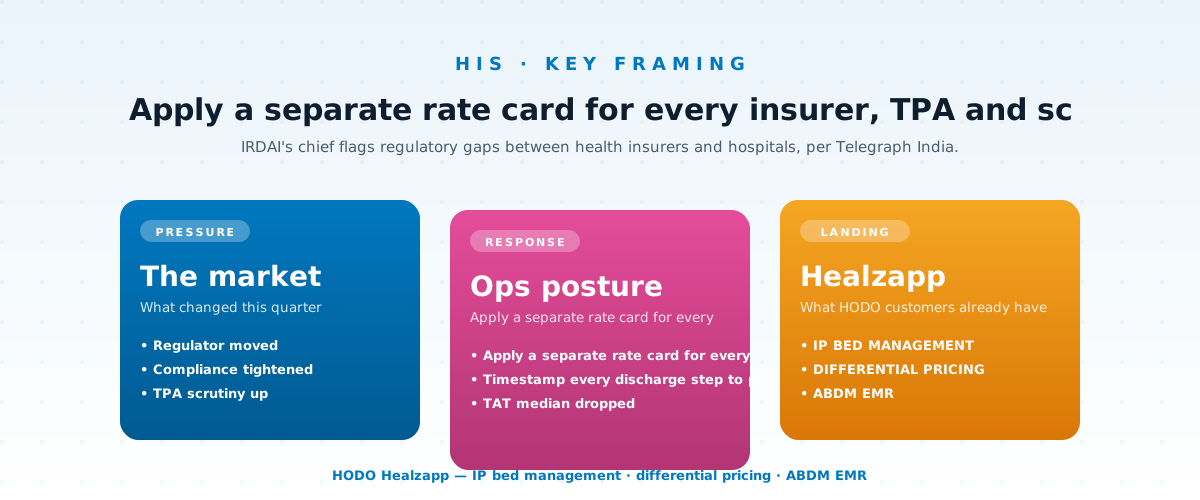
Apply a separate rate card for every insurer, TPA and scheme.
What this means for HODO customers
The gap IRDAI has described will not be closed by software. What a hospital information system can do is make the hospital's side of every file complete, correctly priced and traceable, so that delays and deductions stop originating inside the building.
Differential pricing in Healzapp lets the billing desk hold separate rate cards for insurers, TPAs, corporate partners and schemes, so the bill matches the agreed rate at the counter instead of being corrected later. IP bed management gives the floor and management a live view of beds, making discharged-but-waiting patients visible rather than buried in a ward register. Tally integration carries billing into accounts, so settlements and deductions can be reconciled against the original bill instead of across emails and spreadsheets.
HODO has run hospital and clinic operations since 2013 across 500+ client outlets, and was among the first 20 ABDM-integrated HealthTechs in India, which matters as India's claims ecosystem moves towards structured digital records.