
The Financial Express has reported that Ajay Seth, Chairman of IRDAI, confirmed the regulator is actively pushing insurer-hospital talks to fix health insurance frictions. For hospital owners and administrators in India, this is less about the political headline and more about the operational cleanup that will follow — because when the regulator sits down with insurers and providers, standardisation of cashless workflows, empanelment terms and claim documentation is what usually lands on the table.
Every hospital MD in India already knows the pain: insurance receivables sitting 45 to 90 days, TPAs reworking discharge summaries three times before releasing payment, pre-authorisations pending on a fax that never quite arrived. What is new is that IRDAI is now signalling — publicly — that this friction is a regulatory concern, not just an industry grumble. Once the framework tightens, hospitals that have not cleaned up their own claim documentation, pricing masters and clinical record-keeping will find themselves on the wrong side of an audit rather than on the winning side of a faster payment cycle.
The practical read is simple. The window to fix internal claim workflows without regulatory pressure is closing. Hospitals with clean digital records, TPA-specific price grids and traceable pre-auth trails will absorb the transition. The ones still running claim files on shared drives and WhatsApp groups will not.
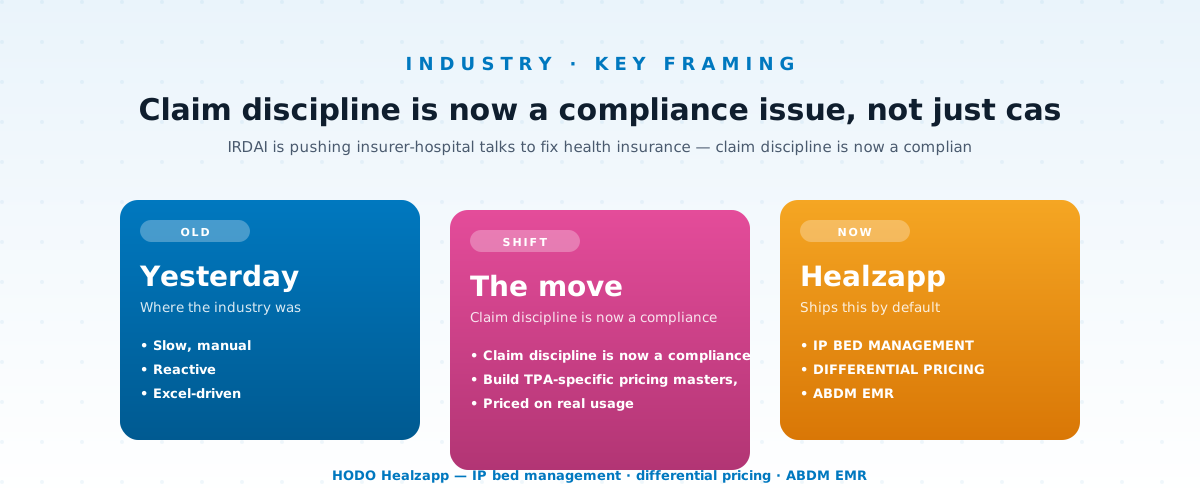
Money leaks out of the insurance cycle at four predictable points, and each one has an operational root cause worth naming.
The first is pre-authorisation. Delays here mean the patient is admitted but the claim is not confirmed, and any escalation later gets flagged as a documentation gap. Root cause: the pre-auth form is filled by hand, faxed and then re-typed by the TPA. The second is package-versus-itemised billing confusion. TPAs each have their own pricing sheets for the same procedure, and when the billing team applies a generic rate card, the shortfall is written off. Third is the discharge summary. A clinical summary that does not tie back to the ICD code on the pre-auth is grounds for partial payment. Fourth is post-discharge query resolution — TPAs raise queries seven to twenty days after discharge, and by then the treating consultant has moved on and the file has to be reconstructed from memory.
Each of these has a fix that lives inside the HIS, not outside it. Which is why the vendor decision on hospital software is no longer a back-office IT choice — it is a P&L decision.
Three things are worth doing this quarter, regardless of what IRDAI eventually publishes.
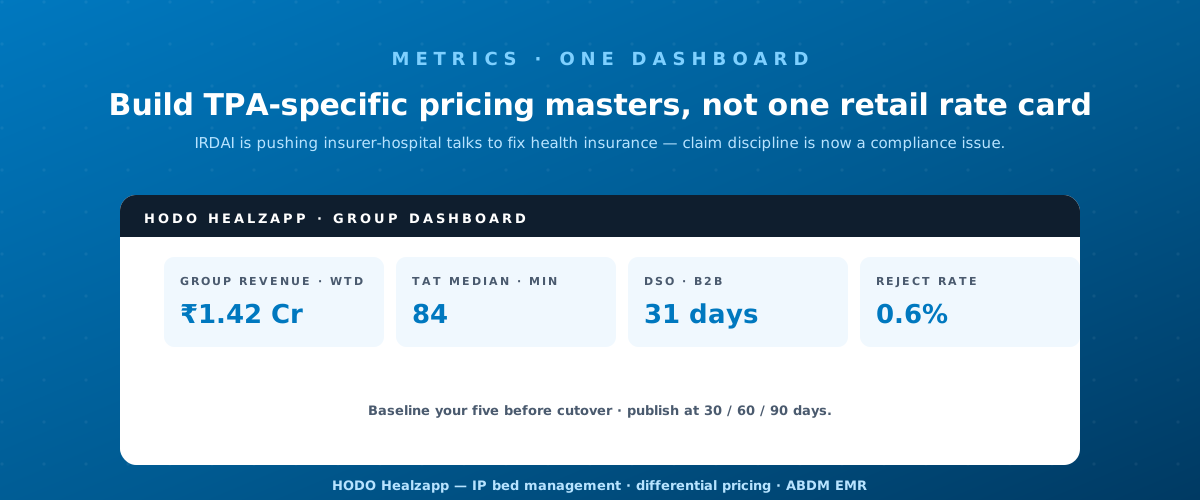
One, build TPA-specific price masters and stop applying a single retail rate card to every payer. If a hospital has 22 TPA empanelments, it needs 22 pricing masters, each mapped to procedure codes and updated when the TPA revises terms. Two, digitise the pre-auth trail end to end. Every form, every attachment, every clarification email should sit against the patient's IP record, not in a shared folder. Three, tie the discharge summary to the pre-auth ICD code inside the EMR itself, so the clinical narrative and the claim narrative cannot drift apart. This is a workflow discipline more than a technology purchase — but it only works if the underlying HIS lets the billing team see what the clinician wrote and the clinician see what the billing team invoiced.
For clinic chains and diagnostic groups, the IRDAI conversation compounds. A four-outlet pathology chain running the same NABL-empanelled TPA contract across all outlets often ends up with four different billing interpretations — because each outlet's front desk was trained separately and each has its own version of the pricing sheet. When the regulator standardises, the group that cannot roll out a single pricing master across all outlets in one update will be exposed.
The scan and pathology segment has an additional problem — corporate tie-ups. A corporate partner may negotiate a rate that is 40% below the retail list, but if the LIMS cannot enforce that differential pricing at the outlet counter, the discount is either given away twice (once by the negotiated rate and once by the outlet staff) or missed entirely, leading to disputed invoices at month-end reconciliation. Neither outcome survives an IRDAI-driven audit trail.
HODO Healzapp was built around the assumption that Indian hospitals live and die on claim discipline, not clinical software polish. Three specific modules matter for the shift IRDAI is signalling.
Billing in Healzapp is TPA-aware — package rates, itemised rates and corporate rates sit as separate masters against each payer, so the billing team is not manually adjusting invoices at discharge. Differential pricing extends the same logic across corporate partners and multi-outlet chains, which means a new TPA contract is a configuration change, not a re-training exercise across every outlet. And the EMR (AI-condensed history) feeds the discharge summary directly from the clinical record, so the ICD code, the clinical narrative and the claim narrative come from the same source of truth rather than being reconciled after the fact.
For diagnostic and pathology chains, the equivalent conversation sits inside HODO Labzapp — differential pricing per partner and TAT reporting matter for the same reasons at a lab counter as they do at a hospital billing desk.
See how Healzapp handles this — book a 30-min demo.
Source of the news hook: Read the source article →
See how Healzapp, Labzapp and EReazy fit your speciality in a free 30-minute demo.
Book a Free Demo