ETHealthworld.com reports that IRDAI is moving to make health insurance claims more transparent, including real-time tracking of claim status for policyholders. Read as a patient-experience story, it sounds like an insurer problem. Read as an operations story, it is a hospital data problem: every status a patient can refresh on a phone is a status someone in the billing room has to keep true.
What the IRDAI move actually changes
The direction of travel is not new, only sharper. Across recent policy cycles the regulator has pushed standardised claim formats, tighter pre-authorisation timelines and a stated goal of cashless settlement across network hospitals. Real-time tracking is the logical next layer. If a policyholder can see where a claim sits — file received, query raised, approval pending, amount settled — the regulator fields fewer grievances and the insurer fields fewer calls. The exchange rails between insurers, TPAs and providers to carry that status already exist in principle.
What changes for a provider is the tolerance for lag. Today a hospital's TPA desk can sit on a claim for two days while someone chases a discharge summary, and nobody outside the building knows. Under a tracked model, that clock becomes visible. The gap between "hospital raised the claim" and "insurer received a complete file" turns into a number a patient, an employer-group HR team and a regulator can all read.
That is a measurement problem before it is a software problem. Most 100-bed hospitals in India still run claims on a hybrid: the HIS produces a bill, and a parallel register in Excel or a WhatsApp group tracks where each claim actually stands. Accountability lives in the register, and the register is invisible to everyone upstream. Transparency rules will not close that gap. They will expose it.
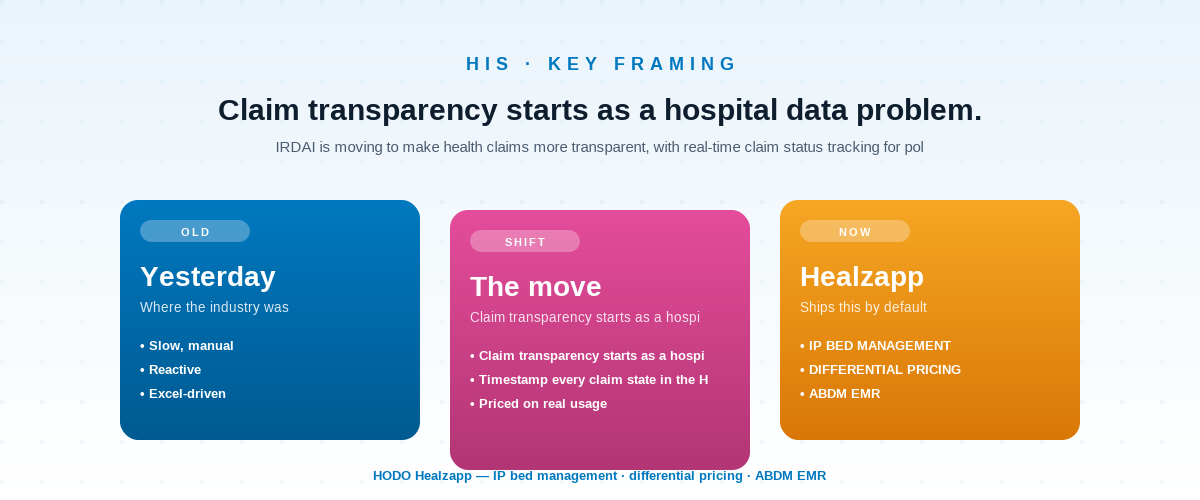
Claim transparency starts as a hospital data problem.
Tracking turns the TPA desk into a system of record
A single inpatient claim passes through more states than most billing software models: pre-authorisation requested, approved with sub-limits, patient admitted, interim enhancement raised, discharge bill finalised, claim submitted, deficiency query received, documents resubmitted, settlement advice received, deduction booked, balance written off or billed to the patient. Each state needs three things attached to it — a timestamp, an owner, and the document that moved it forward.
When those states live in a register outside the HIS, the hospital holds two versions of the truth. The bill says one thing and the register says another, and the front office defaults to calling the TPA coordinator. Once a patient can see the insurer's view on their own screen, the mismatch surfaces at the discharge counter instead of in a monthly MIS review. The practical fix is unglamorous: the claim ledger has to sit on the same patient visit as the bill, so that any status question can be answered from the record rather than from a person's memory.
This also changes who is allowed to answer. With states and timestamps in one place, a receptionist can tell a relative that the query was raised yesterday and the report was uploaded this morning, without escalating. That is a throughput gain on the busiest counter in the building, and it does not require a new team.
Deficiency queries are where the days disappear
Hospitals usually blame payers for slow settlement, but a large share of the delay is self-inflicted and repetitive. The query reasons recur: discharge summary unsigned, diagnosis not matching the coded entry, investigation report not attached, implant invoice missing, a bill line that does not map to the approved package. Each query restarts the clock, and each restart is a few more days of receivables.
The reason the queries recur is that the claim pack is assembled by hand from four places — the clinical record, the lab, the pharmacy and the OT register. Anything assembled by hand at discharge will be incomplete at some predictable rate. If investigation results land in the patient record automatically through machine interfacing, if pharmacy and consumable charges post to the same visit, and if the clinical summary is structured rather than free-typed, the pack becomes a compile step instead of a scavenger hunt.
There is a second-order benefit for hospitals running their own lab and imaging. Reports that are already tied to the visit and already delivered to the patient on WhatsApp are reports nobody has to hunt for three weeks later when a deduction is contested. Appeals get won on documentation that still exists in the right place.
The cashflow numbers worth reviewing weekly
Transparency cuts both ways: once claim status is timestamped end to end, a hospital finally gets honest internal metrics. Five are worth putting on a weekly sheet. First, claims raised versus claims submitted complete — the self-inflicted gap. Second, the share of claims that attract at least one deficiency query, trended by department. Third, median days from submission to settlement, split by payer, because TPA, government scheme and corporate behave nothing alike. Fourth, deduction value grouped by reason code, which tells you whether the loss is tariff mapping or documentation. Fifth, receivables ageing buckets per payer, so the finance team can see which scheme is quietly funding your working capital gap.
Payer mix is the part most easily mishandled in software. A 100-bed hospital may run cash rates, two or three TPA tariffs, a government scheme package list and corporate contracts simultaneously. If those rates are applied by a human at billing time, deductions are guaranteed. Rates belong in the system, attached to the payer, applied at the point the order is raised — not reconciled afterwards. Equally, the claim ledger has to reconcile to the books without re-keying, or finance ends up maintaining a third version of reality.
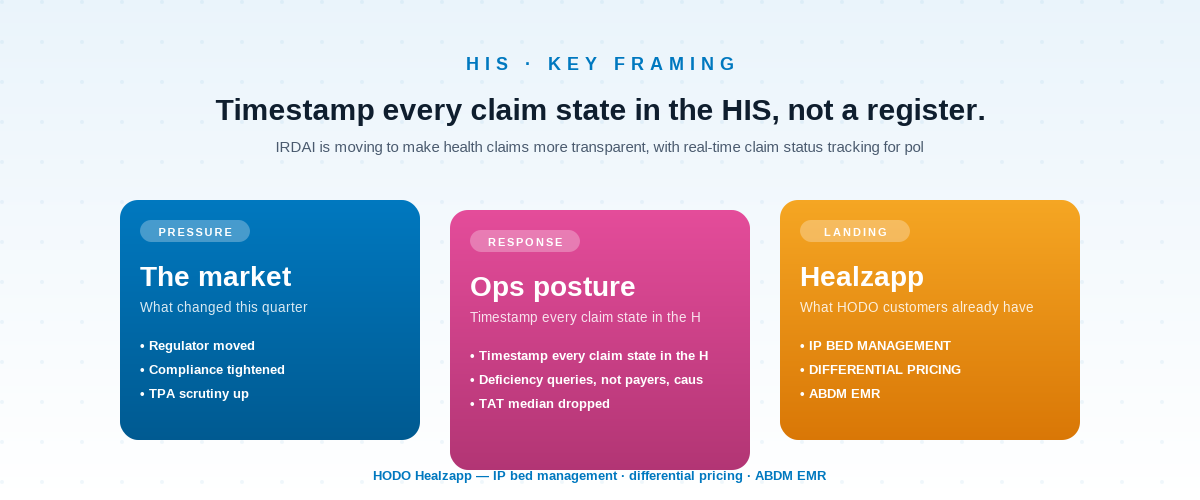
Timestamp every claim state in the HIS, not a register.
An audit list before the rules land
Questions worth asking of your current HIS this quarter, before external tracking makes the answers public. Can the status of any claim be produced from the system without asking a coordinator? Is the payer and scheme captured at registration rather than at discharge? Does the system apply the correct tariff automatically per payer? Is there an audit trail showing who changed a bill line and when? Can referring doctors, corporate clients and partner labs see their own data without someone emailing a spreadsheet? Do claim figures flow to accounting without manual entry? Across a multi-outlet group, can all of this be rolled up without consolidating files by hand?
A "no" on any of these is not a compliance failure today. It is a prediction of where the delays will show up once the clock is visible. The hospitals that come out of this well will be the ones that treated claim status as structured data a year before anyone asked them to.
What this means for HODO customers
Healzapp was built around the assumption that the claim and the clinical record have to be the same object. Billing with Differential pricing applies payer-specific tariffs at the point of order, which is where deduction risk is created rather than discovered. ABDM-compliant EMR with AI-condensed history keeps the discharge pack structured and attached to the visit, so deficiency queries get answered the same day instead of the same week. Tally integration moves settled and outstanding claim values into the books without re-keying, and B2B Referral / Outsource Lab / Corporate-partner logins let corporate clients and referring doctors pull their own status instead of queuing behind the billing desk. For groups adding centres, the same configuration carries over through one-click new-centre setup.