IRDAI is moving health insurance claims towards real-time status tracking, according to a report from OC Academy carried on Google News. For insurers and TPAs this is a disclosure change. For a 100-bed hospital in Kochi, Indore or Nashik, it is an operations change — because a claim clock that ticks in public exposes exactly how long the hospital itself takes to assemble pre-authorisation and discharge documents.
Real-time tracking moves the scrutiny upstream
Today, when a cashless claim stalls, the patient's family has one visible target: the billing counter. The TPA queue is invisible, so every hour of delay is attributed to the hospital, fairly or not. A tracked claim flips that. Once a status timeline is visible to the policyholder, the delay gets attributed to whoever is actually holding the file — and that cuts both ways.
The uncomfortable half is this: in most mid-sized Indian hospitals, a meaningful share of claim delay is self-inflicted. The pre-auth goes out without the admitting consultant's notes attached. The investigation reports referenced in the request are not yet finalised in the system. The implant invoice is with the purchase department. The discharge summary is dictated but not typed. None of these are insurer problems, and all of them become visible the moment a status field says "awaiting documents from provider" with a timestamp.
Hospitals that run claims out of a WhatsApp group, a shared email ID and a spreadsheet of pending files will find that model hard to defend under a tracked timeline. The practical response is not more claim executives. It is making the document pack a by-product of clinical and billing work that is already happening, rather than a separate assembly job that starts after the patient asks for discharge.
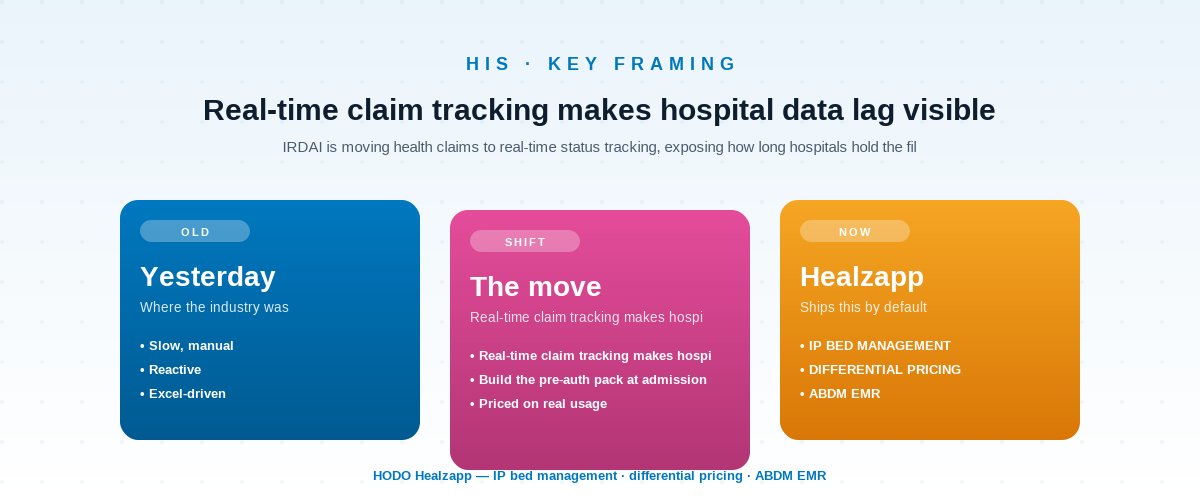
Real-time claim tracking makes hospital data lag visible.
Discharge delay is a data problem before it is a TPA problem
Discharge TAT is the single most visible service metric in an Indian hospital, and it is almost always measured wrongly. Most hospitals measure from "discharge advised" to "patient left". That hides the part that matters commercially: how long the bed stayed blocked while the final bill and claim pack were being reconciled.
Break the interval into three measurable legs — clinical clearance to bill finalisation, bill finalisation to claim submission, and submission to insurer approval of the final amount. Only the third leg belongs to the payer. The first two belong to the hospital, and they are the legs that a real-time tracking regime will illuminate.
The fix is structural. Pharmacy and consumable charges should post to the IP bill as they are issued, not be swept in at discharge. Investigation charges should flow from the lab and radiology modules without re-keying. Bed, nursing and procedure charges should accrue against the occupancy record rather than being reconstructed from the nursing chart. When charge capture is continuous, the final bill is a confirmation step rather than a reconstruction exercise, and the claim pack can be generated the same hour.
This is also where bed occupancy and cashflow meet. A blocked bed during a two-day claim reconciliation is lost revenue that no payer reimburses. In a 100-bed facility running at high occupancy, trimming average discharge-to-vacate by even three hours changes how many admissions the hospital can accept in a week.
Where claims actually die: the documentation pack
Query and partial-disallowance rates in cashless claims cluster around a small set of causes: missing or inconsistent clinical justification for the line of treatment, tariff mismatches against the agreed package, implant and high-value consumable documentation, and discrepancies between the discharge summary and the billed items.
Every one of those is a documentation-discipline failure, not a clinical one. The treating team made the right call; the file did not prove it. Under real-time tracking, each query adds a visible loop to the claim timeline, and repeated loops on the same cause pattern become a payer negotiation point at contract renewal.
Two habits reduce this. First, treat the pre-auth pack as a checklist owned by the ward, not the billing desk — admitting notes, relevant prior history, planned procedure and expected length of stay captured at admission while the information is fresh. Second, maintain a standing query register coded by cause and by payer. Within a quarter, that register will show that a handful of TPAs account for most of the rework, and usually for one or two recurring reasons each. Fixing those reasons is cheaper than chasing every file individually.
Patient history is the quiet bottleneck here. A ten-year-old repeat admission with scattered episodes across OP, IP and diagnostics takes a resident twenty minutes to summarise manually. Condensed, structured history that a doctor can read in a minute is what makes same-day pre-auth realistic.
The cashflow arithmetic for a 100-bed hospital
Consider a hospital where cashless and scheme claims make up the larger share of IP revenue — a common profile for 100-bed facilities carrying a mix of corporate panels, retail health policies and PMJAY or state-scheme volume. Receivables in that structure are not one pool. They are several pools with very different ageing behaviour, and the blended "total outstanding" number hides which pool is actually starving the hospital of working capital.
Three measures are worth tracking separately per payer: days from discharge to submission, days from submission to approval, and the realised percentage against billed. The first is fully controllable. The second is partly controllable through documentation quality. The third determines whether the panel is worth retaining at the current tariff.
Under a tracked-claims regime, the second measure becomes externally evidenced — which is useful at the negotiating table. A hospital that can show it submits within twenty-four hours of discharge, with a low query rate, has a far stronger case on tariff revision and on settlement timelines than one arguing from impressions. Scheme reconciliation benefits similarly: timestamped submission records reduce the end-of-quarter dispute about what was filed and when.
Finance teams should also close the loop to the books. Claim receivables that sit only in the HIS and get re-entered into accounting software monthly will always be reconciled late, and late reconciliation is how disallowances go unnoticed until they are too old to contest.
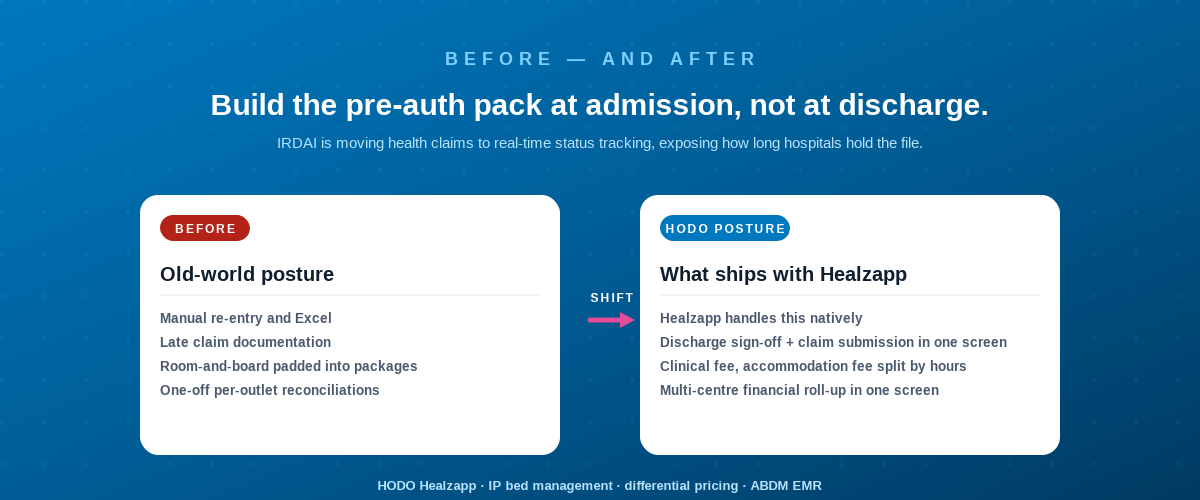
Build the pre-auth pack at admission, not at discharge.
Audit trails are the deliverable, not the paperwork
Real-time tracking is, underneath, an audit-trail requirement. Every status change implies a recorded event with an owner and a timestamp. Hospitals already generate those events; most simply do not store them in a form that can be produced on demand.
The operational test is simple. For any claim closed in the last six months, can the hospital produce — within minutes — who raised the pre-auth, what was attached, which queries came back, who responded, what was finally approved, and what was written off? If that answer requires opening three systems and calling two people, the hospital is not ready for a regime where the patient can see the clock. NABH documentation requirements and ABDM-aligned record-keeping point in the same direction, so the work is not duplicated effort.
What this means for HODO customers
Claim readiness is a HIS design question. In Healzapp, continuous charge capture across IP/OP and Billing means the final bill is assembled as care is delivered rather than rebuilt at discharge, which is what compresses the submission leg of the claim clock. EMR (AI-condensed history) gives the treating team a readable summary of prior episodes, so clinical justification in a pre-auth is written from the record instead of from memory. IP bed management ties the occupancy view to the discharge pipeline, making a bed blocked by claim reconciliation visible to the duty manager rather than discovered at the morning review. For finance, Tally integration keeps claim receivables reconciled against the books instead of re-entered weeks later, and Differential pricing holds payer-wise tariffs so package mismatches stop generating avoidable queries.
For hospitals adding panels or outlets, the same discipline has to replicate without rebuilding it each time — which is the point of standardised setup rather than per-centre improvisation.