
IRDAI has asked general and health insurers to standardise premium rates for senior citizens, per a report carried by HDFC ERGO General Insurance via Google News. The directive is aimed at curbing the sharp premium jumps that policyholders above 60 have been hit with at renewal, and it will ripple straight into hospital admissions desks, TPA cells and IP wards over the next 12 to 24 months.
The regulator's core ask is uniformity: insurers must publish and stick to standardised premium bands for senior citizen health cover, instead of the current practice of steep, opaque revisions at renewal. IRDAI has been building up to this for a while. Earlier moves included the removal of the 65-year entry age cap for health insurance, tighter rules on claim repudiation, and a push for cashless-everywhere. Standardised senior premiums are the next brick in that wall.
For hospital owners and MDs, the reading is straightforward. First, the pool of insured seniors will grow. Households that had let parents' policies lapse because renewal quotes crossed a lakh a year will re-enter the market. Second, in-patient admissions in the 60-plus cohort, already the segment with the longest ALOS and the highest per-bed revenue, will rise. Third, TPA workload will scale in step, and the hospital that handles pre-authorisation, discharge summary uploads and claim reconciliation cleanly will keep its cashflow intact. The one that does not will run 90-day receivables and start borrowing against them.
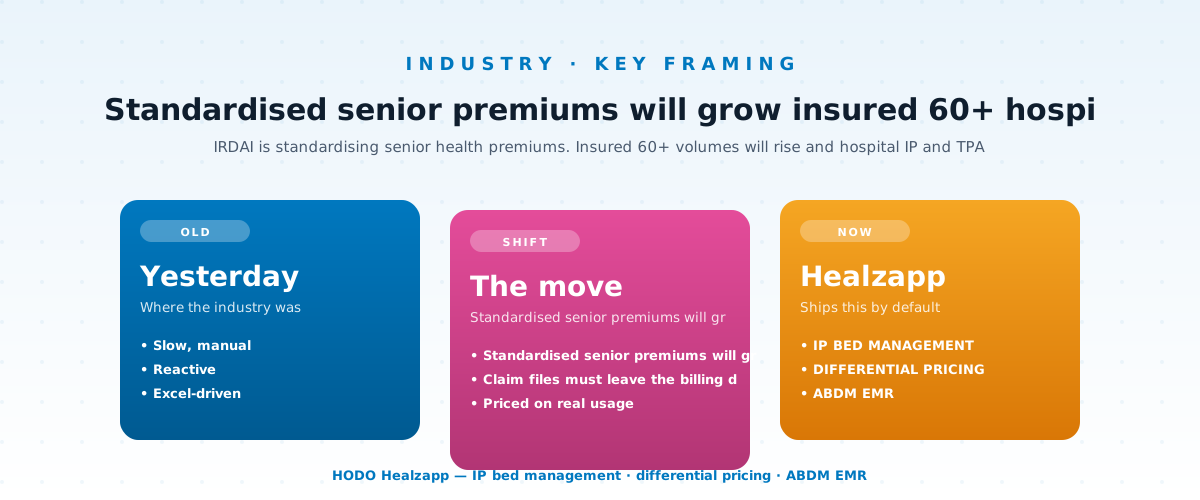
Actuarial numbers from public data are consistent: policyholders above 60 have the highest hospitalisation rate, roughly three to four times the working-age average, and account for a disproportionate share of high-value claims. When premiums drop into an affordable band, coverage widens fast in Tier 2 and Tier 3 cities, which is exactly where most 50 to 500 bed hospitals actually operate.
Operationally, this means three things. Elective admissions calendars will fill earlier in the month. IP bed occupancy in general wards and ICU step-down beds will tighten. And discharge planning becomes the bottleneck, because a five-day cardiac admission that stretches to seven because of a delayed TPA approval is a bed that cannot be turned over. Ops teams that still run a whiteboard for bed status, or that discover a blocked bed only when the ward sister rings the DMS, will feel this within the first two quarters. The fix is not more beds. The fix is knowing where each occupied bed is stuck, in near-real time, and clearing the block before the next admission arrives at OPD.
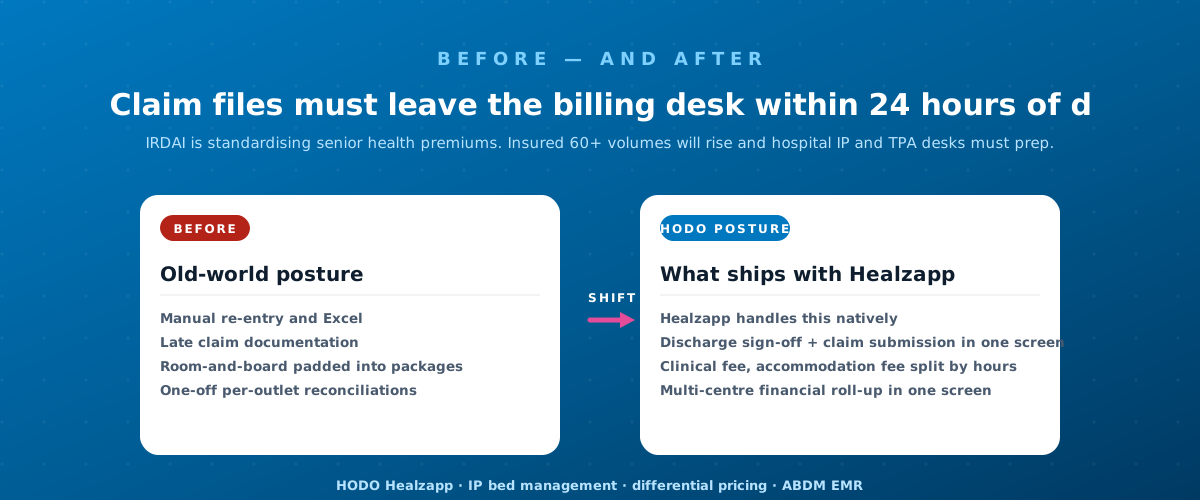
Every additional insured senior is a claim file: pre-auth, mid-stay revisions, final bill, discharge summary, investigation reports, consultant notes. Larger claim files take longer to raise, longer to query and longer to close. Hospitals that measure claim TAT already know the shape of it. A claim that leaves the billing desk within 24 hours of discharge gets paid in 21 to 30 days. One that leaves after 72 hours gets queried, sent back, and lands in the 60 to 90 day bucket.
The volume increase from IRDAI's directive will not be linear on the billing side. It will spike the number of files-in-progress, and any team running senior-heavy IP volumes with a manually stitched billing plus EMR plus report-annexure workflow will hit a wall by Q2. The single most useful fix is a billing module that pulls the discharge summary, investigation reports, consultant notes and pharmacy line items into one claim packet automatically. The second is a differential pricing engine that handles TPA-tariff variations without a manual tariff sheet every time a new insurer is empanelled.
Senior patients arrive with 10 to 15 years of prior records: cardiac stents, diabetes on multiple oral hypoglycaemics, a knee replacement in 2018, a stroke workup in 2021, three prior admissions across two different hospitals. A registrar who has to hunt through PDF attachments to build an admission note will slow the whole admission down. An EMR that condenses prior history into a scannable summary saves 20 to 30 minutes per senior admission, and cuts the medication reconciliation errors that TPAs love to query on the final bill.
The same EMR needs to be ABDM-compliant if the hospital wants to pull ABHA-linked records from other providers. IRDAI's direction of travel, standardised products, cashless everywhere, ABDM-tied claim workflows, assumes the hospital's EMR can talk to the national health stack. Hospitals still on paper case sheets, or on an EMR that a vendor built ten years ago and never modernised, will find their pre-auth turnaround slipping first, then their empanelment status.
Clinic and diagnostic chains carrying 5 to 40 outlets have a specific problem. TPA empanelment, tariff sheets, senior-package pricing and claim submission processes vary by outlet, and the head office has no consolidated view. When senior IP volumes rise, the CFO wants a single dashboard: senior admissions per outlet, TPA-wise claim ageing, denials by reason code, per-bed contribution by insurer. That view has to be built once and rolled out to every outlet in the group, including the ones opened next quarter.
Chains that have been kicking the "we will standardise HIS across outlets next year" can down the road for three years will find the IRDAI shift is the forcing function. Standardised premiums on the insurer side push standardised operations on the provider side; the two go together. A new outlet that comes online with a different billing template or a different EMR structure will not aggregate cleanly into group-level TPA reports, and the CFO will find out at audit.
The IRDAI directive will show up in your P&L via three channels: more senior IP admissions, larger TPA claim files, and tighter cashflow if any of that pipeline breaks. HODO Healzapp is built for exactly this load. The Billing module ties discharge summaries, investigation reports and pharmacy line items into a single claim packet, so files leave the desk inside the 24-hour window, and the IP bed management module lets ward sisters and the DMS see real-time occupancy so discharge planning does not stall on a stuck TPA approval. The ABDM-compliant EMR with AI-condensed prior history cuts the admission-note build time on senior patients with dense case histories. For chains, the Multi-outlet scale-up with one-click new-centre setup means the same TPA workflows, tariffs and dashboards land at every outlet without a per-site rebuild.
See how Healzapp handles this — book a 30-min demo.
See how Healzapp, Labzapp and EReazy fit your speciality in a free 30-minute demo.
Book a Free Demo