Cafemutual reports that IRDAI has imposed a penalty of Rs.2 crore on Star Health for rejecting and reducing Covid-era claims in ways the regulator held to be inconsistent with its own directions. The order is being read mostly as a policyholder story. For Indian hospitals running 80 to 150 beds, the operational reading is sharper: the record that decides whether a claim is paid in full, cut, or refused sits inside the hospital's own files, and most hospitals cannot produce it on demand.
What the regulator actually penalised
The penalty is not about clinical judgement. It concerns process — whether reductions and rejections had a defensible basis, whether they followed the circulars in force, and whether they were communicated properly. That distinction matters for providers. When a supervisor starts testing an insurer's deduction behaviour against documentation, the pressure does not stop at the insurer's desk. It travels down the chain to the TPA and then to the hospital's billing counter in the form of more queries, longer query lists, and stricter matching of billed items against the sanctioned pre-authorisation.
In other words, a fine on an insurer rarely produces easier claims for hospitals in the following quarter. It produces more careful ones. Insurers tightening their own audit trail will ask providers for the evidence they themselves were faulted for not having — timestamps, justification notes, consumable logs, and a discharge summary that explains why the length of stay was what it was. Hospitals that already keep that trail will find the deduction conversation shifting in their favour, because a documented claim is expensive for a payer to cut once the regulator is watching how cuts are justified. Hospitals that reconstruct files manually after a query arrives will simply lose more working days to the same amount of money.
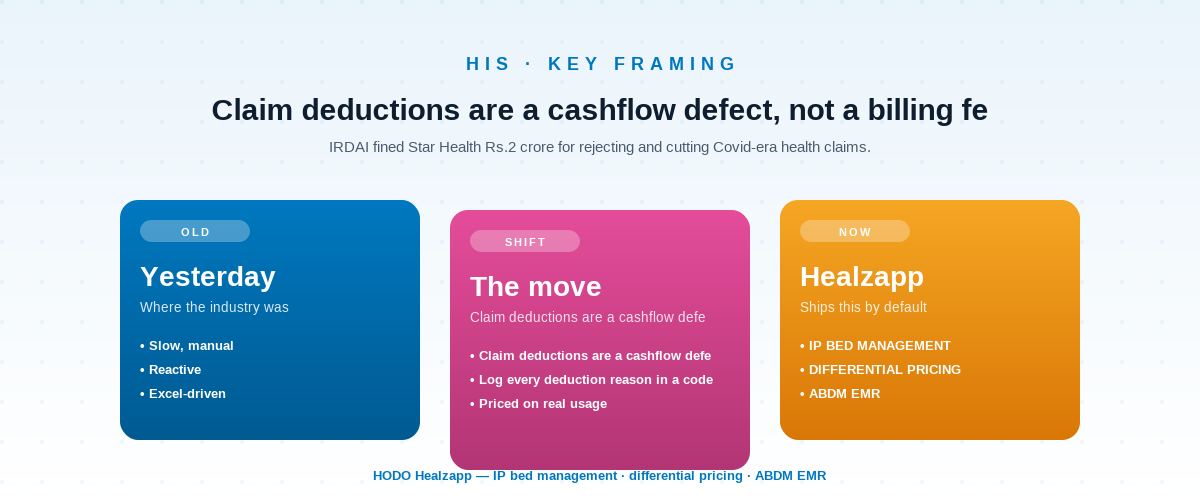
Claim deductions are a cashflow defect, not a billing fee.
A deduction is a cashflow event, not a billing fee
Most hospitals of this size treat deductions as friction — an irritating percentage that the billing team argues down when it has time. Treated correctly, it is one of the largest controllable leaks in the P&L, because it is revenue already earned, already consumed in consumables and staff hours, and then written off.
Take an illustration rather than an industry figure. A hospital billing Rs.4 crore of inpatient revenue a month, with 55 per cent of it cashless through insurers and TPAs, is putting roughly Rs.2.2 crore a month through the claims process. An average deduction of 6 per cent on that flow is about Rs.13 lakh a month, or more than Rs.1.5 crore a year, surrendered without a clinical reason. The second cost is ageing. Every query that cannot be answered from the system on the same day adds days to the payment cycle, and a 100-bed hospital funding salaries and pharmacy purchases from collections feels that immediately.
The management discipline is to report deductions the way bed occupancy is reported: a number per month, per payer, per department, reviewed by the same people who review revenue. A deduction that nobody owns is a deduction that recurs. PMJAY and state scheme claims deserve the same treatment, since scheme rejections carry tighter appeal windows and far thinner margins to absorb the loss.
The records that decide the deduction
Deduction reasons repeat with monotonous consistency. The pre-authorisation says one procedure and the final bill carries another. The discharge summary does not justify an extra two days in the ward. Nursing notes have no timing against a monitored intervention. Investigation reports are attached as scanned paper with no machine-side timestamp, so the payer questions whether the test was done at all. Implant and high-value consumable invoices are missing. Pharmacy items billed do not reconcile with what was issued to the ward.
Every one of those is a systems problem before it is a clinical one. If the admission, the pre-authorisation reference, the nursing record, the lab result, the pharmacy issue slip and the final bill live in one patient record with one clock running through them, a query is answered in minutes by a billing executive, not escalated to the treating consultant three weeks later. Where analysers report directly into the record, the timestamp is machine-generated and not open to argument. Where discharge summaries are assembled from the running record instead of typed from memory at discharge, the justification for the length of stay is already in the document.
This is also where the appeal window is won or lost. Appeals fail far more often because the file could not be assembled before the deadline than because the claim lacked merit.
Keep a denial register, not a grievance folder
The practice worth adopting this quarter is a denial register with coded reasons. Each deduction gets a reason code, a payer, a treating unit, a package or tariff reference, the rupee value, and a status — appealed, recovered, or written off. Within two months, patterns appear that no individual argument would have revealed: one TPA cutting room rent on a specific plan, one surgical package where consumables are consistently disallowed, one consultant whose notes trigger queries at three times the hospital average.
Each pattern has a different fix. A rate-card mismatch is corrected once in the tariff master. A documentation gap is corrected by changing what the unit records at the bedside. A payer behaving outside its own contract becomes a commercial conversation backed by data, which is a very different meeting from a monthly complaint. Hospitals that run this register also discover how much staff time goes into recovering small amounts, and can decide deliberately which deductions are worth appealing at all — a decision currently made by accident in most billing departments.
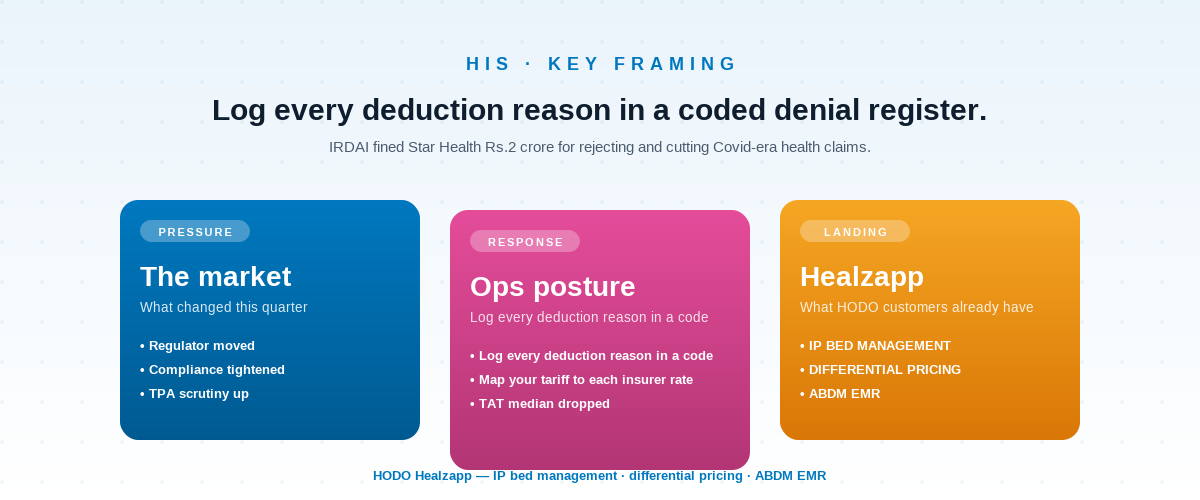
Log every deduction reason in a coded denial register.
Rate cards, packages and differential pricing
The most avoidable deduction category is pricing mismatch. A hospital typically carries a cash tariff, several insurer tariffs, scheme rates, and corporate rates, each with different inclusions on consumables, room category and procedure bundling. When those live in spreadsheets outside the billing system, the counter bills the wrong rate, the payer cuts the difference, and the hospital absorbs it.
Configuring payer-wise rates inside the system removes that class of loss entirely. Non-payable items are flagged at the point of billing so the patient is informed before discharge rather than after a cut has landed. Package inclusions are enforced instead of remembered. Reconciliation into the accounting ledger then happens against the rate actually contracted, which is what makes the deduction number in the monthly review trustworthy. For groups adding a second or third centre, this configuration has to be reproducible — a new unit should inherit the payer masters rather than rebuild them.
What this means for HODO customers
The IRDAI order is a reminder that claims outcomes are decided by records, and records are decided by software design. In Healzapp, Billing holds payer-wise tariffs and Differential pricing applies them at the counter, so the sanctioned rate and the billed rate match before a claim leaves the hospital. EMR (AI-condensed history) assembles the clinical justification a payer asks for, with Machine Interfacing supplying analyser-side timestamps on investigations, and Tally integration carrying the reconciled figure into the ledger so deductions are visible as a monthly number rather than an annual surprise.