From 1 November, hospitals in Karnataka will have to print three numbers against every medicine on a patient's bill, what the hospital paid to procure it, the printed MRP, and the price actually charged to the patient. Fortune India reports the state has moved this from advisory to mandate, with the billing document itself as the disclosure surface. For a 100-bed hospital, this is not a pricing debate. It is a data problem that lands on the pharmacy counter in a fortnight.
The order moves disclosure from the price list to the bill
Most transparency rules so far have asked hospitals to display rates, a board at the entrance, a PDF on the website, a rate card at the billing desk. Those are static artefacts. A hospital can publish them once and move on. The Karnataka requirement is structurally different, because it attaches the disclosure to the transaction. Every discharge bill, every OP pharmacy receipt, every IP interim statement now has to carry the procurement cost of the specific item dispensed.
That shift matters because it removes the gap between the published number and the billed number. A rate card can be aspirational. A bill line cannot. If the hospital's system cannot tell you what a particular strip of antibiotic cost on the day it was received into stock, it cannot print a compliant bill, and nobody will be able to paper over that with a policy document.
It also means the compliance burden is continuous rather than annual. There is no filing date to prepare for. Every bill generated after 1 November is either compliant or it is not, and the evidence sits in the patient's hand.
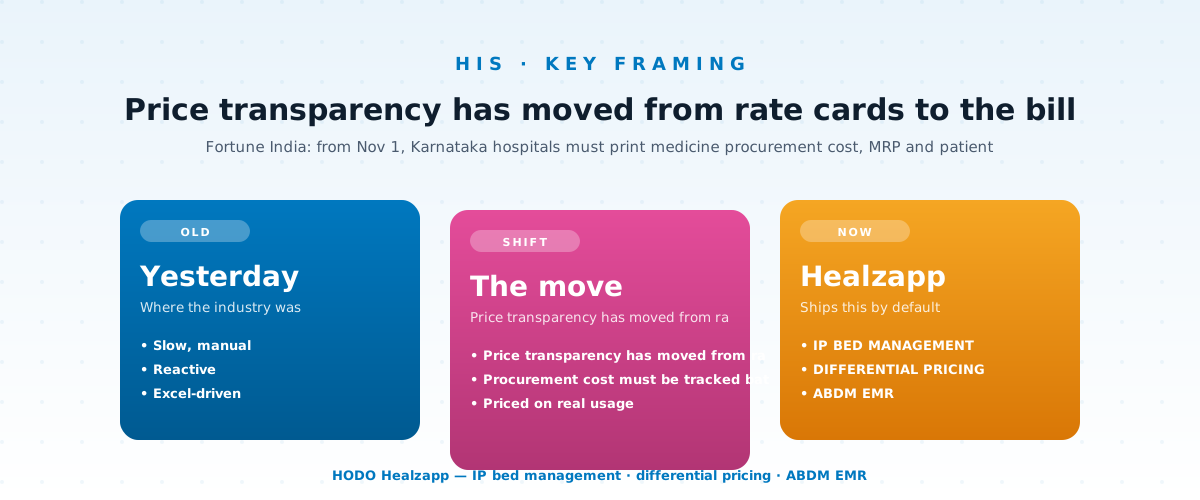
Price transparency has moved from rate cards to the bill line.
Three numbers, and where each one usually breaks
The MRP is the easy one. It is on the pack, it is in the item master, and most HIS installations already print it. The price charged to the patient is also available, that is what the billing engine computes. The number that breaks is procurement cost, and it breaks for a predictable reason: most hospital pharmacy modules track purchase cost at the item level, not at the batch level.
An item-level average works fine for a monthly margin report. It falls apart when the bill has to be specific. The same molecule, same brand, same pack size can arrive at three different landed costs across three purchase orders in one quarter, different distributor schemes, different free-goods offers, different GST treatment on the invoice line. If the system carries a weighted average, the printed procurement cost is a fiction. It may be defensible in an audit; it is not accurate on a bill handed to a patient who can read the strip.
The second failure mode is landed cost versus invoice cost. Freight, cold-chain handling, and distributor discounts are often posted to a general purchase ledger rather than apportioned to the batch. The pharmacy then reports a cost that is lower than what the hospital actually paid, which, perversely, makes the margin look worse than it is on the disclosure line.
Batch-level costing is a goods-receipt discipline
Fixing this on 31 October by changing a print template will not work. The data has to exist before the bill is raised, which pushes the work upstream to goods receipt. Three things need to be true at the point stock enters the hospital.
First, every receipt is posted against a batch with its own cost, not against an item with a rolling average. Second, dispensing picks from a specific batch, FEFO enforced by the system, not by the pharmacist's judgement, so the bill line can be traced back to a known receipt. Third, the cost carried on that batch is the landed cost, with scheme discounts and taxes already apportioned, so there is only one number to print and it reconciles to the purchase ledger.
Hospitals running barcoded or batch-wise stock for narcotics and high-value implants already do this for a subset of items. The Karnataka order effectively extends that discipline to the full formulary, including the fast-moving ward consumables where nobody has historically bothered. That is the real workload: not the printing, but getting every GRN clerk across pharmacy, sub-stores, and ward indents to post batch-wise from day one.
The adjacent benefit is that expiry control and stock valuation stop being separate exercises. A hospital that can print batch cost on a bill can also age its inventory properly, which is usually worth more than the compliance itself.
What this does to TPA, PMJAY and package billing
The awkward case is the packaged rate. Under PMJAY and most TPA arrangements, medicines inside a surgical package are not billed line by line to the payer, the hospital absorbs them against a bundled rate. But the patient copy of the bill still has to show what was dispensed. Hospitals will need to decide, deliberately, how a package line reconciles with item-level disclosure, and make that decision in the system rather than at the counter.
Differential pricing makes this sharper. A hospital that charges one rate to a cash patient, another to a corporate panel, and a third under a scheme is now printing the same procurement cost against three different patient prices. That is legitimate, different payers carry different collection costs and credit periods, but it has to be consistent and explainable. Ad-hoc counter-level discounts, the kind entered as a rupee override by a senior billing clerk, become very hard to justify when the cost basis is printed next to them.
Practically, this is an argument for moving all pricing into configured payer-wise tariffs and removing manual override rights from the billing screen. Hospitals that have been meaning to clean up their price master have now been given a deadline by the state.
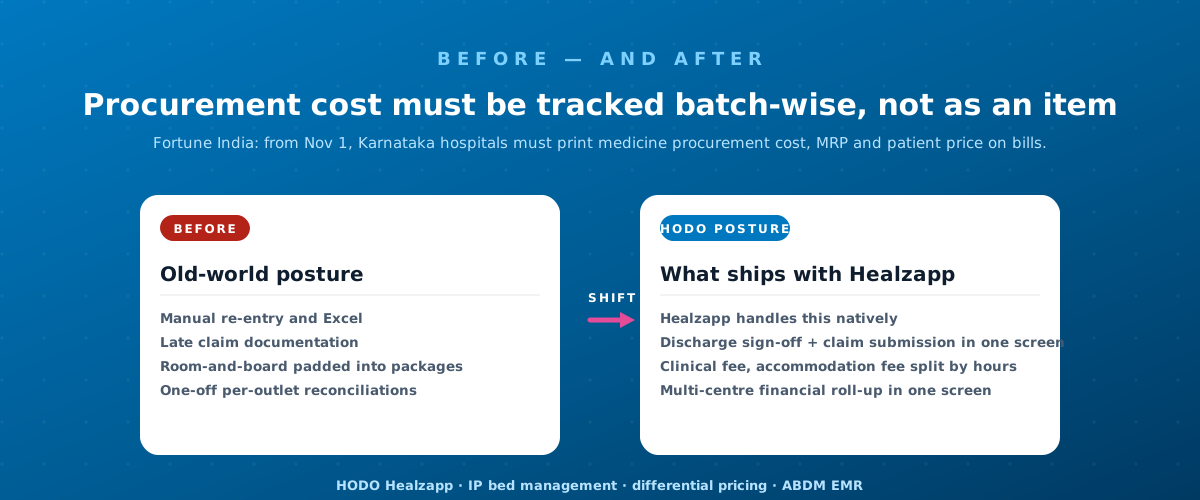
Procurement cost must be tracked batch-wise, not as an item average.
A readiness check before 1 November
A 100-bed hospital can audit this in a day. Pull ten recent pharmacy bills, pick one line from each, and ask the system to produce the purchase invoice and batch for that exact dispense. If the answer involves a store-keeper opening a register, the system is not ready. Then check whether the pharmacy's closing stock value reconciles with the purchase ledger in Tally for the last completed month, a gap there means landed cost is not being apportioned correctly, and the printed number will not survive scrutiny.
Finally, check the sub-stores. Ward-level and OT-level stock is where batch traceability is usually lost, because issues are made in bulk and consumption is reported in aggregate. If an OT consumable cannot be traced to a batch, its procurement cost cannot be printed on the patient's bill, and that is the line most likely to be questioned.
What this means for HODO customers
Healzapp handles the medicine lifecycle as one chain rather than three disconnected screens. Pharmacy and Inventory carry batch-wise receipt, landed cost, and FEFO dispensing, so a bill line can be traced back to the purchase it came from without a manual register. Differential pricing keeps payer-wise rates configured rather than overridden at the counter, which is what makes a printed cost-versus-price comparison defensible across cash, corporate, and scheme patients. Tally integration closes the loop so pharmacy stock valuation and the purchase ledger agree month on month. For multi-outlet groups, the same item and batch structure rolls out to each new centre instead of being rebuilt locally.