
The Kerala government's move to implement the Clinical Establishments Act has drawn sharp pushback from the Kerala Private Hospitals Association (KPHA) and the Indian Medical Association (IMA), who warn that the compliance load will hit small and mid-sized hospitals hardest, according to a report in The Hindu. For hospital owners running 50-300 bed set-ups outside the metro tier, the debate is not academic — the Act's registration, record-keeping and infrastructure clauses translate directly into staffing hours, capital spend and a much sharper audit trail than most facilities currently maintain.
The Clinical Establishments (Registration and Regulation) Act framework, adapted at the state level, requires every clinical establishment — from a single-doctor clinic to a multi-speciality hospital — to register with a district authority, meet notified minimum standards for infrastructure and staffing, display rate cards, and maintain patient records in a prescribed format. Kerala's implementation adds a state-specific rulebook on top of the central Act, and the KPHA-IMA position is that standards drafted for large tertiary set-ups have been applied wholesale to small nursing homes and taluk-level hospitals. The friction is real: a 60-bed hospital that has run on paper case sheets and a basic billing package for two decades now has to produce structured discharge summaries, standardised rate displays, biomedical waste logs, and monthly returns on demand. The registration itself is renewable, which means non-compliance is not a one-time risk but a recurring inspection cycle that will surface every renewal window.
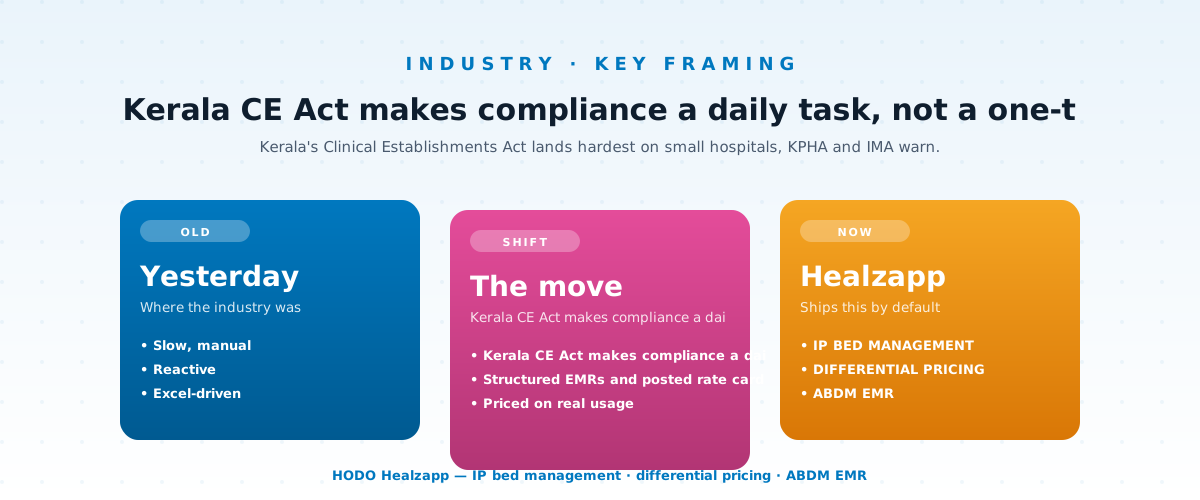
The KPHA's argument, echoed by the IMA, is not that standards are wrong — it is that the cost curve is inverted for smaller facilities. A 300-bed corporate hospital can absorb a full-time compliance officer and a records team; a 40-bed hospital in Malappuram or Idukki cannot. The Act's minimum-standard checklist covers space per bed, fire-safety clearances, biomedical waste tie-ups, qualified staff ratios, emergency drug lists and grievance-redressal boards. Each item is defensible on its own, but the aggregate capital and operating cost — industry estimates put first-year compliance at Rs 15-40 lakh for a mid-sized hospital — is what has triggered the protest. There is also a competitive angle: unregistered or semi-formal set-ups will exit the market or consolidate, which shifts patient volume but also raises the average cost per patient for those who remain. Owners planning the next twelve months need a compliance roadmap, not a wait-and-watch stance, because inspection notices will not distinguish between a hospital that is halfway there and one that has not started.
Ask any hospital owner in Kerala what would trip them up in a surprise inspection, and the answer is almost always the same: records. The Act mandates that patient records be maintained in a prescribed format, retrievable on demand, and — increasingly — digitally shareable under ABDM norms. Handwritten case sheets, WhatsApp-forwarded lab reports and Excel-based billing registers do not clear this bar. Discharge summaries need to be structured, coded where relevant, and linked to the patient's longitudinal record. Rate cards must be current, visible in outpatient areas, and matched against the actual billing done at the counter. Inventory of scheduled drugs, expiry tracking, and biomedical equipment maintenance logs all need to be auditable. Facilities that have already invested in a hospital information system will find the transition manageable; those still on paper or on fragmented tools will discover that the Act is essentially a forcing function for digitisation, whether or not that was the stated intent of the drafters.
Beyond records, the Act sets staffing ratios — nurses per bed, resident doctors on call, qualified pharmacists, radiographers where imaging is offered. Kerala's draft rules also touch on infrastructure: minimum bed spacing, ventilation, waste segregation zones, and separate wash areas for infectious cases. For an owner running a nursing home converted from a residential building — a very common Kerala pattern — this is where retrofit costs bite. The reporting cadence is the second operational hit: monthly returns on notifiable diseases, adverse events, maternal outcomes and, in some categories, tariff data. Doing this by hand means a full-time role; doing it as a report generated from live operational data means near-zero incremental effort. That gap is the single biggest argument for hospitals in the 50-300 bed range to move to a unified HIS platform this year rather than next, because the reporting formats will only tighten from here.
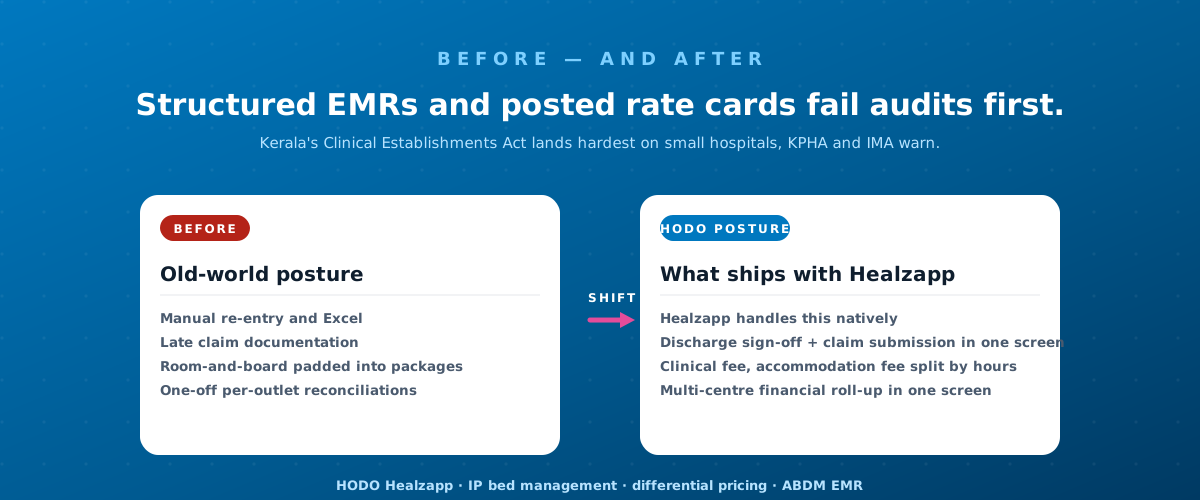
The pragmatic path for a small or mid-sized hospital is to treat the Act as a scoping document for a technology decision, not as a legal problem to be delegated to a consultant. Registration and standards are the easy part — infrastructure gaps can be planned and phased over two or three quarters. The harder part is the operational spine: a system that captures every patient encounter in structured form, prices it against a published tariff, generates the discharge summary, files the ABDM-linked record, and produces the monthly return without manual assembly. For chains planning to add a second or third outlet, the compliance load multiplies, and the case for a platform that can onboard a new centre with the same master data, rate cards and reporting formats becomes a scaling requirement rather than a nice-to-have.
Hospitals on HODO Healzapp already have most of the compliance spine in place. Patient Management and the ABDM-compliant EMR together produce the structured, retrievable patient record that the Act's inspection checklist asks for — including discharge summaries, prescription history and the longitudinal view that state-level auditors have begun requesting. Billing ties directly into the displayed rate card, so tariff-versus-charge audits become a report rather than a reconciliation exercise. For groups planning to open a second or third outlet under a common licence umbrella, Multi-outlet scale-up with one-click new-centre setup means the compliance configuration — user roles, rate cards, report templates, ABDM linkage — is cloned rather than rebuilt, which is where most chains lose weeks. Owners waiting for the KPHA-IMA representations to soften the timeline should plan for the timeline that is on paper today.
See how HODO Healzapp handles this — book a 30-min demo.
See how Healzapp, Labzapp and EReazy fit your speciality in a free 30-minute demo.
Book a Free Demo