KKR has agreed to acquire Medicover Hospitals India in a transaction valued at roughly $1.5 billion, with the private equity firm committing Rs 13,000-14,000 crore, of which Rs 3,000-4,000 crore will go in as primary capital to fund growth and repay debt, according to ETHealthworld. The buyout hands full control to KKR and sets the stage for another aggressive PE-backed hospital roll-up in India, following the template Manipal, Aster and Care have already road-tested at scale.
What the deal actually signals
Hospital chains in India are no longer being valued purely on bed count or brand recall. The KKR-Medicover trade puts a hard number on what a mid-sized, multi-city hospital operator is worth when it comes with a functional back-office, a reasonable payer mix, and headroom to add outlets. The Rs 3,000-4,000 crore primary capital tranche is the more revealing piece, it says the buyer expects the platform to add centres, absorb tuck-in acquisitions, and refinance existing debt on the strength of consolidated financials.
For every hospital owner watching this, the takeaway is not that PseudoPE money has arrived. It has been here for a decade. The takeaway is that the diligence bar has moved. Buyers now open the HIS before they open the P&L. If the data model cannot produce clean centre-wise EBITDA, doctor-wise revenue attribution, and TPA-wise ageing at the click of a button, the valuation multiple compresses. Vendors of paper-based or half-migrated systems will feel this first, and the promoters carrying them will feel it in the exit cheque.
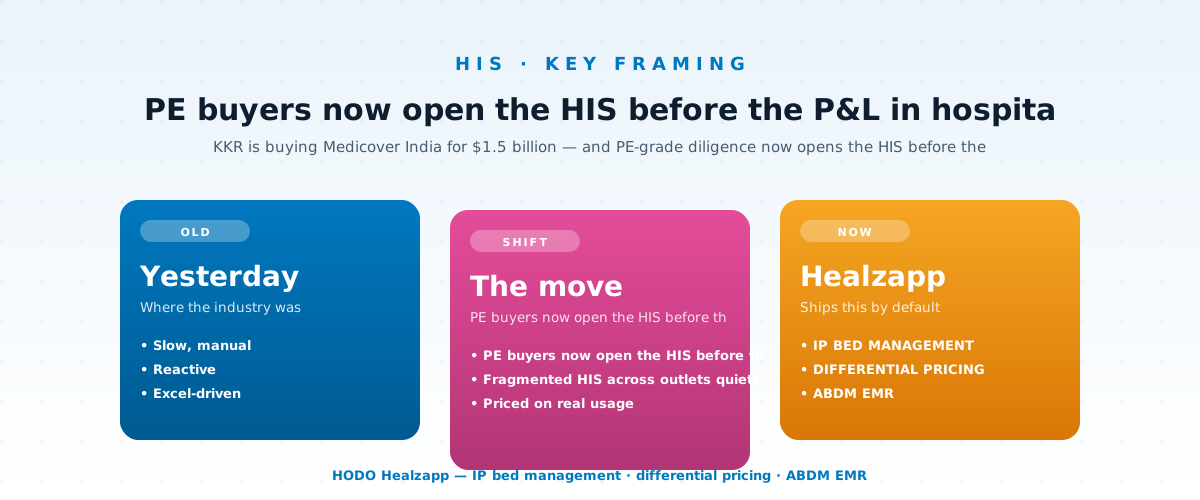
PE buyers now open the HIS before the P&L in hospital diligence.
Why roll-ups live or die on operational plumbing
A hospital chain that has grown from two centres to twelve through acquisitions typically runs on three or four different HIS instances, two accounting systems, and a WhatsApp group holding it all together. This is workable at Rs 200 crore of revenue and fatal at Rs 1,000 crore. Every additional centre without a common platform adds a reconciliation team, not a margin.
The Medicover-KKR structure, where fresh capital is earmarked for expansion, will force exactly this question inside the acquired entity within the first 100 days. Which HIS becomes the group standard? How fast can a newly acquired hospital be onboarded onto that stack without a six-month freeze on billing? These are not IT questions. They are the difference between hitting the sponsor's underwriting case and missing it by two years, which is the gap between a top-quartile exit and a write-down.
The multi-outlet HIS problem no one owns
Most hospital CIOs have inherited the multi-outlet problem, they have not designed it. The typical pattern is one flagship on a decent HIS, three older units on a legacy build the original vendor no longer supports, and two greenfield centres on whatever the local consultant sold. Master data does not match. Item codes drift. Consultant lists diverge. A referring doctor at Centre A has a different ID at Centre B, and the same procedure sits at two different price points across the group.
The fix is not another migration project. It is choosing a HIS with native multi-tenant architecture where a new centre inherits master data, price lists, and workflow templates on day one. The alternative, replicating configuration by hand across every new outlet, is what turns a nine-month integration into eighteen, and what makes the sponsor's next add-on acquisition uneconomic before it closes.
Cashflow, TPA and financial consolidation
PE-backed hospital groups underwrite to working capital efficiency, not just topline growth. The single biggest lever most Indian chains still under-use is TPA cashflow management, pre-authorisation TAT, discharge summary readiness, claim rejection rate per payer, and days-sales-outstanding at the group level rather than per centre.
Chains that consolidate their receivables view see two things immediately. First, the same TPA is often paying Centre A in 45 days and Centre B in 90 for identical procedure codes, usually because Centre B is missing one document at submission. Second, group-level pricing negotiations with insurers become possible only when you can produce a single view of volumes across all centres. Without a consolidated HIS or a robust ERP bridge, this data lives in spreadsheets and dies there, which is where most negotiating leverage also dies.
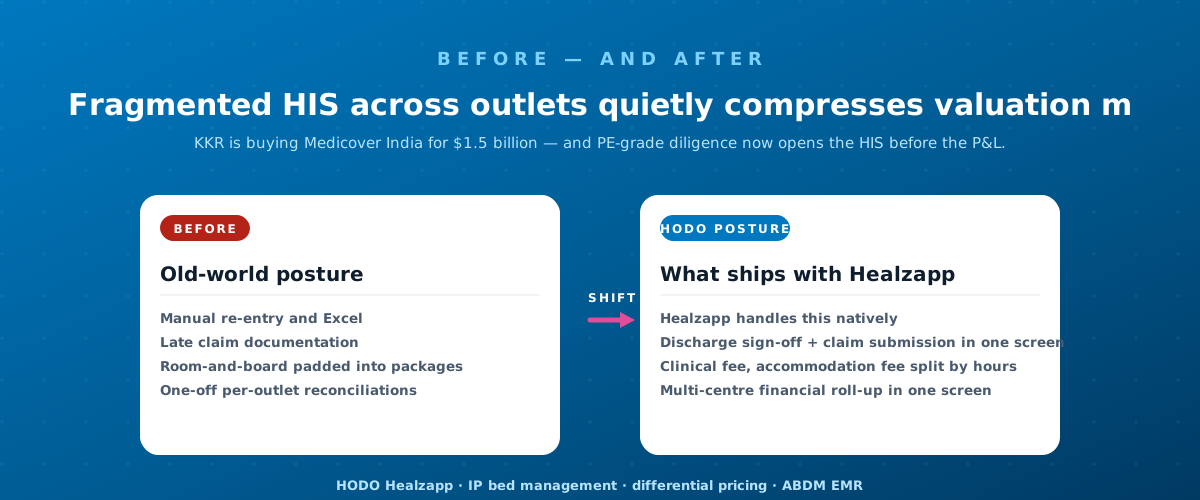
Fragmented HIS across outlets quietly compresses valuation multiples.
ABDM and compliance debt at scale
ABDM compliance is now a diligence checklist item, not a badge. A buyer paying Rs 13,000 crore wants to see that every centre in the group is issuing ABHA-linked records, that consent artefacts are logged, and that the EMR is future-ready for HPR and HFR interlinks. Compliance debt, centres running on non-ABDM-compliant systems that will need to be lifted and shifted later, is priced into the deal as a discount.
The same logic applies to Telemedicine Practice Guidelines, NABH digital documentation requirements, and the emerging insurance-side rules on standardised discharge summaries. Chains that centralise on ABDM-compliant infrastructure early pay less compliance rent later, and enter the next diligence room with fewer footnotes to explain away.
What this means for HODO customers
The Medicover transaction is a reminder that the HIS is no longer back-office plumbing, it is the asset that gets valued. Hospital groups already on Healzapp are set up to answer the questions a buyer or a bank will ask on day one of a data room. Multi-outlet scale-up with one-click new-centre setup means adding a hospital to the group does not restart the configuration clock; master data, price lists, and templates carry over. Differential pricing lets group-level TPA and corporate contracts sit alongside centre-level cash rates without the finance team maintaining parallel rate cards. And Tally integration collapses the gap between clinical operations and consolidated group financials, which is where the diligence data room actually lives.
For chains still evaluating, the operational cost of staying on fragmented systems compounds every quarter. The next PE cheque in Indian hospitals will not wait for the migration project to finish.