Business Standard reports that KKR has committed ₹13,188 crore to acquire Medicover Hospitals as part of an accelerated India push. Read past the headline and this is not just another private equity trade, it is a repricing of what mid-sized Indian hospitals are worth, and how quickly the ~100-bed segment will be forced to modernise, consolidate, or exit.
What KKR is actually buying
Global PE capital of this size does not chase beds; it chases operating tempo. What earns a valuation premium in 2026 is the ability to run twenty-plus centres on one clinical and billing spine, close books monthly across units, and hand a limited partner a dashboard that shows bed occupancy, average length of stay, OP throughput per consultant, and TPA days-sales-outstanding without a spreadsheet exercise. That operational chassis is what moves the multiple from single digits to the teens.
Mid-sized hospital groups reading the Medicover transaction should therefore separate two questions. The first is whether the local catchment can support 100 to 200 beds profitably, that is a market question. The second is whether the group is instrumented well enough that a strategic or financial buyer could plug it into a national roll-up inside sixty days of diligence. The second question is entirely in the operator's hands, and the answer today decides the multiple tomorrow.
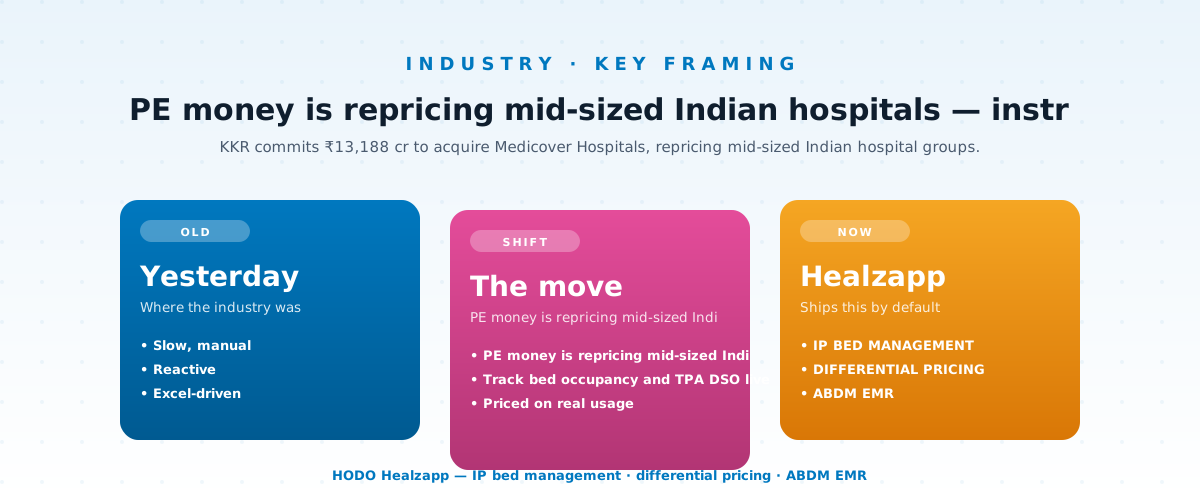
PE money is repricing mid-sized Indian hospitals, instrument or exit.
Why the ~100-bed segment feels the squeeze first
When a KKR-backed platform enters a tier-2 or tier-3 catchment, three things typically happen inside 18 months. Consultant retention costs rise as the branded chain bids for senior clinicians. TPA and insurer rate cards get renegotiated against the smaller player, because the chain has volume leverage the standalone unit cannot match. And OP walk-in patterns shift toward the branded name, particularly for scans, day-care procedures, and salaried-class health checks.
A ~100-bed hospital that has not fixed its core operational reporting, bed occupancy by ward, OP throughput per consultant per session, TPA and PMJAY claims ageing, pharmacy margin per prescription, will lose margin quietly for six to nine months before it notices the volume drop. The Medicover deal does not create this pressure; it simply compresses the timeline across every mid-market catchment that a national platform now has capital to enter.
The HIS replacement is now a strategic decision
Most 100-bed Indian hospitals still run a stack assembled between 2010 and 2015, a legacy HIS, a separate pharmacy application, a lab system that exchanges nothing with the HIS, and an accounts package that reconciles two weeks after month-end. That stack was defensible when the hospital was single-unit and owner-managed. It becomes a liability the moment the group opens a second centre, because every process has to be re-taught, every master data field re-created, and every finance role duplicated.
Replacing the HIS is no longer an IT purchase, it is the decision that determines whether the group can be a multi-outlet business. Acquirers look at the HIS the way they look at the CFO function: is this something a national platform can absorb, or something that has to be ripped out on day 91 of the integration? The answer to that question is now a line item in the term sheet.
TPA, PMJAY and receivables discipline
PE-backed chains treat receivables like a KPI, not a back-office nuisance. Days sales outstanding under 45 for TPA, PMJAY claim cycles measured in weeks and not quarters, denial rates tracked per empanelled scheme and per empanelled doctor, and a monthly reconciliation between the HIS, the TPA desk, and the accounts package that runs without manual matching. This work is not glamorous, but it is the single largest hidden discount at the valuation table.
For a 100-bed hospital in a tier-2 city, the practical implication is that the claims dashboard has to be live on Monday morning, not compiled at month-end. If the CFO cannot see ageing buckets by TPA, by scheme, and by consultant on demand, the group is bleeding working capital and simultaneously mispricing its own book of business. Both problems compound quietly until the buyer's diligence team surfaces them at a discount.
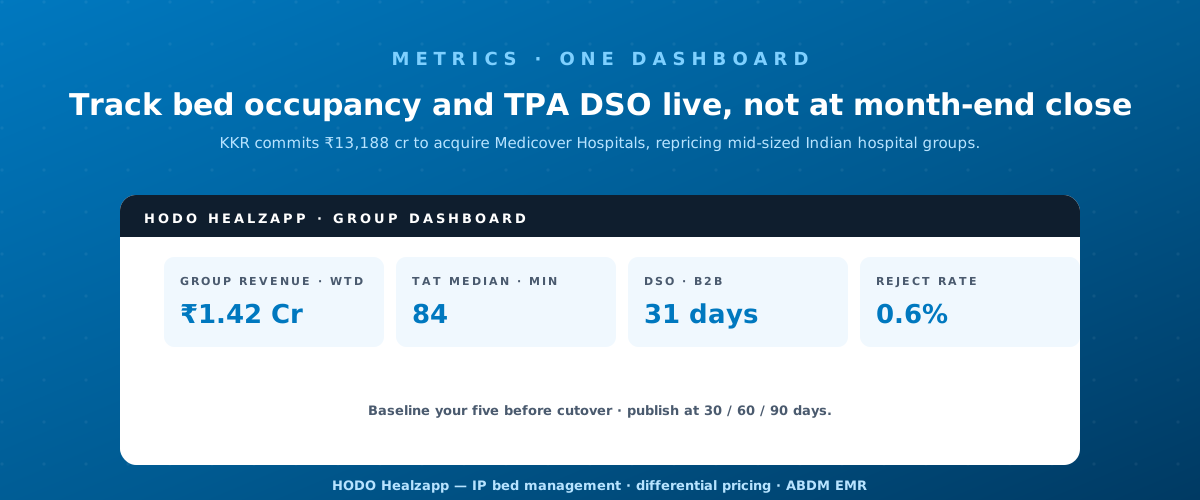
Track bed occupancy and TPA DSO live, not at month-end close.
Multi-outlet or deeply specialised, the middle is gone
The Medicover transaction narrows the strategic options for mid-sized groups to two. One route is committing to multi-outlet, unified master data, one patient identifier across centres, shared referral and corporate portals, standardised clinical protocols, and the ability to open a new centre without re-implementing the HIS from scratch. The other route is specialising deeply enough, single-speciality, single-unit, brand-led, that a local premium survives the branded chain arriving down the road.
Drifting in the middle, running two or three units on incompatible systems, no unified P&L, and no ABDM readiness, is the position that gets acquired at a discount or squeezed out entirely. The window to pick a side was already narrowing; a ₹13,188 crore commitment landing in the segment closes it faster.
What this means for HODO customers
The operational message from this deal is not that every mid-sized hospital must sell to PE, it is that every mid-sized hospital must run as if it could. That means an HIS built for multiple units rather than adapted to them, a claims and billing engine that treats TPA and PMJAY as first-class workflows, and ABDM readiness as a default state, not a project.
HODO Healzapp is designed for exactly this segment. Multi-outlet scale-up with one-click new-centre setup means a second or third unit inherits the master data, price lists, and role definitions of the original centre instead of a fresh implementation cycle. IP bed management gives ward-level occupancy and length of stay in real time, which is the single dashboard a PE diligence team asks for on day one. ABDM-compliant EMR, HODO is among the first 20 ABDM-integrated HealthTechs in India, takes the regulatory question off the table for any acquirer, empanelment, or corporate contract conversation.