BusinessLine reported this week that KKR has agreed to acquire Medicover India for ₹14,250 crore, one of the largest private equity plays in Indian multi-specialty healthcare this year. For hospital owners and MDs watching from the sidelines, the deal is less a headline about valuation and more a signal about what the next five years of consolidation will demand from operations and IT.
Why PE Money Keeps Landing in Multi-Specialty
Private equity is not buying Medicover for the brand. It is buying a platform: a chain that can absorb bolt-on hospitals, diagnostic centres and clinics, then push standardised processes, pricing and reporting across them. The KKR thesis, as covered by BusinessLine, is a scaled multi-specialty rollup across Tier 1 and Tier 2 cities. Every hospital owner in the 50-500 bed range should read that carefully. The same PE funds looking at Medicover are also scouting mid-market chains and standalone assets across South and West India, and they are looking for platforms that can be scaled without a decade of integration debt.
The operational reality after a PE deal is unforgiving. Investors want month-on-month EBITDA visibility, per-bed and per-outlet productivity, and cost-per-patient tracked at the SKU level. Chains that run on spreadsheets, disconnected billing modules and paper-based OPD registers do not survive the first quarterly board review. The bar for HIS, LIMS and ER automation has quietly moved up, and it is now a due-diligence line item.
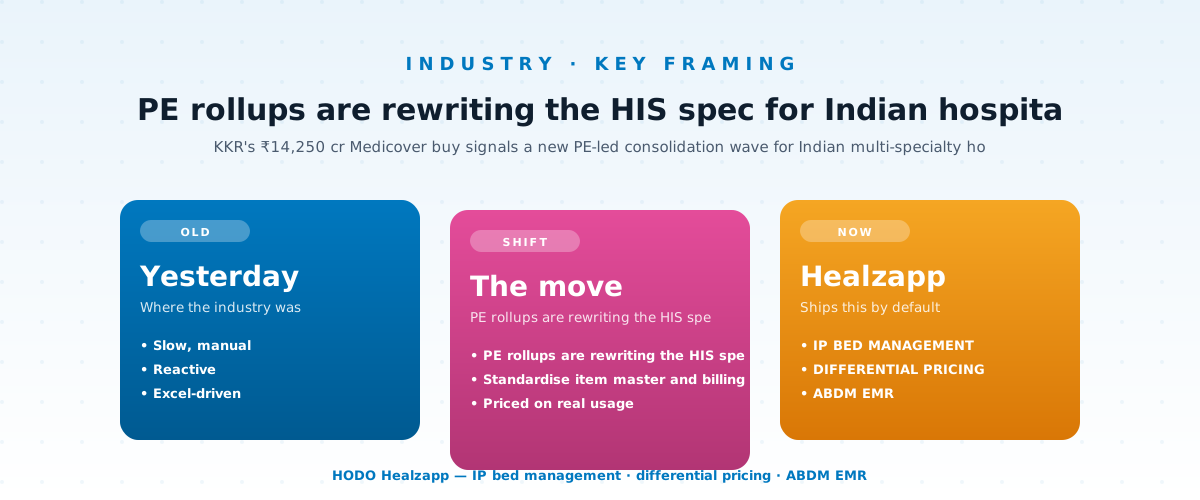
PE rollups are rewriting the HIS spec for Indian hospitals.
Standardisation is the New Table Stakes
The most under-reported cost in a hospital acquisition is the six to eighseen months spent harmonising software. Different HIS at each unit means different chart-of-accounts, different item masters, different discharge summary templates and different insurance workflows. Reporting a consolidated P&L up to a PE board becomes an exercise in Excel gymnastics that consumes finance teams for weeks around every close.
Chains that want to be acquisition-ready - or acquirers themselves - need a HIS that can open a new outlet in days, not quarters, with the same master data, the same billing rules and the same clinical templates. That is not a nice-to-have. It is what determines whether a bolt-on hospital contributes to group EBITDA in month three or month fifteen. Finance leaders who have lived through a botched integration will pay a premium for tooling that removes that risk.
TPA Cashflow and the Insurance Squeeze
PE-owned hospitals live and die by working capital. Every rupee stuck in a TPA queue for 90 days is a rupee the board wants back. Post-acquisition, Medicover-style groups will push aggressive DSO targets on their revenue cycle teams, and the tools have to keep pace.
That means claim-ready billing at discharge, itemised charges tagged to the correct package, and a single view of pending claims across all outlets. Corporate-partner and TPA logins that let the payer verify eligibility and pre-authorisation without a phone call save days per claim. Multiply that across 500 discharges a month in a mid-sized chain, and the cashflow difference reads as several crores of freed-up working capital every quarter. The ability to price differently for different corporate partners without breaking the audit trail also matters when a group runs 30-plus MoUs at once.
ABDM, NABH and the Compliance Ratchet
Regulatory scrutiny follows PE capital. ABDM integration, NABH re-accreditation cycles, HPR/HFR listing, e-prescription mandates and state-level insurance schemes each need audit-grade data trails. Buying a group and discovering half the outlets are not ABDM-linked is a red flag that shows up in Quality of Earnings reports and drags the multiple.
Owners looking to sell into the next wave of consolidation should treat ABDM compliance and audit readiness the way they treat fire NOCs - a non-negotiable that has to be in place well before the term sheet lands. That includes ABHA-linked patient records, consent artefacts and structured discharge summaries that a diligence team can pull without a week of manual work. Chains that already have this discipline are commanding a visible premium in deal rooms.
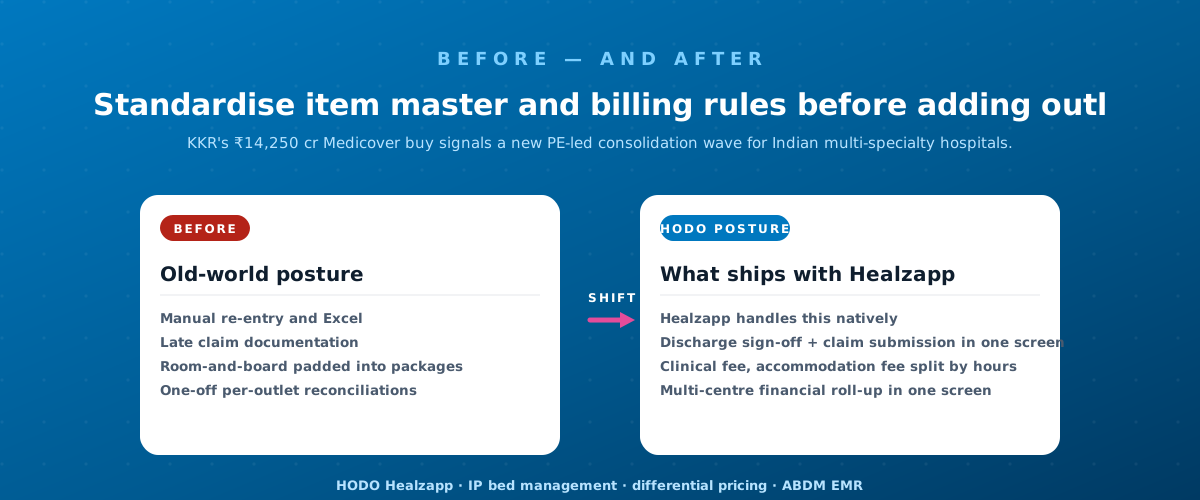
Standardise item master and billing rules before adding outlets.
Diagnostics is the Quiet Prize
Medicover in India is not just a hospital chain - its diagnostic and fertility footprint is a large part of the valuation. Every PE deal in this space now looks at the lab and imaging business as a separate profit centre, with its own TAT, its own quality metrics and its own referral-network economics.
Labs that cannot report TAT by test, by centre and by shift, or that cannot show a Levey-Jennings chart on request, are trading at a discount. Diagnostic chains preparing for their own PE conversation - or looking to become the preferred partner-lab for an acquiring hospital group - need LIMS discipline that stretches from barcoded samples at the collection counter to consolidated MIS at the group office. Machine interfacing at every bench, automated report delivery over SMS or WhatsApp, and clean franchisee commercials are what a PE analyst looks for before writing the LOI.
What this means for HODO customers
The KKR-Medicover deal is a reminder that the IT decisions taken in a 100-bed hospital today shape whether it can be part of a 5,000-bed platform tomorrow. HODO Healzapp is built around the operational lines this consolidation wave stresses hardest.
Multi-outlet scale-up with one-click new-centre setup keeps master data, billing rules and clinical templates consistent as a chain adds units - the exact problem that eats six months of post-acquisition integration budgets. Corporate-partner logins and TPA workflows shorten the days-sales-outstanding cycle that PE boards track quarterly. ABDM-compliant EMR ensures the group is audit-ready when diligence teams arrive, without a scramble to backfill ABHA linkages.