KKR has signed definitive agreements to acquire Medicover India, a 24-hospital, roughly 4,800-bed multi-specialty network built up since 2017, from Medicover AB, according to a report in Express Healthcare. For owners running 50-500 bed hospitals, multi-outlet clinic chains or diagnostic groups, the deal is less about who is buying and more about what buyers are now willing to pay for.
What the deal actually says about the market
Medicover India built 24 hospitals in about eight years. That is a doubling every couple of years, funded through greenfield and a set of bolt-ons. When a global PE firm the size of KKR writes the cheque, it is signalling three things at once. One, that Indian multi-specialty hospital chains are now considered a hardened asset class rather than a speculative bet. Two, that the operating discipline needed to run 4,000-plus beds under one brand is available in the country. Three, that further consolidation is coming, because PE holds do not exit through single-hospital sales, they exit through IPO or another strategic buyer, and both those exits require the chain to keep growing.
For the mid-sized operator watching from the sidelines, this creates two paths. The first is to become an attractive acquisition target, which means clean books, standardised operations across sites, and defensible unit economics. The second is to stay independent and compete against increasingly well-capitalised chains for the same doctors, the same corporate contracts, and the same TPA panels. Both paths have the same starting point: the operating system running the group.
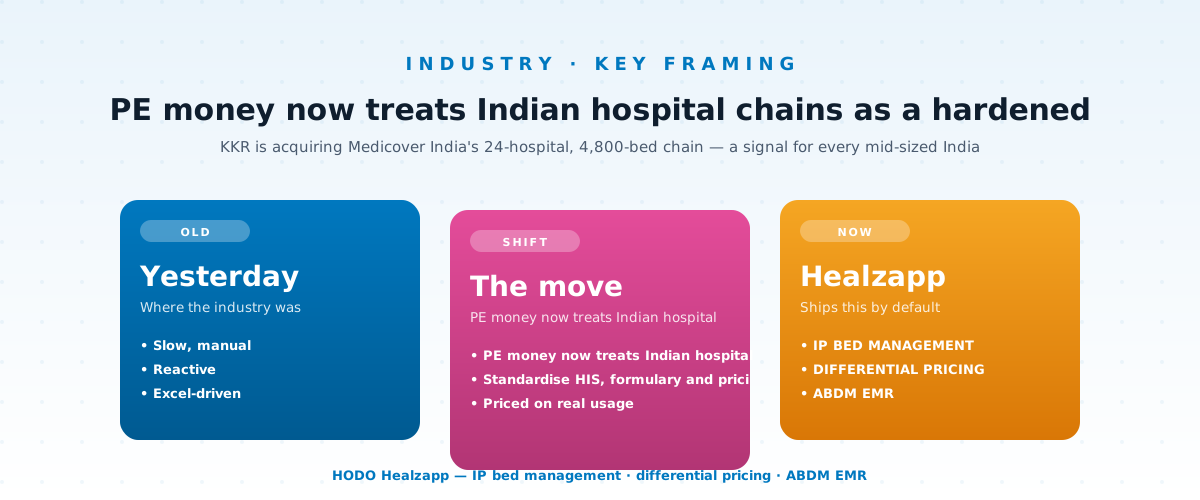
PE money now treats Indian hospital chains as a hardened asset class.
What acquirers audit before writing the cheque
Deals of this size do not close on brand equity or bed count alone. Due diligence teams spend weeks on the operating layer, and a few themes come up in nearly every transaction. Are patient records complete and portable, or scattered across paper files and three different vendor stacks? Can revenue be traced from OP registration to final TPA settlement without spreadsheet reconciliation? Is inventory drawdown at the pharmacy and the OT reconciled against consumption per patient, or is shrinkage buried in the P&L? Does the group have one price list, or does every branch quietly negotiate its own?
The answers to these questions determine the discount rate. Chains that have digitised end-to-end command a premium because integration risk drops sharply. Chains that still run three HIS instances and a paper OT register get marked down, not because the assets are worse, but because the acquirer must budget for the migration. Owners who plan to sell, IPO or raise growth capital in the next 24 months should be scoring themselves against this checklist now, not the month before the term sheet.
The multi-outlet operating model this forces
Running two dozen hospitals under one brand means every clinical, billing and inventory process has to survive being copied across sites. A protocol that works because the nursing supervisor at one site personally chases it will not scale. This is why serious chains standardise on a single HIS backbone, a single formulary, a single price grid with defined per-site variations, and central visibility into bed occupancy, OT utilisation and daily collections.
The operational tell is how quickly a new hospital gets to break-even. Chains with a repeatable stack can open a new centre and go live on billing, EMR and pharmacy in weeks, because the workflows, master data and role permissions come pre-configured. Chains without it spend six to nine months building the same setup by hand at every new site, and lose the first two quarters of revenue to configuration drift. When a PE-backed operator is opening two hospitals a year, that gap compounds into a full acquisition target the independent operator could have taken.
Cashflow, TPA and the discipline the deal quietly assumes
A 4,800-bed network runs on TPA and insurance receivables. If those receivables age past 90 days at even a small percentage, working capital gets ugly fast. Buyers looking at a chain like Medicover will model the collections cycle down to the sub-payer level, how long does Star Health take, how long does CGHS take, how many claims come back for query, what is the eventual write-off rate. The chain either has that data at the click, or it does not.
For a mid-sized hospital that wants the same investor attention, the fix is not more accountants. It is billing, EMR and TPA workflows sitting in one system so that every claim carries its clinical documentation, and every payment posts back against the exact invoice. Add differential pricing per corporate and per TPA, because uniform pricing across payers is money left on the table, and the picture the buyer sees changes materially.
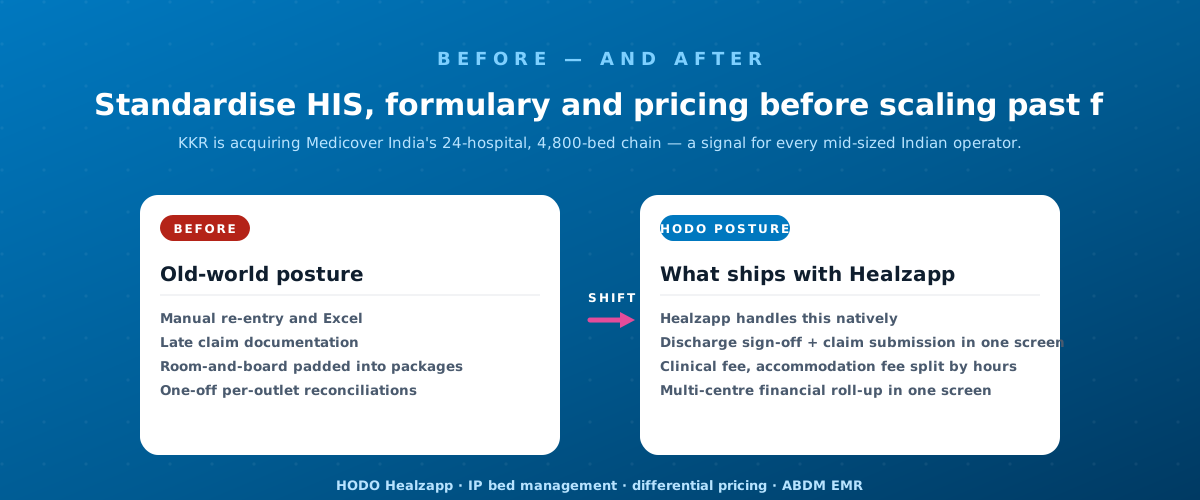
Standardise HIS, formulary and pricing before scaling past four sites.
ABDM, compliance and the regulatory floor
Any large chain being bought in 2026 will be assessed on ABDM readiness. Health-ID linkage, consented record sharing, HFR and HPR registration are no longer nice-to-haves; they are prerequisites for corporate insurance panel renewals and, increasingly, for private-sector empanelments. Buyers do not want to inherit a chain that has to spend the first year of ownership retrofitting compliance. Groups that were early ABDM adopters get valued on their patient graph, the fact that records are portable, deduplicated and shareable turns the patient base into a real asset instead of a stack of paper files.
What this means for HODO customers
Hospital groups on HODO Healzapp already have the operating layer that a KKR-style buyer looks for. Multi-outlet scale-up with one-click new-centre setup means a new hospital or branch inherits master data, formulary, price grids and role permissions on day one, the six-month configuration tail that hurts chain valuations goes away. Differential pricing handles the TPA-by-TPA and corporate-by-corporate rate cards that a serious buyer will audit line by line. And the ABDM-compliant EMR means the patient graph is portable, consented and defensible under the regulatory floor that every PE-backed acquirer is now underwriting against. Whether the goal is to sell, to raise, or simply to not get out-run by a consolidator, the work is the same, and it starts with the stack.