KKR has agreed to acquire Medicover India, a multi-specialty hospital operator, according to a press release circulated via Google News and republished by 富途牛牛. The deal lands at a moment when private equity capital is chasing India's mid-market hospital and diagnostic chains. For every MD, administrator and multi-outlet owner, it raises a direct question: is the business legible enough to survive due diligence, or to scale under new ownership?
What the deal actually signals
The Medicover transaction is not an outlier. KKR, Blackstone, Temasek, Everstone and General Atlantic have all been circling Indian healthcare provider assets for the past three years, with cheque sizes ranging from ₹500 crore growth capital to full buyouts north of ₹5,000 crore. What ties the shortlist together is not clinical excellence, most of these hospitals already have that. It is operational legibility. PE diligence teams want a consolidated P&L across outlets in under 48 hours, patient-level cost data, occupancy trends that reconcile with staffing rosters, and a clean digital paper trail that supports ABDM audits and future insurance claim reviews. Hospitals that cannot produce this evidence get valued as real-estate plays, not as scalable platforms. The delta between those two valuations is typically a 3–4x EBITDA multiple. For owners planning to sell, raise fresh capital or franchise inside the next five years, the KKR-Medicover deal is a reminder that the buyer's checklist is now IT-heavy, not brand-heavy. The clinical story has become table stakes; the operational story is the actual investable asset.
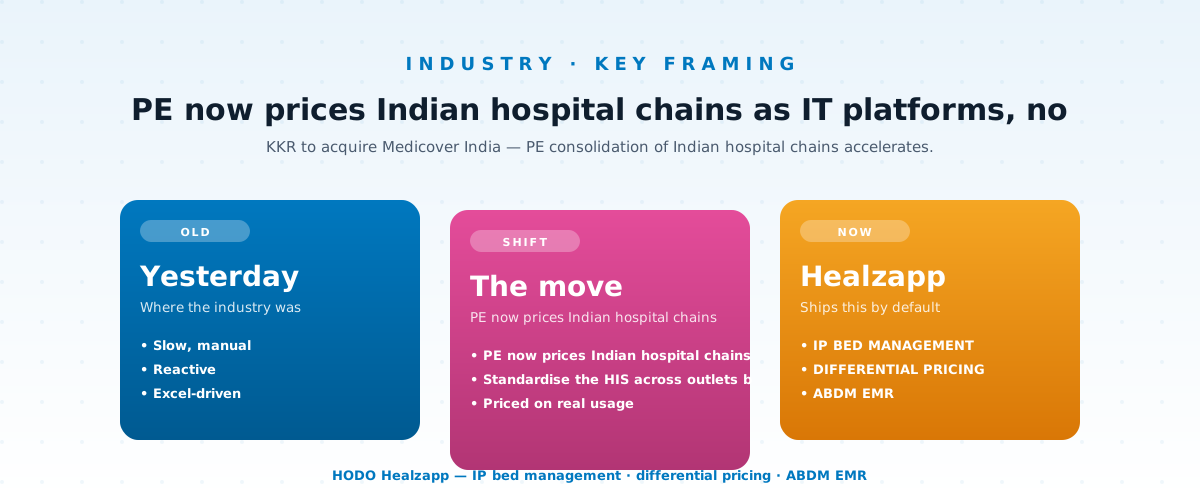
PE now prices Indian hospital chains as IT platforms, not real estate.
Why multi-outlet operators become the shortlist
Multi-outlet chains attract PE money because they promise predictable unit economics, cross-outlet referral flow, brand leverage and shorter working-capital cycles. Those advantages only exist on paper, though, if the group back-office actually behaves like a single company. In practice, most Indian chains grow by acquiring or franchising, and each new outlet arrives carrying its own HIS, its own tariff card, its own pharmacy inventory logic and its own approach to insurance claim submission. The MD ends up with five ERPs pretending to be one group. When a PE analyst asks, what is your gross margin per outlet, month-on-month, for the last 24 months, the answer takes three weeks of manual reconciliation. That lag is what kills valuations, not the underlying clinical business. Operators that have standardised the HIS layer across outlets, kept a common master-data spine for doctors, procedures and tariffs, and can bring a new centre online without a three-month IT project are the ones that make PE shortlists. The rest end up as distressed targets or as bolt-ons priced at real-estate value. The lesson from the Medicover deal for a 50–500 bed hospital or a 12-clinic chain is simple: standardise now, or accept a lower price later.
The consolidated financials problem
The single biggest diligence blocker for Indian hospital chains is the finance system. Group entities typically run Tally at the corporate level, while each outlet's billing engine dumps flat files that require manual mapping every month. Consolidated group financials arrive on day 15, not day 3. Fixing that requires a HIS with native Tally integration, so every OP bill, IP discharge, pharmacy sale and TPA settlement flows to the correct ledger the moment it is raised. It also requires differential pricing baked into the HIS itself. A group that operates a flagship in Trivandrum, two spoke units in tier-2 towns and a corporate-partner tie-up cannot run one tariff card. It needs outlet-level rate cards, partner-specific rates for corporates and insurers, and package pricing that flexes without a database change. When both pieces are in place, the corporate finance team can produce an outlet-wise consolidated P&L on demand, which is exactly what a PE dataroom needs. Without them, valuations are discounted for information risk before the buyer even opens the operations audit.
TPA cashflow and the working-capital drag
Insurance and TPA settlements are the largest working-capital drag in an Indian hospital chain. Days sales outstanding of 90–120 days is not uncommon, and every day locked in receivables is a day of interest cost that erodes EBITDA. The chains that shorten this cycle do it with three levers, all IT-dependent. First, discharge summaries and pre-auth packets that are generated inside the HIS, not typed separately, so nothing goes to the TPA with missing fields. Second, corporate-partner logins that let large empanellers see status on their own claims, cutting the phone-call cycle. Third, billing modules that ring-fence TPA claims from cash claims and track ageing per payer, not just in aggregate. When a PE team scans the dataroom, DSO by payer is one of the first three charts they pull. A chain that can show a 20-day improvement year-on-year in TPA DSO is worth measurably more than one that cannot. In the Medicover context, this is not theoretical, buyers price cashflow discipline directly into the multiple.
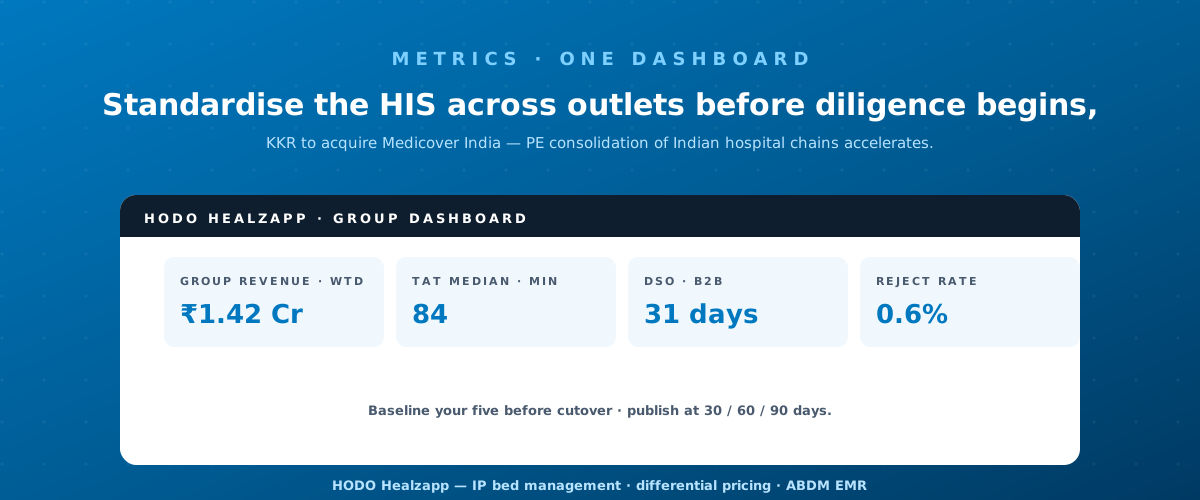
Standardise the HIS across outlets before diligence begins, not after.
ABDM and the compliance floor
ABDM has moved from optional badge to diligence checkbox in the last 18 months. PE buyers now expect the target to be ABDM-integrated, hold ABHA-linked patient records, and produce documentation of NRCeS listing where applicable. This is no longer about winning government contracts, it is about surviving the regulatory-risk section of an investment memo. Chains that are not ABDM-integrated show up as future compliance liabilities, priced into the buyer's downside case. The fix is straightforward in principle: run an EMR that is ABDM-compliant out of the box, so every consultation, prescription and diagnostic report is exchangeable via the ABDM stack without a bolt-on integration. It also helps if the vendor is already listed among ABDM's early adopters, since the buyer's technology diligence team will verify this against the NHA's public registry. Compliance is not a differentiator anymore; the absence of it is a discount on the sale price.
What this means for HODO customers
The KKR-Medicover deal is a proxy for what institutional buyers now expect from every Indian hospital chain of scale. It is not enough to run good clinics; the group has to behave like one operationally-legible business. That is where HODO Healzapp is designed to sit.
Multi-outlet scale-up with one-click new-centre setup means a chain can bring a new hospital or clinic onto the same HIS in days, not a quarter, so the master-data spine stays intact through acquisition or franchise expansion. Tally integration collapses the day-15 consolidated P&L problem into real-time ledger posting, giving the corporate finance team the dataroom output PE analysts ask for. Differential pricing lets each outlet, corporate partner or TPA carry its own tariff without fragmenting the underlying billing engine. Together these three features move a chain from priced-as-real-estate to priced-as-a-platform.