The Times of India reports that Maharashtra has made it mandatory for hospitals to put up visible rate lists in both Marathi and English, so that patients can read the price before the service rather than after it. The rule is written for hospital bills, but diagnostic labs and collection centres running retail counters in the state sit inside exactly the same expectation. For a lab chain with thirty collection points on franchisee agreements, the hard question is not signage, it is whether one authoritative rate card exists at all.
What the directive actually asks for
Two details in the Maharashtra rule matter operationally. The first is bilingual presentation: a rate card in English alone no longer counts, so every line item on the list has to carry a Marathi label as well. The second is placement, the list has to sit where the patient makes the decision, which in practice means the reception desk, the billing counter and the admission desk, not a folder kept behind the cashier.
For diagnostic labs, none of that logic is hospital-specific. A patient walking into a collection centre in Pune or Nashik to give a sample for a thyroid profile faces the same information gap, and a retail lab counter is the easiest place in healthcare to inspect, because the service is priced per test and the receipt is itemised line by line. State health administrations have been moving in this direction for a couple of years now, and the enforcement pattern is predictable: someone compares the board on the wall with the receipt in a patient's hand. That comparison either holds for every line or it does not.
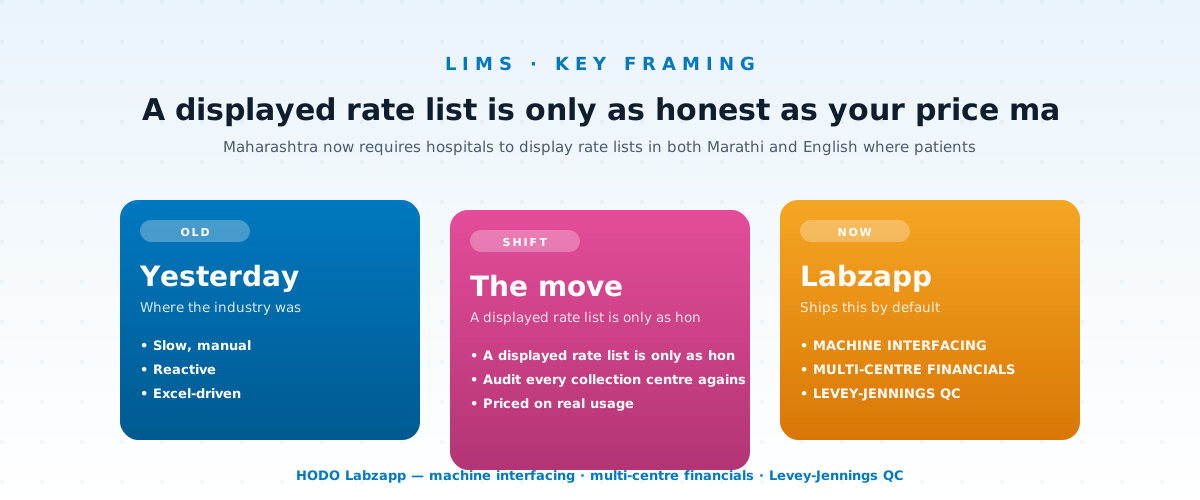
A displayed rate list is only as honest as your price master.
The board is easy. The price master is not.
Most labs can get a board printed in a day. The difficulty is that the board is a snapshot of a rate structure that is usually scattered across four places: a master list inside the LIMS, a revised list circulated on WhatsApp after the last price review, a handful of outlet-level exceptions a branch manager agreed to verbally, and a package price sheet maintained in a spreadsheet by the marketing team. Each of those is defensible on its own. Together they guarantee the wall and the receipt will diverge within a quarter.
The structural fix is a single price master inside the LIMS, where every retail rate is held as a version with an effective date, and where there is no path to bill a rate that does not exist in that master. Once that holds, the displayed card stops being a document somebody maintains and becomes a report the system generates. That is the difference between a compliance exercise repeated at every price revision and a compliance posture that survives revisions.
Labs that have been through NABL documentation cycles will recognise the pattern. It is the same version-and-effective-date discipline already applied to SOPs and reference ranges, extended to the commercial side of the test menu.
Franchisee and collection-centre drift
Price divergence across outlets is where multi-centre labs get caught. A franchisee drops the rate on a high-volume test to beat a competitor two streets away. A home-collection visit fee gets charged at one centre and waived at another depending on who is at the counter. None of these are frauds; they are local commercial decisions. But once a bilingual rate card is displayed at each centre, every one of them becomes a visible mismatch between the wall and the receipt at that specific address.
The operating answer is to separate price from margin in the franchisee agreement. The retail rate is set centrally and displayed centrally; the franchisee's earnings come from the settlement share, not from what is charged at the counter. That removes the incentive to discount locally and makes the displayed card defensible across the network. Backing it up needs one recurring report rather than an inspection drive: tests billed below master rate, counted by centre and by billing user, reviewed monthly. A chain that cannot produce that number does not know what its own rate card says.
Home-collection operators should treat the visit fee with the same seriousness as the test price. It is the charge patients most often describe as a surprise, and it is the one most likely to be missing from a printed list that was built from the test menu alone.
Keep partner rates off the public card
A working lab runs several rate tiers at once: retail walk-ins, referral doctors, corporate contracts, insurer panels, and partner labs sending outsourced work. Those negotiated rates are commercial terms and have no place on a public board. The rule asks for the rate the walk-in patient pays, not the chain's entire pricing strategy, and publishing the lowest tier simply teaches every walk-in to ask for it.
The real exposure runs the other way. A billing user picks a corporate tier for a patient who is not on that corporate's panel, and the receipt now sits below the displayed card. The fix is to bind the rate tier to the patient's registration, the referral doctor, employer or partner recorded at the point of entry, rather than leaving tier selection as a dropdown at the billing screen. Where a partner needs to see its own rates, the right place for that is a partner login, not a circulated price sheet that gets forwarded onward.
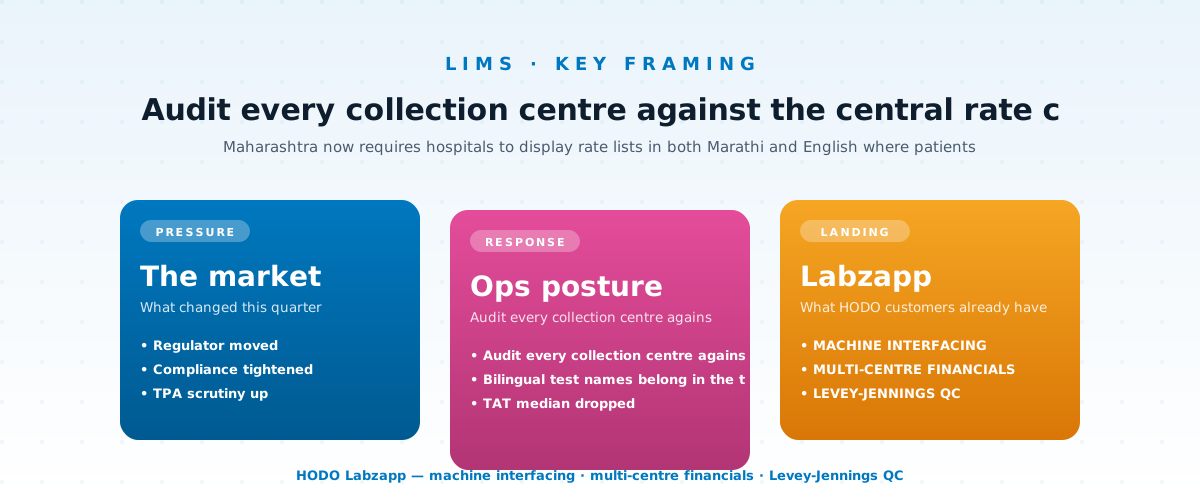
Audit every collection centre against the central rate card monthly.
Marathi labels belong in the test master
The translation work is finite, and it should be done once, centrally, by the people who own the test menu, not by each branch's local printer. Lab leadership has to settle one editorial question first: whether a test name is translated or transliterated into Devanagari. Both are reasonable; mixing them across outlets is not. Keeping the standard English test name alongside the Marathi label avoids ambiguity at the counter and keeps the card readable for patients who are used to the English name.
The mapping has to stay stable downstream, because reports reach patients by SMS, WhatsApp or email carrying the English test name. A patient who read a Marathi label on the wall and receives an English report should be able to match the two without help from a phlebotomist. The Marathi label should become part of the test creation checklist, alongside sample type, container, turnaround time and price. If adding a new test to the menu does not require a bilingual label, that label will lag the menu by months, and the gap will show up on the one test an inspector happens to check.
What this means for HODO customers
Rate display rules reward labs that already hold pricing in one place and punish those that hold it in many. In Labzapp, Differential pricing per partner keeps the negotiated tiers for referral doctors, corporates and partner labs separate from the retail rate, so the public card is not disturbed every time a contract changes. Multi-centre financials make below-master billing visible per outlet instead of surfacing at year-end reconciliation, which is what makes a monthly variance review possible at all. Franchisee management ties the network to a centrally governed rate and a settlement share, so a franchisee's margin does not depend on the number printed at its own counter. The display rule is, in the end, a test of whether the chain's price master is the single source of truth, and that question is worth answering before an inspector asks it.