Big News Network reports that a Kolkata founder, after 17 years building software for doctors, has launched ClinikPe, a platform pitched at giving India's small, independent laboratories the tooling that large chains already run on. The launch itself is routine; the framing is not. It is an explicit bet that the bottom half of the diagnostics market is now digitised enough, and crowded enough, to carry a software business, and that is a bet worth reading closely if you are building anything in diagnostics, lab-at-home or clinic operations.
The 17 years matter more than the launch
The detail doing the work in that headline is not the product name, it is the tenure. Diagnostics software fails for reasons that are invisible from outside the lab floor: an analyser that exports a flat file with a column order nobody documented, a technician who reruns a sample and expects the second result to overwrite the first in the report but not in the audit log, a reporting pathologist who signs 180 reports in a 40-minute window and will abandon any screen that adds two clicks to each one. None of that shows up in a market-size slide.
Founders entering diagnostics from adjacent markets usually get the commercial thesis right and the workflow wrong. The small-lab segment is real: India has thousands of single-centre pathology labs running on a mix of spreadsheets, a local billing package and WhatsApp. But it is also the segment with the least tolerance for software that assumes someone has time to configure it. A seventeen-year operator has seen which assumptions break, and that is a harder asset to buy than engineering capacity. The transferable lesson for builders is narrower than "get domain expertise": spend the pre-build months sitting in three labs of the size you intend to sell to, during their peak hours, and write down every workaround staff have already invented. Those workarounds are the product spec.
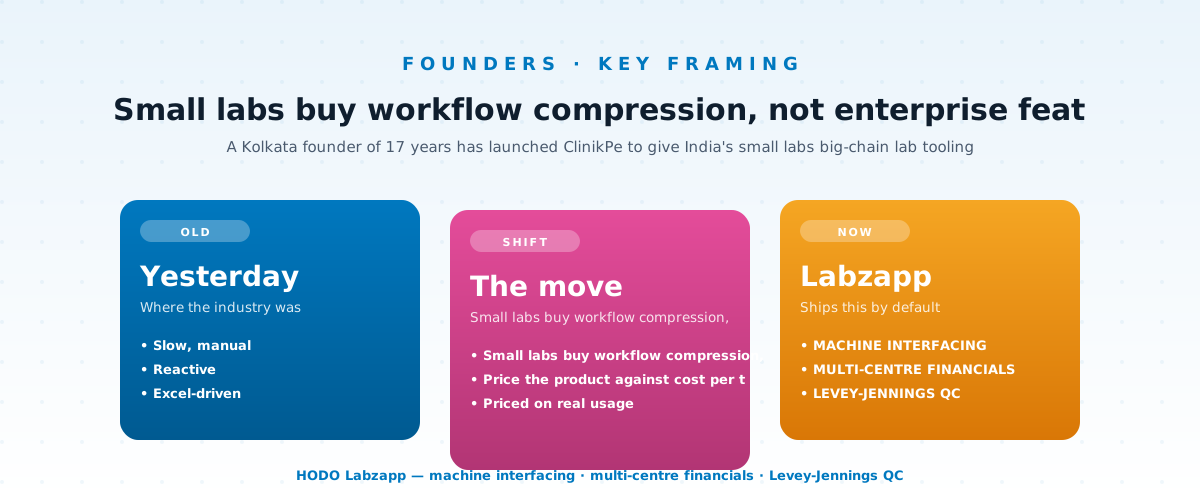
Small labs buy workflow compression, not enterprise feature lists.
"The tools big chains use" is a spec that needs editing
The pitch of bringing enterprise capability to small operators is attractive and partly a trap. Large chains need hub-and-spoke sample routing, inter-centre reconciliation, group-level quality dashboards and procurement controls across dozens of locations. A three-technician standalone lab needs something much more specific: registration to printed report in the fewest possible steps, the correct price applied without a lookup, and a result that reaches the patient without a phone call.
Ported enterprise feature lists are a common cause of churn in this segment. Each configuration screen that a large chain's IT team fills in once becomes, for a standalone lab, a blocker that stalls go-live for weeks. Builders who want this market should ship an opinionated default, a pre-loaded test master, standard reference ranges, one price list, and make configuration optional rather than prerequisite.
The same editing applies outside India. Standalone labs in Dubai, Sharjah, Doha and Manama have more spending capacity than their Indian counterparts, but they want different defaults: bilingual report layouts, insurance claim fields that match the local payer's format, and licensing-ready record retention. A product built with one price list and one language hardcoded will not cross the Gulf without a rewrite, and the rewrite always arrives at the worst possible time, mid-pilot, with a signed LOI waiting.
Unit economics decide whether a small-lab product survives
The hard constraint in this segment is not willingness to adopt, it is price ceiling. A single-centre lab billing a few lakh rupees a month will compare software spend against its cost per test, not against a per-seat benchmark. That arithmetic caps monthly subscription value at a level where a single human support ticket can erase the margin on a customer for a quarter.
Three implications follow for anyone building here. First, onboarding has to be self-serve or near it, because a sales engineer flying to a district town destroys the economics of a small contract. Second, support volume is a product metric and should be tracked per customer per month, with the top three ticket causes treated as release blockers. Third, the account value has to grow without a new sale, through additional collection centres, referral doctors or corporate tie-ups attached to the same tenant.
That last point is where small-lab products either compound or stall. A lab that signs on alone is a low-value account forever. A lab that adds four collection centres and a corporate contract over eighteen months triples its own throughput and the vendor's revenue with no new acquisition cost. Build for the growth path, and price the steps along it.
Accreditation and machine interfacing are the moat
The genuinely defensible layer in lab software is the unglamorous part. NABL assessment turns on traceability: internal quality control records with charted trends, calibration and maintenance logs, documented turnaround performance, and a clear chain from sample receipt to authorised report. Labs that have survived one assessment know exactly how much of that evidence they currently assemble by hand, and will pay to stop doing so.
Analyser interfacing is the other hard piece. Bidirectional connection to a biochemistry or haematology analyser is slow, device-specific engineering work with no demo value, and precisely because of that, it is the part competitors skip. A lab that still types results from an analyser printout into a reporting screen has not been digitised; it has been given a second data-entry job. Transcription is also where the error rate lives, and in a segment selling on reliability, that matters more than any dashboard.
For builders, the sequencing advice is uncomfortable but consistent: invest in interfacing and quality-control records before investing in analytics. The first two are what the buyer is inspected on. The third is what the buyer looks at once a quarter.
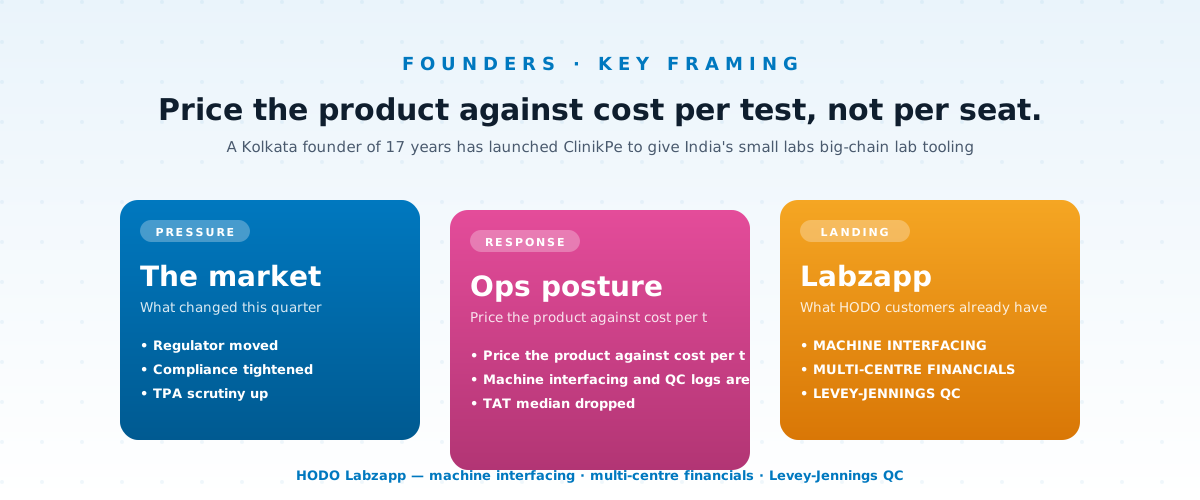
Price the product against cost per test, not per seat.
Distribution: sell to networks, not to single labs
One-lab-at-a-time selling rarely clears its own cost in this market. The efficient routes in are networks that already aggregate small labs: franchisee and collection-centre groups, referral-doctor clusters, corporate health-checkup contractors, and larger labs that outsource specialised tests to partners. A single signed network can bring twenty outlets with one commercial conversation.
Designing for that from the start has specific architectural consequences. Pricing must vary by partner, not just by test. Partner labs need to receive samples and return results without seeing patient identity. Referring doctors and corporate HR teams need their own read-only access rather than a staff member emailing PDFs. Each of these is straightforward to build into the data model early and painful to retrofit into a billing engine that assumed one tariff and one tenant. The same pattern holds in GCC markets, where small polyclinics and standalone labs frequently operate as feeder points for a larger diagnostics brand.
What this means for builders
The ClinikPe launch is a signal that the small-lab segment is being contested seriously, which raises the bar on what a new entrant has to cover at version one. HODO Labzapp is a useful reference architecture for the pieces that are expensive to discover late: machine interfacing with barcoded samples so results arrive without transcription, Levey-Jennings QC and TAT reporting that produce accreditation evidence as a by-product of daily operations rather than as a pre-assessment scramble, and franchisee management with differential pricing per partner so an account can expand from one centre to twenty without a schema change. Builders can treat those four as the floor, then compete on everything above them.