MarketsandMarkets has put the global Laboratory Information Management System market on track for $5.84 billion by 2031, in a report carried this week by Moomoo. For a four-centre pathology chain in Kochi or a thirty-collection-point network in Pune, the headline number matters less than what is driving it. Growth of that shape comes from labs that have outgrown analyser printouts, WhatsApp groups and a shared Excel register, and are now buying software to hold their daily throughput together.
What a $5.84 billion market number actually signals
Forecasts like this one aggregate pharmaceutical R&D labs, food and environmental testing, and clinical diagnostics into a single figure. The Indian diagnostic slice is small inside it. The useful signal is not the size but the composition of demand: most of the spend is replacement spend, not greenfield. Very few labs at scale are buying their first system. They are buying their second or third, after the first one stopped keeping pace with volume.
That pattern holds in India. NABL-accredited medical testing labs have multiplied over the last decade, and accreditation brings documentation load that manual registers cannot carry. At the same time, analyser density per lab has gone up, a mid-sized centre now runs a biochemistry analyser, a five-part haematology counter, an immunoassay platform and often a molecular bench. Each one produces results in its own format. The gap between what the machines generate and what the front office can bill and despatch is where labs lose hours every single day.
Read the market forecast that way and it becomes an operations statement rather than an investment thesis: labs are paying to close the gap between instrument output and report delivery, because that gap now costs more than the software does.
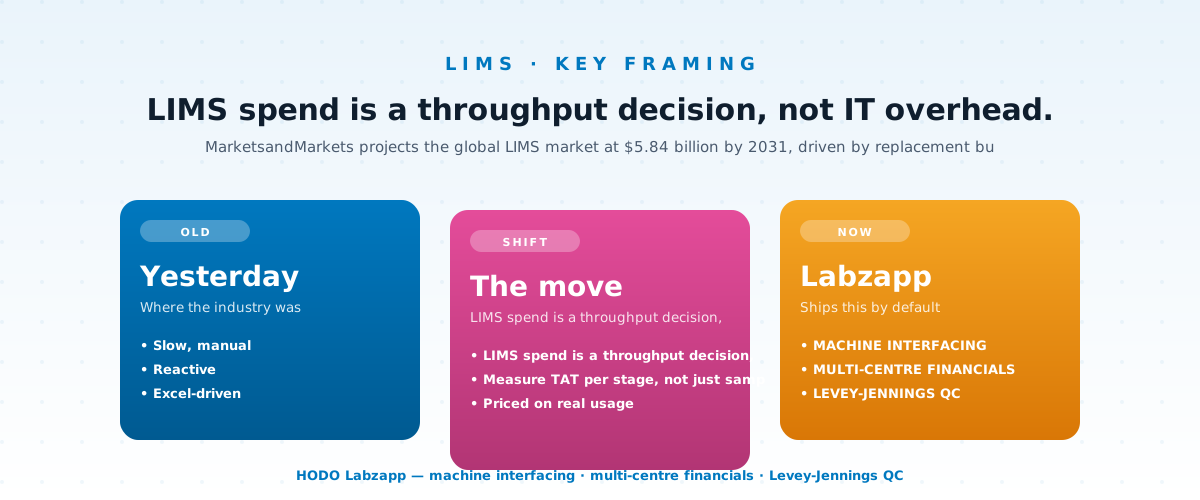
LIMS spend is a throughput decision, not IT overhead.
Why most Indian labs buy a LIMS two years late
The typical sequence is predictable. A single lab runs on a billing package with a results module bolted on. It works until the second centre opens. Then the owner adds a second instance of the same package, reconciles the two at month-end by hand, and tells himself it is temporary. By the fourth centre, nobody can answer basic questions without three phone calls: how many samples were rejected last week, which referral doctor is driving CBC volume, what the average turnaround was for outstation samples on Tuesdays.
The delay is rational in the short term and expensive in the long term. Switching a live lab is genuinely disruptive, test masters, reference ranges, rate cards per partner, historical results that clinicians still ask for. So the decision gets deferred until something forces it: an NABL surveillance audit, a hospital tie-up that demands result feeds, or a franchise partner who will not sign without a portal of his own.
The labs that come out of this well are the ones that treat the migration as a chance to standardise rather than lift and shift. One test master across all centres, not five. One barcode scheme. One rate-card structure with defined exceptions instead of ad hoc discounts entered at the counter. A chain that migrates its mess into new software has bought a faster version of the same problem.
Turnaround time is the only number that settles the argument
When a lab owner is comparing quotes, turnaround time is the metric that decides whether the spend pays back. The mistake is measuring it end to end only. Sample-in to report-out is a single average that hides everything useful. The stages that actually move are registration to phlebotomy, collection to receipt at the processing lab, receipt to run, run to validation, and validation to despatch.
Breaking TAT down by stage usually produces one uncomfortable finding. Most delay in a multi-centre chain is not analytical. It sits in transport windows and in the validation queue, where a pathologist is waiting on a batch that could have been released hours earlier. A lab that discovers this can fix it with routing and roster changes that cost nothing, and it can only discover it if the system timestamps every stage.
Per-stage TAT also changes how a chain sells. A corporate client or a referring hospital does not want an average; it wants a commitment on a specific panel by a specific hour. Chains that can quote that reliably win institutional volume, which is the volume that fills capacity in the lean part of the day. Chains that cannot end up competing on price per test, which is the worst position in Indian diagnostics right now.
Analyser interfacing decides how many centres you can add
Manual result entry is the quiet ceiling on a lab chain. A technologist reading values off an analyser screen and typing them into a form costs roughly two to four minutes per report, plus the transcription errors that get caught at validation and the ones that do not. At 300 samples a day, that is one full shift of labour spent retyping numbers a machine already calculated.
Bidirectional interfacing removes the retyping and, more importantly, removes the argument. The order goes to the analyser from the worklist, the result comes back against the same accession number, and nobody keys anything. Add barcoded samples at the point of collection and the mislabelling rework, the single most common cause of a repeat draw, drops to near zero.
This matters for expansion maths. The reason a chain can supervise eight centres with one quality manager instead of three is that the centres are not generating manual exceptions. Interfacing every analyser before opening the next centre is cheaper than opening the next centre and then discovering that the supervisory load scaled linearly with it. Quality control belongs in the same conversation: Levey-Jennings charts maintained inside the system, rather than in a separate workbook that gets updated the week before an audit, is what keeps accreditation from becoming a fire drill.
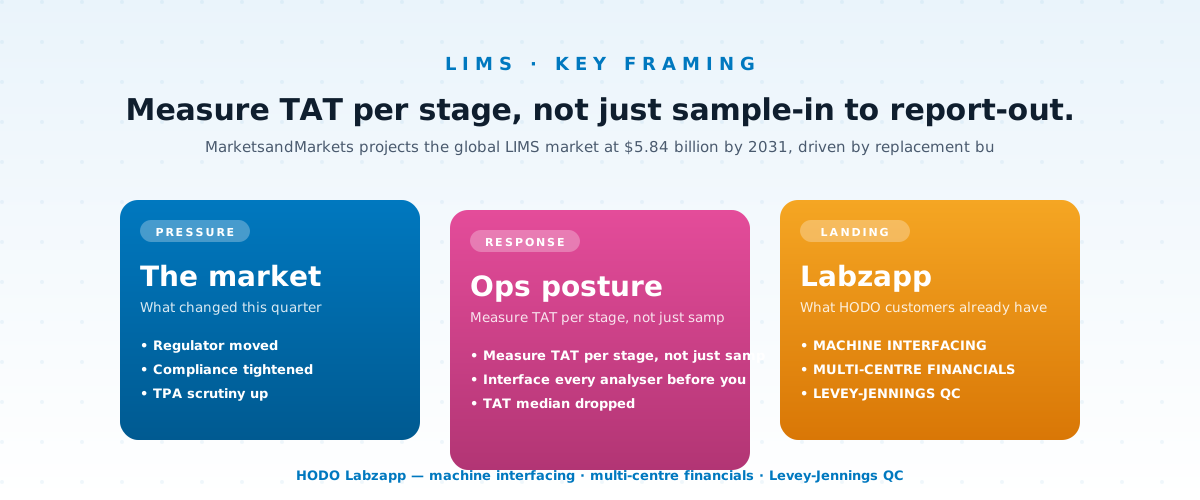
Measure TAT per stage, not just sample-in to report-out.
Partners, franchisees and the per-test P&L
Indian lab chains rarely grow through owned centres alone. They grow through collection centres run by franchise partners, referral doctors, corporate contracts and outsourced tests sent to larger reference labs. Each of these has a different rate, a different settlement cycle and a different reporting expectation, and each one quietly erodes margin when it is tracked outside the system.
Differential pricing per partner is the baseline requirement. Beyond it, the operationally decisive feature is giving partners their own login. A franchisee who can see his own registrations, pending reports and settlement statement stops calling the central office, and the central office stops losing an hour a day to those calls. The same logic applies to referring doctors, who mostly want one thing: their patients' reports without chasing anyone.
Outsourced tests deserve particular attention. Sending a sample to a partner lab without anonymised tracking means handing a competitor a named patient and a referral source. Chains that have been burnt by this once never make the mistake again. Cost per test, computed honestly, has to include courier, repeat rate, outsource fee and the reagent wastage from small batches, not just the reagent cost on the invoice.
What this means for HODO customers
The LIMS market growing towards $5.84 billion is a proxy for labs deciding that instrument output and report delivery can no longer be joined by hand. Labzapp is built around that join: machine interfacing with barcoded samples so results arrive against the right accession without transcription, TAT reporting broken down by stage so delays can be located rather than guessed at, and Levey-Jennings QC maintained continuously instead of assembled before an audit. Partner-lab integration with anonymised sample tracking, referral-doctor and corporate-partner portals, and franchisee management sit on top for chains adding outlets. The operational test is simple, a chain should be able to add its next collection centre without adding a supervisor.