The Economic Times reports that Temasek-backed Manipal Health Enterprises has filed its Draft Red Herring Prospectus with SEBI, seeking to raise Rs 8,000 crore via a fresh issue. For owners of 50-500 bed hospitals and multi-outlet chains, the filing is less about Manipal's own ambitions and more about the operational bar the sector is now being measured against.
A DRHP is a public benchmark of hospital operations
When a chain of Manipal's size files a DRHP, every mid-sized operator in the country gets a free reference document. The prospectus will lay out bed-level occupancy across each hospital, average revenue per occupied bed (ARPOB), payor mix between cash, insurance, TPA and government schemes, average length of stay, and out-patient to in-patient conversion. It will also disclose acquisitions since the last funding round and how quickly each one was integrated onto the group's back-end.
Those numbers become the sector's shorthand. Bankers, PE analysts and even TPAs quietly benchmark other chains against them. If a 200-bed chain in Tier-2 India is negotiating a debt raise or a strategic investment in FY26, the questions on the table will begin with, "How does your ARPOB compare to Manipal's disclosed range?" and "What is your integration timeline per new outlet?" Operators who cannot answer those questions from a single system, without a two-week reconciliation exercise, lose the room.
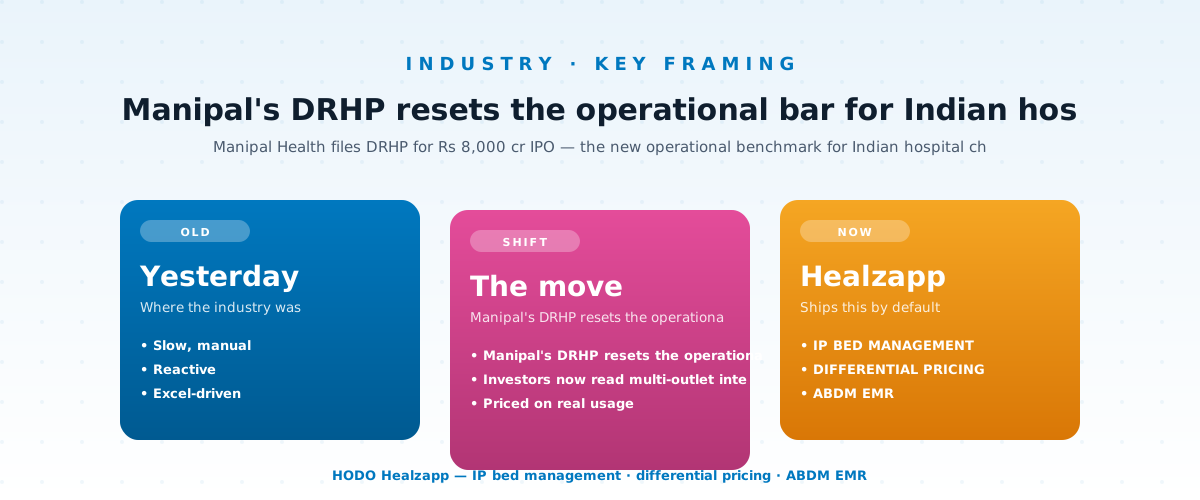
Manipal's DRHP resets the operational bar for Indian hospital chains.
Investors now grade multi-outlet integration speed
Manipal has grown through acquisition, Vikram Hospitals, Columbia Asia India, AMRI Hospitals. Each acquisition triggers a question that will now appear in the DRHP: how long did it take to bring the acquired unit onto the group HIS, EMR, pharmacy inventory, and billing? A chain that quotes six months per outlet reads differently from one that quotes six weeks.
For a five-outlet clinic chain in South India or an 80-bed group opening a fourth site, the mechanics are the same. If every new outlet requires a fresh HIS deployment, a distinct chart of accounts, a re-mapping of tests and packages, and a bespoke integration with the local imaging vendor, the group is carrying integration debt that will surface the moment any diligence team looks at the books. The strategic question is no longer which HIS should be bought for a new outlet; it is how quickly the existing HIS instance can stand up the new outlet.
Cashflow: TPAs, differential pricing, and Tally-level books
Hospital IPOs live and die on receivables. A DRHP forces disclosure of days-sales-outstanding by payor category, ageing of TPA and PMJAY dues, provisioning for disputed claims, and the split between rate-carded and negotiated pricing across corporate and insurance partners. Chains that quietly maintain three or four price lists, retail, corporate, TPA, referral, but reconcile only at the parent Tally book will find the gap between HIS revenue and Tally revenue impossible to explain.
The discipline required is boring but non-negotiable. Every partner needs its own tariff at the point of billing. Every claim needs an audit trail from OP registration to the final TPA remittance. Every discount needs an approver. And the whole thing needs to close into Tally at the end of every day, not at the end of the quarter when the auditor is on-site. Chains that get this right do not chase reconciliation; chains that get it wrong lose weeks of finance-team bandwidth every month.
ABDM readiness is now a diligence line item
Two years ago, ABDM integration was a compliance nice-to-have that most operators postponed. Post-2024, it has moved into due-diligence checklists. PMJAY empanelment, state-scheme reimbursements, ABHA-linked patient records, and NRCeS-listed HIS credentials are all read as signals of a hospital's readiness to operate in the government-financed segment that increasingly drives volume.
The DRHP will disclose the group's ABDM-integration status by facility. For any mid-sized chain preparing for external capital in FY26 or FY27, the equivalent question is coming: how many of the group's facilities are ABDM-compliant today, and what is the timeline for the rest? The right answer references an HIS that is ABDM-compliant out of the box, so the answer is measured in weeks per outlet, not quarters. The wrong answer is a vendor conversation that begins with, "We are exploring options."
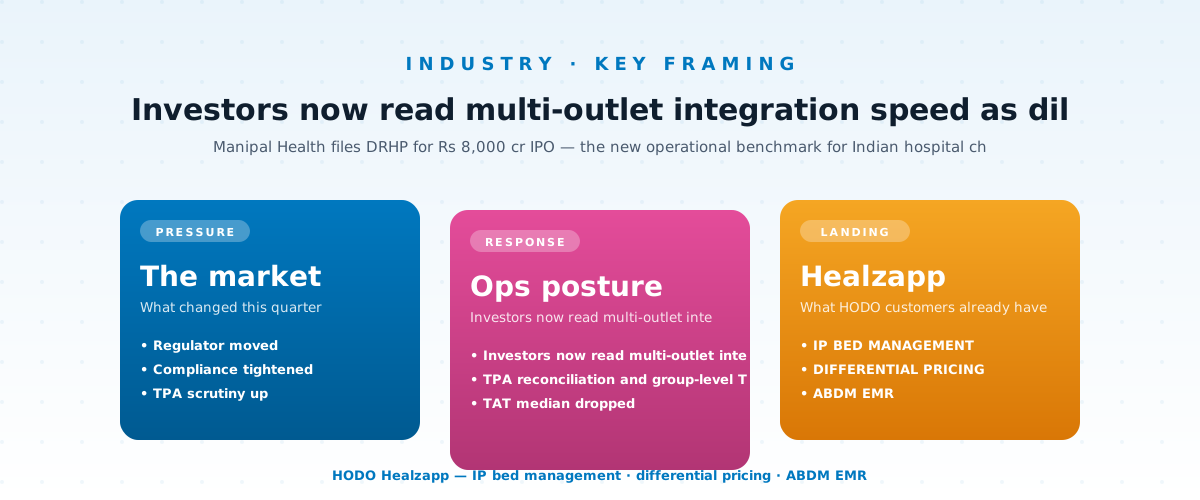
Investors now read multi-outlet integration speed as diligence.
The IPO-adjacent playbook for 50-500 bed operators
Most mid-sized hospitals will never file a DRHP. Many will, however, raise term debt, sell a minority stake to a strategic investor, or negotiate a franchise-led expansion. The operational discipline that survives investor scrutiny is the same regardseless of the exit path: unified HIS across outlets, per-partner differential pricing, daily Tally reconciliation, ABDM-compliant EMR, and a documented playbook for standing up a new centre in weeks rather than quarters.
The Manipal filing is a useful forcing function. Every mid-sized operator can pull the DRHP when it is published and use it as a self-assessment. Which of these disclosures could the group make today from its current systems? Which would require a six-week data-cleansing sprint? The gap between the two is the operational debt the group is carrying, and it is the same gap that shows up when a PE partner or a debt syndicator opens the data room.
What this means for HODO customers
The features that turn the above discipline into daily operations already sit inside HODO Healzapp. Group-level scale-up runs through Multi-outlet scale-up with one-click new-centre setup, which is what compresses the integration timeline per new hospital or clinic from months to weeks. Per-partner tariffs are handled through Differential pricing, so TPA, corporate and referral books never diverge from the retail line. And the daily close into the group's finance system runs through Tally integration, so the group ledger and the HIS revenue register do not have to be reconciled by hand. For chains that expect a diligence conversation in the next 18 months, these are not upgrades, they are the baseline the DRHP has now defined.