Upstox reports that Manipal Health Enterprises' IPO was subscribed 4.73 times by Day 3, with allotment due shortly and the country's largest hospital chain heading for a listed life. For owners and administrators watching from smaller chains, the more interesting question is not the price band, it is the operating discipline a listed hospital group is now committing to, and how much of that discipline lives inside the HIS.
The IPO is a signal, not a story about one chain
Manipal's 4.73x subscription on Day 3 confirms what pathology chains and diagnostic groups have already tested with public markets: institutional capital is willing to pay for scale in Indian healthcare, provided the numbers are consistent, auditable, and comparable across outlets. That final phrase is where most 50-500 bed operators stumble. A chain running eight outlets on five different registration books, three billing formats, and two ERP tenants cannot answer a due-diligence request in under a week, never mind quarter-close for the Street. The Manipal listing puts a fresh benchmark in front of every Tier-2 chain that wants growth capital: the HIS is now part of the balance sheet, and the way it captures data across outlets shapes both the equity story and the terms lenders will offer.
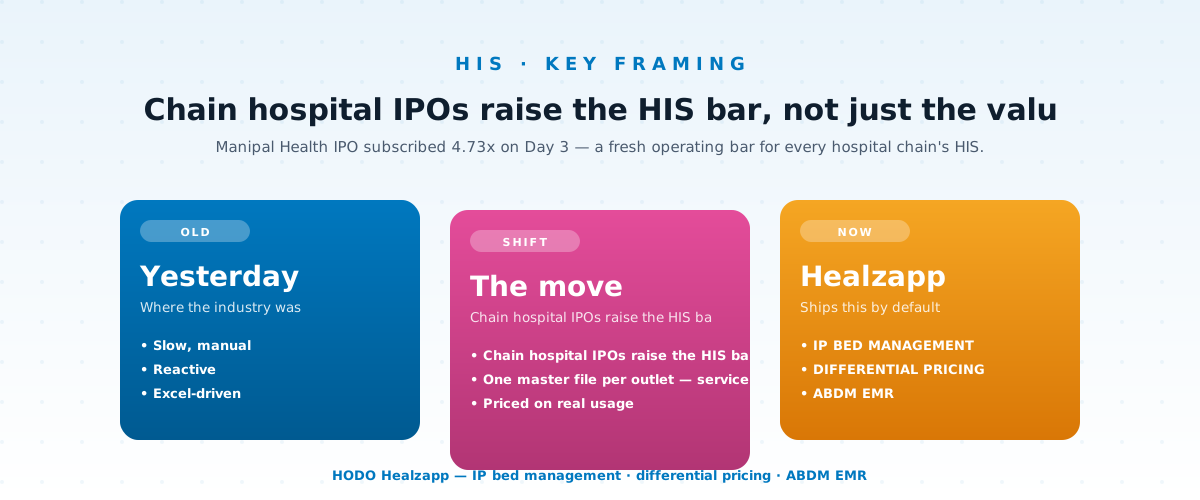
Chain hospital IPOs raise the HIS bar, not just the valuation.
What "IPO-grade" actually looks like at the ward level
Investors and rating agencies do not read HIS documentation. They read outputs. What matters is that every outlet reports the same OP volume definition, the same TAT clock on radiology and lab work, the same insurance-cashflow bucketing, and the same GST-mapped SKU on the pharmacy shelf. In practice that means the HIS must enforce a single master, for services, doctors, packages, TPA rate cards, and consumables, across every outlet, and it must do so without a two-week integration sprint every time a new centre opens. When a rural cath-lab centre and a metro flagship both roll up cleanly into the same MIS, the audit narrative writes itself. When they don't, the CFO spends weekends reconciling and the auditor writes a management-letter point. That is the operational gap the Manipal listing is quietly raising the bar on.
TPA cashflow and Tally: the finance stack that decides valuation
Two line-items dominate every hospital chain's diligence pack: insurance receivables ageing and pharmacy inventory turns. Both are functions of the HIS, not the finance team. If TPA claims are keyed in twice, once in billing, once in a spreadsheet, DSO drifts, denials compound, and revenue leakage runs quietly at 3-5% of the top line. If pharmacy stock does not flow into the accounting ledger the same night it is consumed, closing stock is always an estimate and every quarter-end carries a swing. A modern HIS closes both loops. Tally-linked billing, differential pricing per TPA and per corporate, and machine-interfaced billing at radiology and lab counters are the plumbing that makes MIS credible enough to be audited on a quarter-close cadence. Chains that get this right raise money at healthier multiples and negotiate working-capital lines on better terms.
Scaling to the next outlet without adding a project team
Most chains between 50 and 500 beds add outlets faster than they can hire IT project managers. The result is a familiar failure mode: each new centre goes live on a slightly different configuration, and by outlet number six no one can produseq a like-for-like OP conversion rate or a comparable cost-per-test. A one-click new-centre setup, where masters, price lists, TPA contracseq, doctor rosters, report templates, and role permissions replicate from a template outlet, is not a nice-to-have when the board is asking for a five-year growth plan. It is the difference between opening the next twelve outlets in nine months and stalling at outlet eight while corporate IT catches up. Manipal did not scale to 30+ hospitals by rebuilding its HIS every time. The smaller chains chasing IPO-adjacent multiples cannot afford to either.
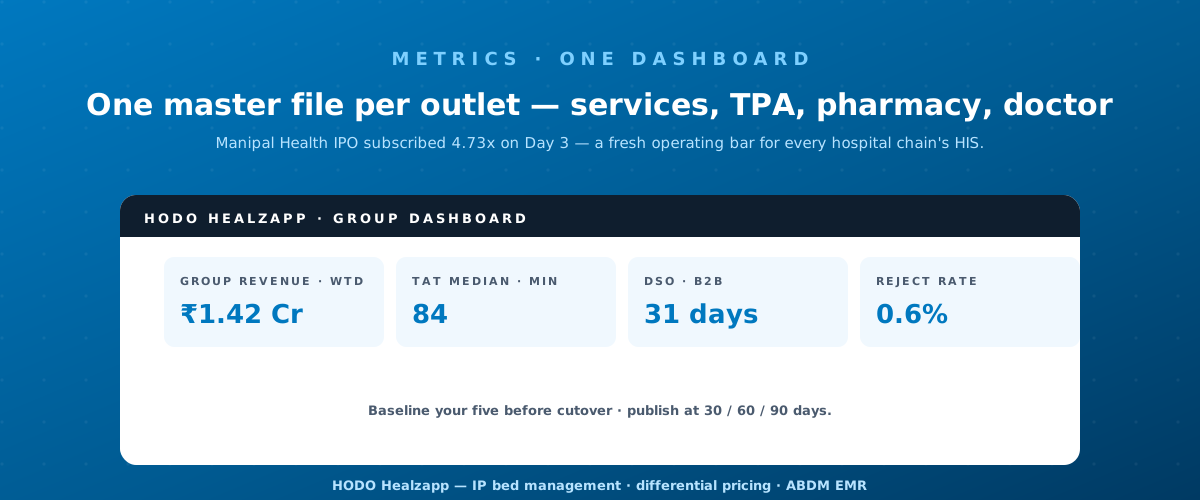
One master file per outlet, services, TPA, pharmacy, doctors.
What boards and auditors now expect from the HIS itself
Beyond the numbers, listed and pre-listed groups face a growing checklist: ABDM compliance for every EMR record, audit trails on billing edits, role-based access down to the nursing station, and evidence that patient data cannot walk out on a pen drive. A HIS that is ABDM-integrated by design, that timestamps every EMR change, and that segments logins by clinical role (nurse, resident, consultant, cashier, pharmacy) is not just a compliance win, it materially shortens the diligence Q&A. Boards also increasingly ask for uptime SLAs and disaster-recovery evidence; a cloud-hosted HIS with published RPO/RTO numbers answers that question in one paragraph rather than three meetings. These are not features that show up in a demo checklist. They show up in a term sheet, and in the covenants that follow.
What this means for HODO customers
The Manipal listing is a useful moment for every hospital owner to audit the HIS against IPO-grade operating expectations, even if a listing is five years away. Three HODO Healzapp capabilities matter most in this context. First, Multi-outlet scale-up with one-click new-centre setup collapses the cost of adding the ninth, tenth, and twentieth outlet, the point at which most chains lose configuration discipline and start reporting apples-to-oranges numbers. Second, Tally integration combined with Differential pricing per TPA and corporate closes the receivables-and-inventory loop that dominates diligence packs and quarterly closes. Third, the ABDM-compliant EMR with role-tailored logins across Nursing Station, OT, and Pharmacy gives auditors and boards the audit-trail evidence they now expect by default. None of this makes a hospital IPO-ready on its own, but a HIS that already behaves this way removes an entire category of friction from the growth conversation and keeps the CFO's weekends free.