Manipal Hospitals has signed a Business Transfer Agreement to acquire Kinder Women's Hospital in Doddanekundi, Whitefield, Bengaluru, for ₹130 crore, according to ETHealthworld. The deal adds around 100 beds to Manipal's Karnataka footprint and continues a run of bolt-on acquisitions the group has used to build density in metros. For any hospital operator watching the private equity money flow into Indian healthcare, the interesting question is not the sticker price, it is what happens in the first 90 days after the papers are signed.
The ₹130 crore Bengaluru buy in context
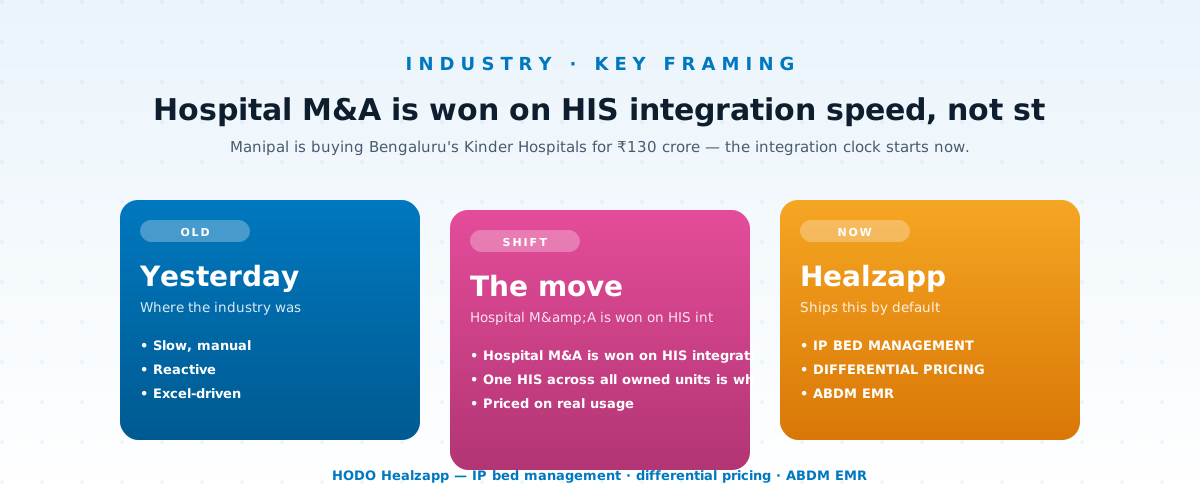
Kinder's Doddanekundi facility is a women's and paediatric unit in the Whitefield tech corridor, a catchment Manipal already serves through Manipal Hospitals Whitefield and Sarjapur Road. On paper the acquisition looks like a routine tuck-in: buy the beds, buy the walk-in patients, plug the specialty into an existing referral engine. The BTA structure, a business transfer rather than a share purchase, is telling. It suggests Manipal wants the licence, the doctors, the equipment and the patient files, but is ring-fencing the acquired entity's legacy liabilities. That leaves the balance sheet clean, but the operational lift is the same as any other integration: two hospitals, one brand, one operational spine, one patient identity. In a market where Manipal, Aster, Max, Fortis and Apollo are all buying beds rather than building them, the winners are the groups that can absorb an acquired unit into their existing OP, IP, billing and TPA workflow inside a quarter, not the ones that leave the acquired site running on its old software for eighteen months while a phased migration drifts.Hospital M&A is won on HIS integration speed, not sticker price.
Why HIS integration decides deal economics
The deal math on a hospital acquisition assumes revenue synergies, cross-referrals, shared consultants, shared diagnostic infrastructure, and cost synergies from consolidated back-office. Both depend on the acquiring group being able to see the acquired unit's patient, billing and TPA data from Day 1 in the same shape as its own. If the acquired hospital is on a different HIS, that visibility does not exist. Finance closes its books later. TPA claims sit in two queues. The same patient exists as two MRNs. Referral to the parent group's tertiary centre requires a phone call and a re-registration. Every one of these frictions is a real rupee cost, and they compound while integration drags. The groups running the most acquisitions have quietly standardised on a single HIS across all owned units precisely because the alternative is a stack of five to eight different systems, each with its own vendor contract, its own downtime window and its own reporting export. A common HIS is not a nice-to-have for an acquisitive group, it is the operating layer that lets the M&A thesis actually pay out.
The multi-outlet operator's checklist
An operator sitting on 5-50 hospital outlets who is planning the next acquisition should have a short, blunt integration checklist ready before signing an LOI. First: how long does it take to stand up the acquired unit on the group HIS, days, weeks or months? Second: can the acquired unit's historical patient records migrate in as searchable EMR, or do they sit in a separate archive instance that nobody opens? Third: can the acquired unit's price list be loaded as a separate rate card without breaking the group's central master, because Whitefield rates are not Kozhikode rates, and forcing one price list on both destroys volume. Fourth: can the acquired unit's TPAs, corporate tie-ups and referral doctors be brought over as first-class entities, or do they collapse into free-text fields? Fifth: what is the ABDM story, is the acquired unit already registered on the ABDM Health Facility Registry, and can its patient IDs be reconciled with the group's existing ABHA-linked records? If the answer to any of these is “we'll figure it out later”, the acquisition will underperform its model.
Pricing, TPA and cashflow after Day 1
The first month post-acquisition is where cashflow gets ugly. TPA empanelment does not transfer automatically, insurers need to re-verify the change of ownership, and cashless claims can freeze in the gap. Corporate contracts have change-of-control clauses. Referring doctors have to be re-onboarded to the group's portal. The acquiring group needs a HIS that can carry differential pricing per corporate, per TPA and per referral partner without a manual override on every bill, otherwise the front office runs spreadsheets and every discount is a leakage risk. It also needs a Tally integration that reconciles the acquired unit's ledger into the group's books without a parallel accounting exercise. The operators who lose money in the integration window usually lose it here: not on clinical care, but on billing hygiene, TPA float and pricing discipline while the two systems are being reconciled.
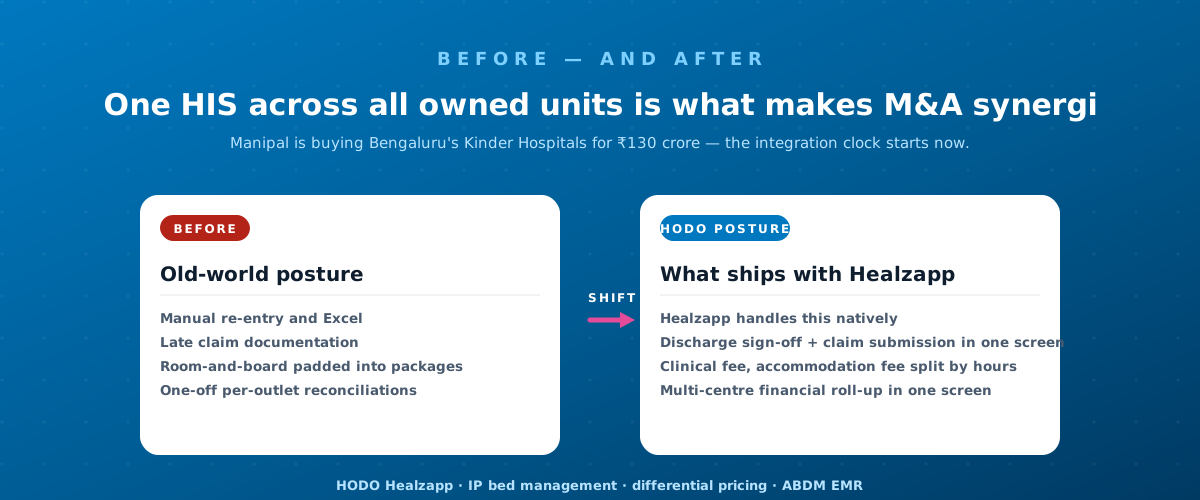
One HIS across all owned units is what makes M&A synergies real.
ABDM, data portability and the compliance clock
The regulatory floor has moved. Any acquired hospital now has to be on the ABDM Health Facility Registry, its consultants on the Healthcare Professional Registry, and its EMR issuing ABHA-linked records. If the acquired unit's HIS is not ABDM-compliant, the acquiring group inherits a compliance debt that has to be cleared before the unit can participate in Ayushman Bharat cashless flows or state schemes. Data portability under the DPDP Act adds another layer, the acquired unit's patient consents need to survive the change of controller, and audit trails need to remain intact. A group that has already standardised on an ABDM-compliant HIS clears this in the migration itself. A group that hasn't now has two compliance projects running in parallel while trying to hit its year-one synergy targets.
What this means for HODO customers
For hospital groups running HODO Healzapp as their operating spine, the Manipal-Kinder template is the exact use case the product is built around. Multi-outlet scale-up with one-click new-centre setup means an acquired unit can be provisioned as a new node on the existing HIS in days rather than months, with the group's price masters, TPA panels and referral network already available. Differential pricing lets Whitefield-rate procedures coexist with Trivandrum-rate procedures on the same platform without a nightly reconciliation. And the ABDM-compliant EMR means the acquired unit inherits registry compliance from Day 1 rather than as a follow-on project. For diagnostic and pathology chains running the same M&A play on smaller lab acquisitions, HODO Labzapp carries the equivalent multi-centre financial and franchisee management model.