Manipal Hospitals' buyout of Sahyadri Hospitals has been called a new benchmark in Indian healthcare M&A by eHealth Magazine, and the deal size matters less than the pattern it confirms. Chains are hunting for regional density, and the ~100-bed hospital in a Tier-2 or Tier-3 town has become both a target and a competitor overnight. For promoters running one to three units, the transaction is a prompt to look inward, at systems, cashflow visibility, and ABDM readiness, before the next call from a buyer or a bank.
The consolidation signal is louder than the deal size
The Manipal-Sahyadri transaction is the latest in a run of consolidations that includes Aster's western India moves, KIMSHEALTH's expansion outside Kerala, and PE-backed platforms rolling up single-city groups into multi-state networks. Every one of these deals shares a common playbook: buy clinical capacity that is already in place, then re-platform the back-office in year one.
For a promoter running a 60-120 bed hospital, this changes two things at once. First, the competitive set is no longer the hospital across the road, it is a chain that can price surgical packages against national vendor deals and move a specialist between two cities in the same week. Second, the acquirer's diligence bar has moved up. Buyers now examine bed occupancy trends, OP throughput per consultant, TPA and PMJAY receivable ageing, and the state of the HIS. A hospital with clean, queryable data commands a materially different multiple from one whose numbers live in spreadsheets.
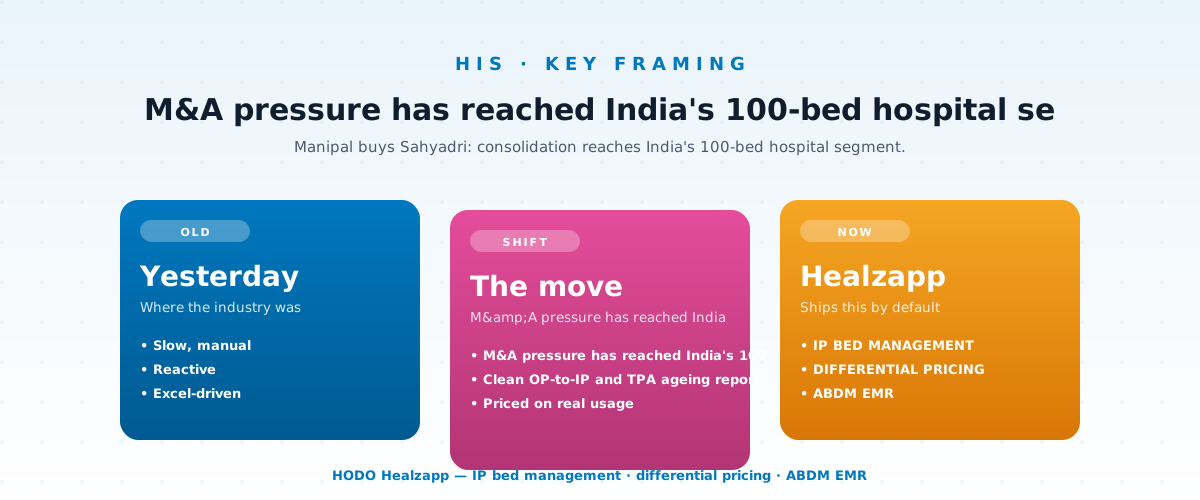
M&A pressure has reached India's 100-bed hospital segment.
Why mid-size hospitals feel the squeeze first
The 100-bed hospital is caught between two forces. On the top line, insurance and PMJAY tariffs compress margins on the exact procedures, cardiology, orthopaedics, general surgery, dialysis, that filled the beds through the last decade. On the cost line, consultant retention, biomedical AMC, and pharmacy inventory all trend up. The two escape hatches are throughput and multi-unit scale, and both need software that was probably not built for either.
Most ~100-bed HIS deployments in India are 8-15 year old installations from the first wave of hospital software. They handle registration and billing well enough, but they were not designed for teleconsultation load, WhatsApp report delivery, ABDM-compliant EMR, or a Tally handoff that closes books by the 5th of the month. When a chain acquires such a hospital, the first quarter after signing is spent ripping out that stack. That integration cost is quietly priced into the deal.
The HIS problem inside every acquisition
Diligence teams look for three specific things in the hospital system. One, can it produce a clean OP-to-IP conversion report by consultant and by month, without a spreadsheet in between. Two, can it show the TPA claim pipeline, submitted, queried, approved, paid, with ageing, so working capital tied up in claims is visible. Three, is the EMR structured enough that ABDM linkage is a configuration switch, not a project.
Hospitals that fail these three tests are still bought, but they are bought at a discount because the acquirer knows it will spend 12-18 months and a seven-figure integration budget bringing the unit onto the group's platform. The promoter who invests in a modern HIS ahead of a possible sale is essentially prepaying that integration cost, but capturing the multiple uplift for themselves.
Beyond diligence, the same system decides whether a second or third unit can be opened without doubling the head office. Shared master data, one-click new-centre setup, and consolidated financials are no longer nice-to-haves; they are the difference between a group that adds a unit in a quarter and one that takes a year.
Multi-outlet finance: TPA, PMJAY and cashflow across units
The single biggest working-capital drain in Indian mid-size hospitals is TPA and PMJAY receivable ageing. Chains solve this centrally, one claims team, one escalation matrix, one dashboard across units. A single-unit hospital that runs claims out of the front-office cannot match that on cashflow, no matter how good the tariff.
The fix is not more people. It is a billing and claims workflow that captures pre-authorisation numbers, tariff mismatches, and rejection reasons at the point of billing, not two weeks later when the cheque does not arrive. Add differential pricing per TPA and per corporate, Tally integration for daily posting, and a multi-outlet consolidation view, and the hospital is running finance the way a chain would, before the chain arrives.
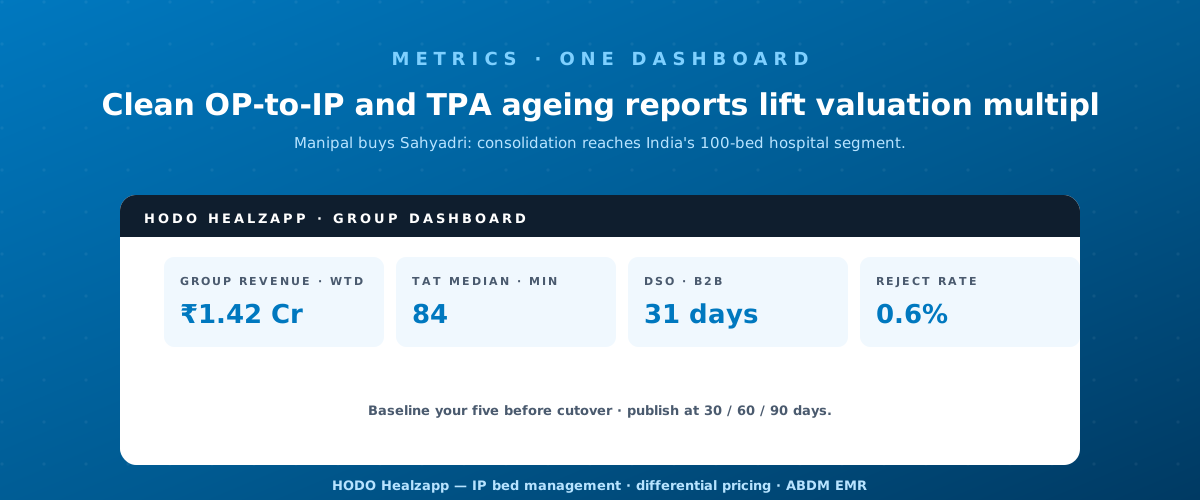
Clean OP-to-IP and TPA ageing reports lift valuation multiples.
ABDM, NABH and the valuation floor
ABDM linkage and NABH accreditation are moving from marketing badges to valuation inputs. Empanelment with certain state schemes now requires ABDM. Corporate tie-ups increasingly ask for NABH-lite or full NABH. Buyers value both because they reduce integration risk when the hospital joins a chain that is already ABDM-native and NABH-mapped.
The practical read: an ABDM-compliant EMR with the ABHA linkage flow built in, and audit-ready NABH documentation coming out of the same system, moves the hospital into a different valuation bracket. Delaying that work does not save money, it defers a cost the buyer will negotiate back into the purchase price.
What this means for HODO customers
For ~100-bed hospitals watching the Manipal-Sahyadri deal, the operational to-do list is short and it starts with the systems layer. HODO Healzapp is built around three features that map directly to what buyers, lenders, and rating agencies now examine: ABDM-compliant EMR so that linkage is a switch rather than a project, Multi-outlet scale-up with one-click new-centre setup so that adding a unit does not add a head office, and Tally integration paired with differential pricing so that TPA, PMJAY, and corporate cashflow are visible daily rather than at month-end. Hospitals that get these three right raise their own valuation floor and keep the option to stay independent, partner, or exit on their own terms.