Medi Assist has rolled out AI-powered platforms to speed up cashless health insurance claim processing, according to a report in Indian Pharma Post. The pitch is faster pre-authorisation, cleaner adjudication, and shorter turnaround on discharge approvals, all pointed at the same pain that keeps hospital CFOs awake: cash locked in claims-in-progress. The interesting question for a ~100-bed hospital is not what Medi Assist can do on its side, but what your HIS has to hand over for the speed-up to actually land in your bank account.
What Medi Assist actually announced
The Indian Pharma Post write-up describes a set of AI layers sitting on Medi Assist's existing TPA workflow, document intake, medical-necessity checks, and adjudication triggers that the insurer or the TPA operates. The direction of travel is clear: the industry is trying to compress claim cycle time from days to hours. For a ~100-bed hospital in Kochi, Nashik or Coimbatore that runs 60-70% bed occupancy on TPA and PMJAY patients, that promise is meaningful. Faster clearance means less working capital tied up, fewer disputed line-items, and shorter LOS-vs-approved-LOS gaps at discharge. But, and this is the part the announcement quietly assumes, the AI on the TPA side is only as fast as the data it receives from the hospital side. A missing discharge summary field, a mismatched ICD code, a scanned pre-auth form at 90 DPI, and the AI stalls exactly where a human queue would. Medi Assist has done its half of the job. The other half sits inside your billing counter, your consultant chambers and your HIS.
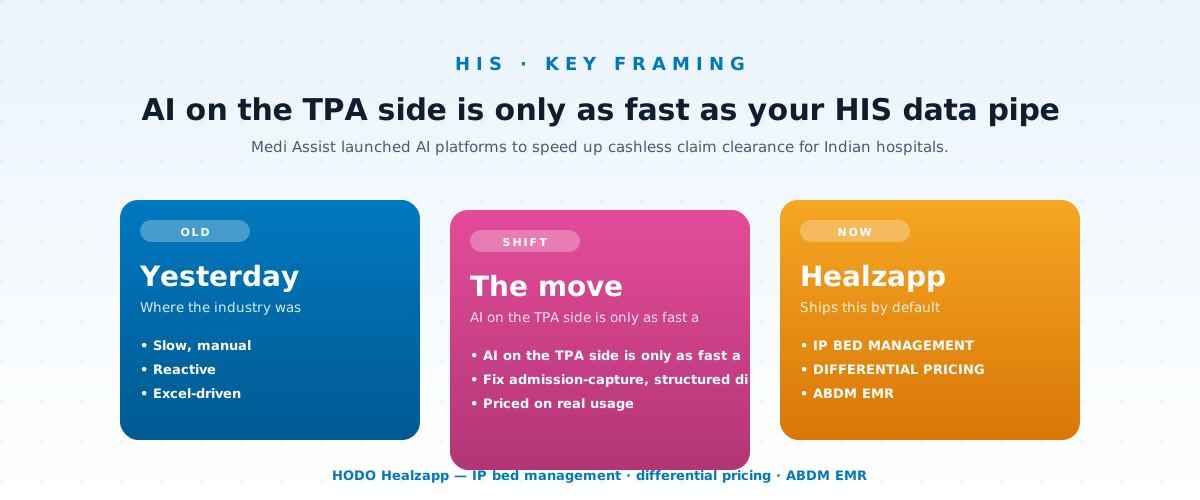
AI on the TPA side is only as fast as your HIS data pipeline.
The bottleneck is inside the hospital, not the TPA
Most of the TPA-cycle delay a 100-bed hospital sees is generated inside its own four walls. Pre-auth forms typed by the front office get sent hours after admission. Discharge summaries wait on the consultant's dictation. Bill breakups don't match the treatment sheet. Uploads to the TPA portal are done manually, one PDF at a time, from a shared desktop at the billing counter. When Medi Assist or Star or Bajaj rolls out an AI adjudicator that can clear a clean claim in twenty minutes, the hospitals that will see that speed-up are the ones whose HIS can hand over structured data, not the ones whose staff are still scanning a paper file at 6pm. The AI-side speed-up is real, but capturing it requires the hospital-side data pipeline to already be tight. Otherwise the AI just waits, quietly, for the file to arrive, and the hospital's DSO stays exactly where it was last quarter.
The data AI claim engines actually need from you
Concretely, a ~100-bed hospital that wants to ride the AI-claims wave has to fix five things at source. One, admission-time capture of insurer, policy and TPA card details, validated against the master, not re-typed from a photocopy. Two, pre-auth generated from the same clinical note the doctor wrote, not re-keyed by a clerk two hours later. Three, discharge summary structured enough that ICD-10 codes and procedure codes are already tagged when it leaves the ward. Four, bill line-items reconciled against the pharmacy, OT and investigation modules so the TPA's line-checker doesn't kick it back on a ₹340 mismatch. Five, automated upload to the TPA portal or API, with a timestamped audit trail per document. If any of those five happen in Excel or on paper, the AI on the insurer side saves the hospital nothing. This is not really a claims problem. It is an HIS integration problem, and it is exactly why hospitals stuck on 15-year-old billing software feel the TPA cash-cycle as a permanent tax on the P&L.
Cashflow math on a 100-bed floor
Consider the arithmetic. A 100-bed hospital running 65% occupancy, average LOS four days, average bill ₹45,000, with 55% of patients on some cashless product, carries roughly ₹6-8 crore of TPA receivables at any given time. Every day of average days-sales-outstanding on that book is worth ₹18-22 lakh in working capital. If AI-side adjudication trims claim cycle time from 22 days to 12, the hospital does not just get faster payouts, it releases ₹1.8-2.2 crore of trapped cash that can fund a new CT tube, a second cath-lab shift, or an OP outreach clinic. But again: that release only happens if the hospital's own submission is clean the first time. Rejection-and-resubmit loops eat the AI's speed advantage and leave the CFO exactly where they started. The competitive gap between Indian ~100-bed hospitals over the next 24 months will be measured in claim-cycle days, not in bed count or brochure specialities.
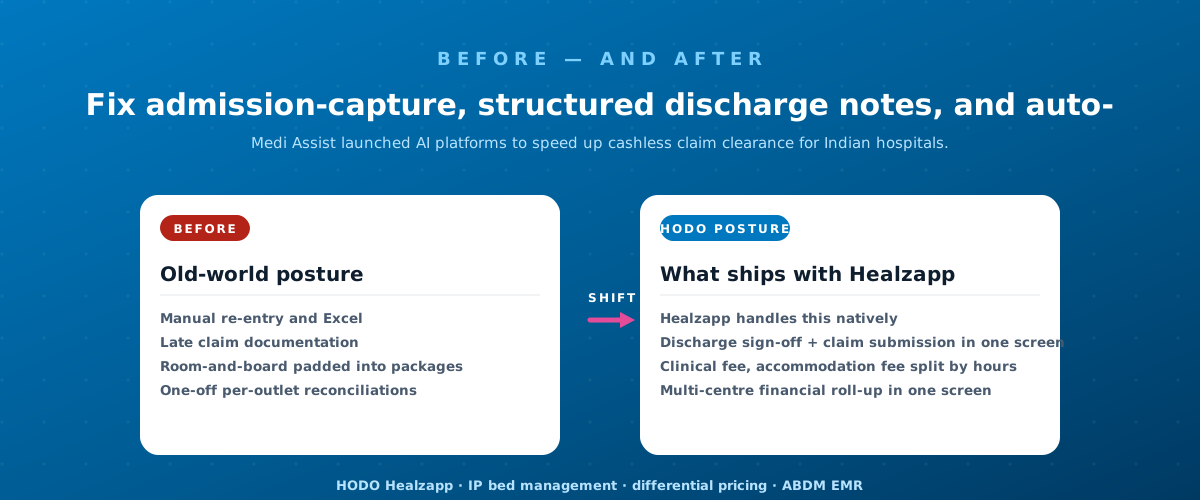
Fix admission-capture, structured discharge notes, and auto-uploads.
Lab chains and multi-outlet groups feel the same squeeze
For Indian diagnostic and lab chains, the Labzapp buyer profile, the pressure is arriving through a different door but the mechanism is identical. B2B corporate contracts, TPA panel work and empanelled health-check packages now flow through insurer or aggregator platforms that expect structured line-item data, HSN codes and rate-card compliance per centre. A chain running eight or twenty collection centres cannot survive an AI-driven audit on the payer side using branch-level Excel reconciliations. Differential pricing per corporate, per TPA, per referring doctor has to live inside the LIMS itself, not in a shared drive. Machine-interfaced results, barcoded samples and TAT logs have to be defensible when the payer's AI asks why a test was billed on a particular day. The lab chains that will win the next round of corporate and TPA panels are the ones whose LIMS already carries this audit surface. The others will keep losing rate negotiations by 3-5% every renewal cycle without ever quite knowing why.
What this means for HODO customers
The Medi Assist announcement is a useful forcing function. It is a signal that TPA-side automation is arriving faster than most 100-bed hospitals and lab chains have planned for, and that the hospitals with clean, structured data at source will capture the working-capital release while others watch it go past. Inside Healzapp, the modules that carry this weight are Billing with TPA and corporate workflows tied to the same patient master, EMR where the discharge summary and ICD tagging get generated once and reused for pre-auth and claim, and Machine Interfacing plus pharmacy and OT integration so bill line-items reconcile automatically against clinical activity, with the ABDM-compliant EMR layer keeping records addressable across insurers and network hospitals. For multi-outlet lab groups, Labzapp covers the same ground with barcoded samples, per-partner differential pricing and TAT reporting that stands up to payer-side scrutiny. Hospitals and lab chains that fix the source-data pipeline in this quarter will feel the AI-claims tailwind directly in the next quarter's DSO number.