Fast Company Middle East reports that the UAE is becoming a test bed for medical AI, and that the real test begins after the pilot ends. For diagnostic and pathology labs across the GCC, that gap is operational rather than scientific. A model that performs well on a curated dataset still has to survive a Tuesday morning backlog, four analysers, a locum pathologist, and a referring clinic that expects the report before noon.
The pilot environment is not the lab floor
Most medical AI pilots run under conditions no working lab ever sees. Cases are selected retrospectively, images and result files are cleaned before they reach the model, one motivated consultant reviews every output, and nothing is on a turnaround clock. Under those conditions almost any reasonable tool looks good, because the hard parts of lab operations have been removed from the test.
Production inverts all of it. Samples arrive in bursts tied to morning collection rounds and corporate camp schedules. Some tubes are mislabelled. Some analysers are mid-calibration. The reviewing doctor is covering two branches and has eleven minutes per batch, not forty. The question that decides whether a pilot becomes a deployment is not "was the model accurate?" but "did the result reach a verified report, inside TAT, without adding a manual step?"
That is why labs in Dubai, Abu Dhabi, Doha and Manama that have scaled AI past the trial stage tend to have one thing in common: the surrounding workflow was already digital and measured before the model arrived. The AI slotted into an existing path. Labs that still move results on paper worksheets and WhatsApp screenshots end up building the workflow and validating the model at the same time, and usually abandon one of the two.
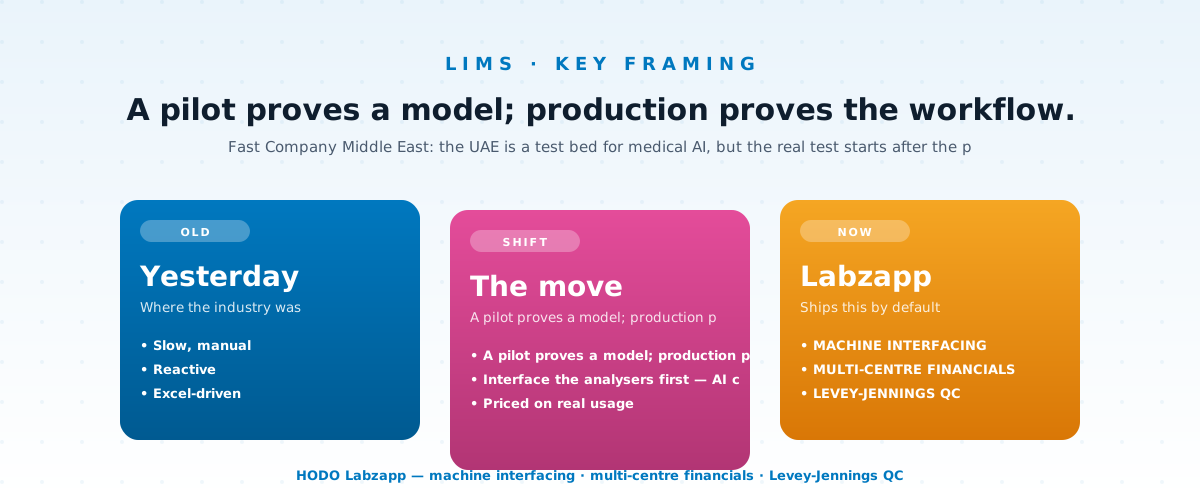
A pilot proves a model; production proves the workflow.
Structured results are the precondition, not the upgrade
The single most common reason a promising lab AI pilot stalls is that the data it needs is not machine-readable in daily operations. A haematology analyser prints to a thermal roll. A biochemistry unit writes to a local folder nobody reads. A technician retypes values into a billing screen. In that setup, any AI layer, flagging logic, delta checks, draft reporting, scan triage, becomes a second data-entry job rather than a saving.
Direct analyser integration changes the arithmetic. When instruments post results straight into the LIMS against a barcoded sample, the AI has a clean, timestamped, patient-linked record to work on, and the lab has an audit trail of what the machine said versus what was reported. Barcoding also removes the failure mode that destroys trust fastest in an AI deployment: a correct output attached to the wrong patient.
Labs planning an AI purchase in 2026 should sequence it plainly. Interface the analysers. Barcode the samples from collection or phlebotomy onward. Get reports leaving the system through automated delivery rather than a counter handover. Only then evaluate the model. Done in that order, the pilot tests the AI. Done in the other order, the pilot tests the lab's data hygiene, fails, and the AI takes the blame.
Baseline the numbers the pilot claims to improve
Very few lab AI pilots in the region are evaluated against a number that existed beforehand. Vendors demonstrate accuracy; labs need throughput, turnaround and cost per test. Without a pre-pilot baseline, the post-pilot review becomes a conversation about impressions, and impressions rarely survive a procurement committee.
Three baselines are usually enough. First, TAT by test group and by branch, measured from sample receipt to report release, with the current breach rate, not the average, which hides the tail that referring doctors actually complain about. Second, cost per test including reagent, consumable, labour and re-run rates, because an AI tool that cuts re-runs is worth more than one that shaves two minutes of reporting time. Third, review load per reporting doctor per day, which is what determines whether a tool genuinely creates capacity or simply relocates the bottleneck.
These numbers also discipline the vendor conversation. A tool pitched as reducing reporting time can be tested against the review-load figure in four weeks. A tool pitched as improving quality can be tested against re-run and amendment rates. Multi-centre labs should run the comparison branch by branch, since a pilot at the flagship centre says little about the franchise outlet with one technician and an older analyser.
Accountability does not transfer to the model
Across the UAE and the wider GCC, licensing and accreditation frameworks, MOHAP and emirate-level health authority requirements, ISO 15189-based accreditation schemes, all rest on the same principle: a named, qualified person is accountable for a released result. An AI assist does not change that, and labs that treat a model output as a signed report create a compliance problem long before they create a clinical one.
Practically, this means every AI-assisted result needs a recorded human verification step, a stored version of what the model proposed, and a log of any override. That record is what an inspector, an insurer querying a claim, or a clinician disputing a value will ask for. It is also the only way a lab can later prove the tool earned its place, by comparing proposed outputs to verified ones over several thousand samples rather than the fifty from the pilot.
Routine quality control stays separate from all of this and remains non-negotiable. Control runs, shift-wise trend review and documented corrective action on an out-of-control analyser are the mechanism that keeps the input to any AI tool trustworthy. A drifting instrument feeding a well-trained model produces confident, consistent, wrong answers, the most expensive failure a lab can ship.
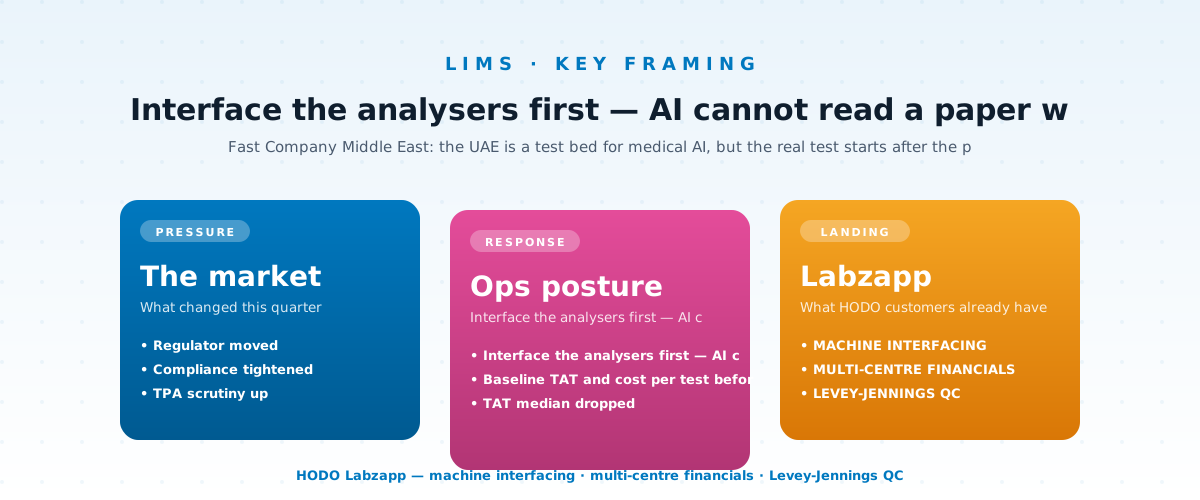
Interface the analysers first, AI cannot read a paper worksheet.
Scaling past the first branch is where pilots die
A single-site pilot and a network deployment are different projects. A GCC lab chain running collection centres across emirates, a central processing lab, partner labs for specialised assays and a franchise tier faces questions the pilot never raised. Which branches get the tool? Who trains relief staff? How are results from a partner lab handled when the referring clinic sees one brand on the report?
Partner and franchise relationships add their own constraints. Outsourced assays require sample tracking that does not expose patient identity to the partner. Franchise outlets need their own financial view without access to group-level pricing. Corporate clients and referring doctors increasingly expect portal access to their own cases rather than emailed PDFs. None of these are AI problems, but all of them determine whether an AI investment reaches enough volume to matter. A tool deployed at one of nine centres rarely pays back.
The practical sequence for 2026: pick the two highest-volume test groups, deploy across every branch running them, measure against the pre-pilot baseline for one quarter, then decide. Breadth at low ambition beats depth at one site.
What this means for HODO customers
Labzapp is built around the operational substrate this kind of deployment assumes. Machine interfacing pulls analyser output directly into the record against barcoded samples, so result data is structured before any AI layer is evaluated. TAT reporting gives the pre-pilot baseline and the branch-level comparison a procurement review needs, alongside multi-centre financials for cost per test. Levey-Jennings QC keeps instrument drift visible, and partner-lab integration with anonymised sample tracking plus franchisee management handle the network questions that decide whether a pilot ever reaches scale. Report delivery through automated SMS, WhatsApp and email closes the loop at the patient end.