Indian Startup News reports that Medulance has raised Rs 24 crore to expand its tech-enabled ambulance network and pre-hospital emergency services. For the 100-bed hospitals that actually receive those ambulances, the news is less about the funding round and more about a hard question, is the receiving end ready for what a networked pre-hospital layer is about to push through the ER door?
Why this round matters beyond Medulance
Pre-hospital emergency in India has been under-capitalised for a long time. A Rs 24 crore round in the space signals that investors now believe there is a scalable operating model between the 108 public system and the fragmented private ambulance market. That matters for hospitals for one practical reason: the volume, tempo, and data richness of arriving patients is about to change. Ambulance operators that used to hand over a paper slip are now handing over vitals, ETA, tentative diagnosis, and sometimes even a live video feed. The hospital's ER team has to receive that stream, act on it, and route the patient, bed, OT, ICU, or discharge, without the usual 20-minute paperwork gap. For district-level 100-bed hospitals in Kerala, Tamil Nadu, Maharashtra and Gujarat, this is not a hypothetical. The next 18 months will decide which hospitals become preferred receiving partners in these networks and which ones lose the volume to a peer three kilometres away.
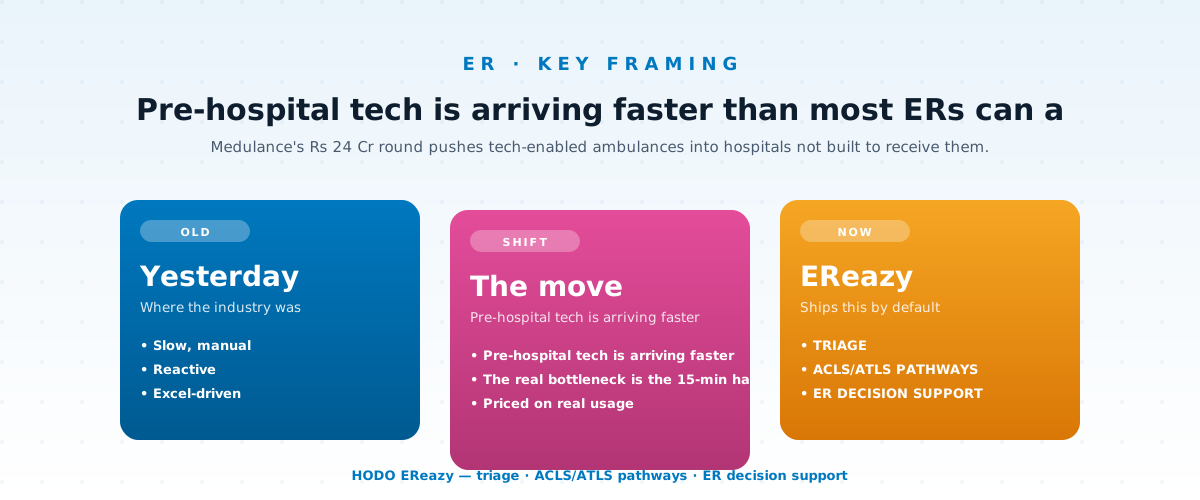
Pre-hospital tech is arriving faster than most ERs can absorb.
The real bottleneck is at the ER door
Talk to any ER resident in a mid-sized Indian hospital and the story is consistent. The bottleneck is rarely the clinical decision. It is the handoff, clerking, triage documentation, bed allocation, billing initiation, and consent capture. Every one of those has to happen in the first ten minutes if the patient is time-sensitive. When an ambulance rolls in with three patients from a road traffic accident, that ten-minute window is where most Indian ERs quietly break. Nursing runs one way, the receptionist runs the other, the resident is on the phone with the consultant, and the HIS is still asking for a UHID before it will let anything else happen. Tech-enabled pre-hospital operators like Medulance solve their side of the workflow. The receiving hospital has to solve its side, or the improvement stops at the ambulance door.
What tech-enabled means on the receiving side
Tech-enabled on the ambulance side is telemetry, vitals streamed, ECG shared, patient identifiers pushed to the receiving hospital before arrival. On the hospital side, tech-enabled means the ER can pre-open a case file, pre-allocate a bed, pre-alert the on-call consultant, and pre-authorise the TPA or PMJAY workflow while the ambulance is still eight minutes out. That is a different kind of software problem from the general HIS. It needs a triage-first data model, role-based flows for the ER Resident, the Triage Nurse and the Receptionist working in parallel, not sequentially, and a live view of what beds are actually free right now, not what the discharge desk cleared this morning. Hospitals that treat their ER as just another OP counter inside the HIS will not keep up with an ambulance network that already knows what is coming through the door.
Bed occupancy, triage and the 15-minute problem
The 15-minute problem is this: from ambulance arrival to a stable, admitted-or-referred decision, the ER team has roughly fifteen minutes before its attention is pulled to the next case. Everything that gets logged after that window gets logged from memory, which means it gets logged badly. Two operational moves close this gap. First, live bed occupancy visible to the triage nurse on the same screen as the incoming patient, not on a whiteboard, not on a WhatsApp group. Second, a triage-to-billing chain that opens the case, tags the payer (self-pay, TPA, PMJAY, corporate), and routes the patient in one flow. When those two are in place, a 100-bed hospital can absorb three or four ambulance arrivals in the same hour without cascading downstream errors in pharmacy, IP admission, and discharge summary quality.
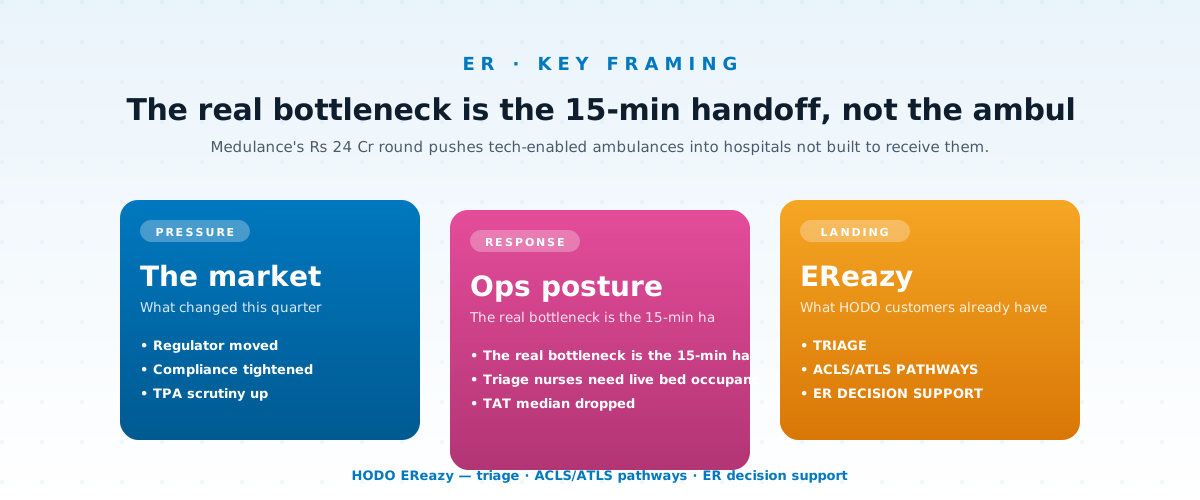
The real bottleneck is the 15-min handoff, not the ambulance.
What district hospitals should audit this quarter
Three questions worth putting to the ER floor in the next thirty days. One, how long does it take from patient arrival to a UHID being generated and the first vitals being in the system? Two, can the triage nurse see, right now, which IP beds are available by ward and gender without calling the admission desk? Three, when a TPA or PMJAY patient arrives via ambulance, does pre-authorisation start at triage or after admission? If the answer to any of these is it depends or we WhatsApp them, the hospital has a solvable ops problem, not a clinical problem. Solving it before the neighbouring hospital does is the difference between being on Medulance's, or any similar network's, preferred-partner list and being the second call the dispatcher makes.
What this means for HODO customers
Networked pre-hospital operators like Medulance change the receiving hospital's job description. The HIS has to stop being a billing engine that also happens to store clinical notes, and start being an operations spine that treats ER arrivals as a first-class flow. HODO EReazy's Triage, ACLS/ATLS pathway decision support, and Bed occupancy dashboard are built for exactly this handoff, with role-tailored flows for the Triage Nurse, ER Resident and Receptionist running in parallel, not queued behind each other. On the Healzapp side, IP bed management and HIS-integrated billing close the loop so that a patient admitted through the ER is not re-clerked at the ward. For 100-bed hospitals that want to be the receiving partner of choice as pre-hospital networks scale up, the audit starts at the ER door and works backwards.