Arab News reported in its latest Startup Wrap that MENA start-ups secured fresh funding across several technology sectors, with health and consumer-services ventures sitting alongside fintech and logistics rounds. The totals are the least interesting part of that story. What matters for a founder building a lab-at-home or doctor-at-home operation in Dubai, Doha or Manama is what those companies had to prove before the money moved, and almost all of it was operational.
Regional capital is underwriting execution, not ideas
The pattern across recent MENA rounds is that investors are paying for proof of a repeatable operation rather than a category thesis. A digital health pitch a few years ago could be carried by market size: so many million residents, high chronic disease prevalence, low penetration of home services. In the current market the questions are narrower. How many collections per phlebotomist per day? What is the repeat rate at ninety days? What share of revenue comes from corporate contracts versus walk-in consumers? How many reports go out past the promised turnaround time?
These are not fundraising questions; they are operating questions that fundraising exposes. Founders who cannot answer them usually cannot answer them internally either, the data sits in spreadsheets, WhatsApp groups and a booking tool that does not talk to the lab. The companies that close rounds tend to have a single system of record where a booking, a sample, a result and an invoice are the same object. That is unglamorous infrastructure, and it is the difference between a diligence call that takes two weeks and one that takes two months.
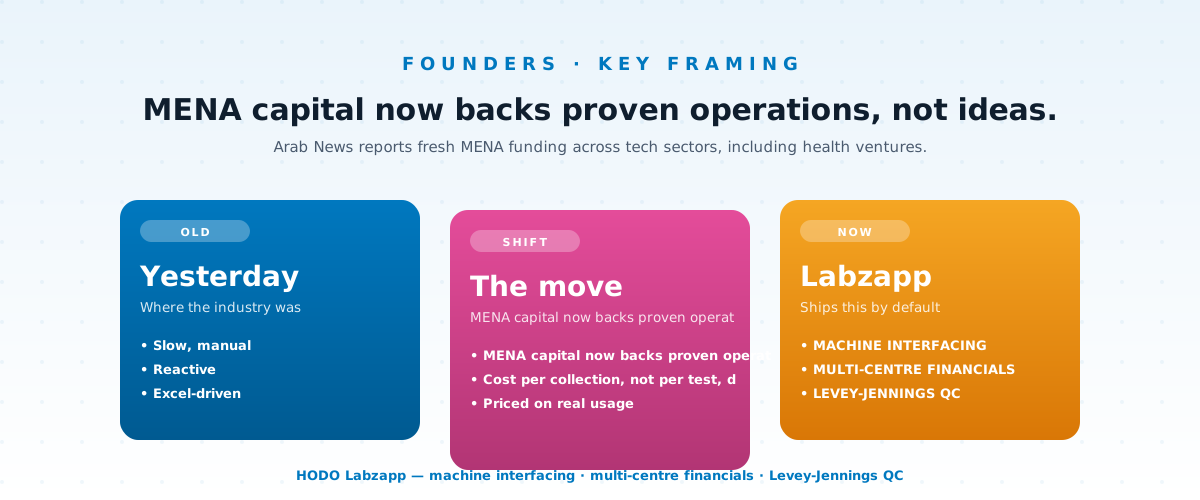
MENA capital now backs proven operations, not ideas.
Cost per collection is the number the round turns on
For a home-collection business the unit is not the test, it is the visit. A realistic cost stack per home collection in the GCC includes the phlebotomist's loaded hourly cost, vehicle and fuel or ride-hailing, consumables and cold-chain packaging, the courier leg back to the processing lab, reagent cost per test at the analyser, report generation and delivery, and the share of visits lost to no-shows and failed draws. Each of those is small. Together they routinely consume the entire gross margin on a single-test order.
Two levers move the number more than anything else. The first is route density: a phlebotomist completing seven collections within a three-kilometre radius has a fundamentally different cost base from one completing four across an emirate. The second is basket size, moving average order value from one test to a panel spreads the fixed visit cost across more billable work without adding a minute of travel. Founders who price before they measure tend to discover the problem at the exact moment volume arrives.
Turnaround time deserves its own metric rather than being folded into customer satisfaction. Late reports generate inbound calls, repeat collections and refund requests, all of which are staffed costs. Tracking turnaround by test group, by collection slot and by processing centre usually reveals that a small number of send-out tests account for most of the complaints.
The regulatory path is facility-first and country-by-country
Nothing in the GCC resembles a single national health stack. A founder operating across the region deals with Dubai Health Authority requirements in Dubai, the Department of Health in Abu Dhabi, MOHAP for several other emirates, Qatar's Ministry of Public Health, the NHRA in Bahrain and the Ministry of Health in Kuwait. Each has its own facility licensing, its own rules on who may draw a sample outside a clinic, and its own expectations on where patient data physically resides.
The practical consequence is that home collection is almost never licensed as a standalone service. It is licensed as an extension of a licensed laboratory or clinic, which means the first regulatory decision is which facility the service hangs off, not which app to build. Phlebotomist credentialing, documented chain of custody from the point of draw to accession, and a defensible audit trail for every sample are inspection items, not internal hygiene. Accreditation expectations in the region lean towards ISO 15189 or CAP rather than the Indian route, and insurers will ask for it before empanelment.
Insurance empanelment is also the slowest variable in the plan. Cash-pay and corporate wellness contracts are usually the only realistic revenue for the first eighteen months, so the financial model should assume that and treat payer revenue as upside rather than base case.
Build the differentiator, buy the operating spine
The most common way a funded healthcare product loses a year is by rebuilding laboratory infrastructure that already exists. Barcoded sample handling, bidirectional analyser integration, quality control charting, multi-centre financial consolidation and partner billing are solved categories with narrow, well-understood requirements. None of them is a differentiator; all of them are mandatory; each takes longer than estimated because the edge cases only appear under real volume.
What is worth building in-house is the part a competitor cannot copy quickly. For a home-collection operator that is usually demand generation and route economics: slot pricing, routing, phlebotomist utilisation, retention mechanics. For a doctor-at-home operator it is clinician supply and visit triage. Those systems should be owned. The laboratory information system underneath them should be bought, configured and treated as plumbing.
Labzapp sits in that second layer, and founders use it as reference architecture even when designing their own front end. Machine interfacing keeps manual result entry out of the critical path. Levey-Jennings QC gives an accreditation assessor the control charts they will ask for without anyone assembling them by hand. Google Cloud Platform hosting matters for the data-residency conversation that follows a licensing application. The point is not vendor preference; it is that engineering time spent on the spine is engineering time not spent on whatever justifies the round.
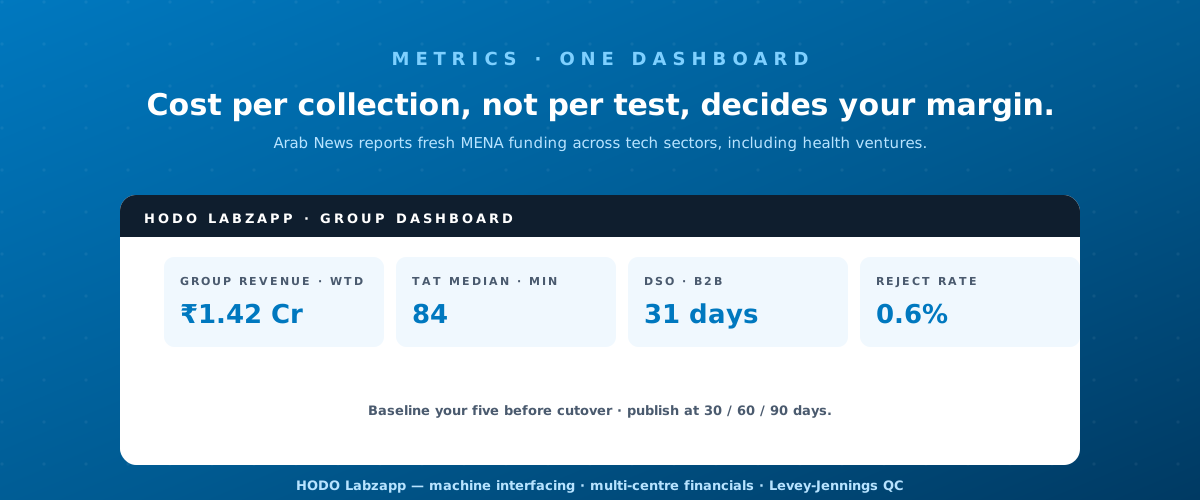
Cost per collection, not per test, decides your margin.
Partner and franchise networks scale faster than direct demand
Direct-to-consumer acquisition in the GCC is expensive and crowded. Operators who grow volume without proportionate marketing spend do it through intermediated demand: referring physicians in nearby polyclinics, corporate wellness and pre-employment screening contracts, send-out work from smaller labs that lack certain analysers, and partner collection points in neighbouring areas.
Each of those channels has a billing pattern that direct consumers do not. Referral doctors need visibility of their patients' results without access to unrelated records. Corporate clients need consolidated monthly invoicing and their own rate card. Partner labs sending samples need status tracking without seeing patient identity. A founder who models all of this as one line of B2B revenue usually discovers that each channel requires a distinct portal, a distinct price list and a distinct reconciliation process.
Designing for that early is cheaper than retrofitting it. Differential pricing per partner and referral-doctor + corporate-partner portals handle the commercial side, while partner-lab integration with anonymised sample tracking covers the send-out relationships most growing labs depend on. Franchisee management becomes relevant the moment a second or third collection hub opens under a partner rather than on the balance sheet, and that transition is smoother when multi-centre financials were separable from day one.
What this means for builders
The funding environment described in the Arab News wrap rewards founders who treat operations as the product. Capital is available, and it is going to teams who can show a measured visit, a defensible cost per collection, a licensing path mapped facility by facility, and a system of record that survives diligence. Build-versus-buy is the fastest lever available: own the demand and routing logic, rent the laboratory spine.
For teams at that decision point, phlebotomy/home-collection workflows, TAT reporting and automated SMS/WhatsApp/Email report delivery cover the operational core of a lab-at-home business without custom code, leaving engineering capacity for the parts investors are actually paying for.