Arab News reports that startups are providing a vital shot in the arm for the MENA health sector, with digital health founders across the UAE, Saudi Arabia and the wider Gulf drawing capital and attention into a market that has historically been dominated by large hospital groups. The headline is funding. The quieter story underneath it is operational: most of these ventures are not building new medicine, they are building new ways to book, deliver, bill and report care. That makes the choice of operating stack a founding decision, not an IT decision to be deferred until after the seed round.
What the MENA funding wave is actually funding
Strip the category labels away and the bulk of funded digital health activity in the Gulf falls into a handful of operational shapes. Teleconsultation platforms that need a consultation record and a payment. Doctor-at-home and nurse-at-home services that need scheduling, routing and a visit note. Home sample collection and diagnostics brands that need barcoded specimens and a report that reaches the patient. Chronic care and women's health programmes that need longitudinal records and structured follow-up. Corporate and insurer-facing wellness offerings that need per-partner pricing and clean invoicing.
None of these are clinical inventions. They are distribution and logistics businesses wrapped around regulated clinical delivery. That has a direct consequence for founders: the defensibility rarely sits in the patient-facing app, which a competent agency can rebuild in eight weeks. It sits in the back end, whether a consultation, a sample or a home visit can be captured, priced, documented, billed and reported without a human re-keying it into a second system. Investors in the region are increasingly asking about cost per visit and cost per test rather than downloads, and those numbers are produced by the ops spine, not by the front end.
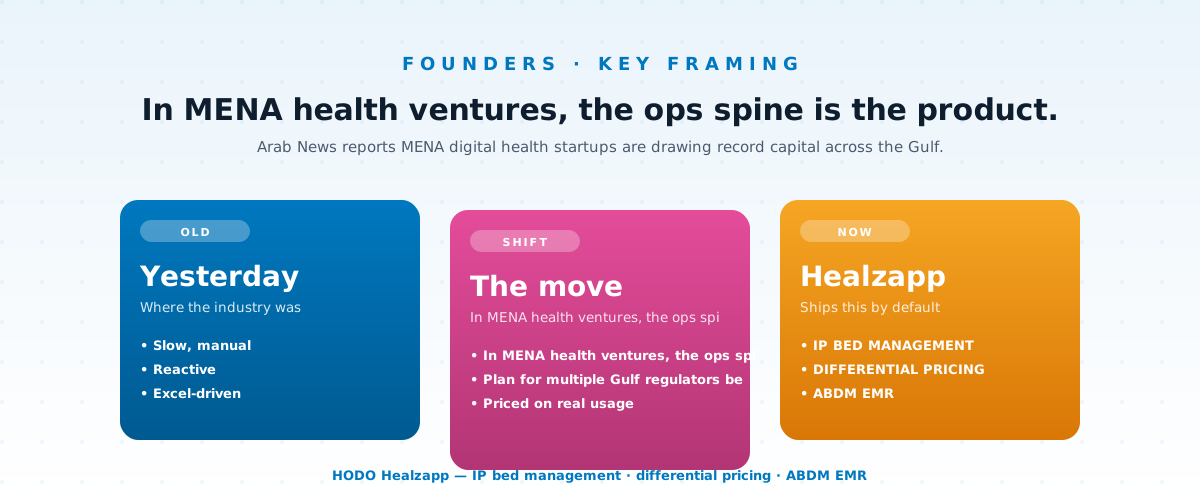
In MENA health ventures, the ops spine is the product.
Licensing and payer rules are an architecture decision
A digital health venture operating in the Gulf does not face one regulator. Dubai, Abu Dhabi and the northern emirates run separate health authority regimes, and Qatar, Kuwait, Bahrain, Oman and Saudi Arabia each add their own facility licensing, practitioner credentialing and insurer submission expectations. A founder planning a Dubai launch with an Abu Dhabi expansion in year two is planning for two licensing contexts, two insurer networks and often two clinical documentation formats.
This is where early stack choices become expensive. A system that hard-codes one facility, one currency, one tax treatment and one price list will need surgery at the first cross-border move. The practical requirement is more modest than it sounds: the ability to run multiple facilities under one tenant, hold a separate licence identity and price list per facility, bill in more than one currency, and keep the clinical record attached to the patient rather than to the branch that happened to see them first.
Founders coming from consumer tech tend to underestimate the insurer side. Cash-pay volumes look clean in the first year because early adopters pay out of pocket. Growth almost always runs through insurance or corporate contracts, and at that point the platform has to support per-payer and per-corporate rate cards, eligibility capture at the counter, and invoices that reconcile. Retrofitting differential pricing into a flat-rate billing module is one of the more common rewrites in this market.
Unit economics live in the ops spine
The most useful exercise for a Gulf health founder is to map a single transaction end to end and count the human touches. A home visit, for instance: enquiry, booking, slot allocation, clinician assignment, travel, consultation or collection, payment, documentation, report delivery, follow-up. If six of those steps require staff to move data between WhatsApp, a spreadsheet, a payment link and an accounting package, the cost per visit is set by coordination labour, not by clinical time. Scaling that model multiplies coordinators rather than margin.
Diagnostics-led ventures face the same arithmetic on turnaround time. A home-collection brand promising same-day results needs the sample barcoded at the door, the analyser result pulled in electronically rather than typed, and the report dispatched automatically. Each manual hop adds both cost and a failure mode that shows up as a refund or a churned customer.
The discipline worth adopting early is to instrument these steps before optimising them. Capture time stamps on booking, assignment, completion and delivery from day one. Without that data, turnaround and cost debates inside the team stay anecdotal, and the numbers presented to investors at the next round are reconstructed rather than measured.
Outlet four is where most stacks break
Single-site operations mask a great deal of process weakness. One manager can hold the workflow in their head, override the system and still close the month. The break usually arrives around the third or fourth location, or the second city, when consolidated reporting stops being a nice report and starts being the only way to know which site is profitable.
Founders should stress-test a candidate platform against expansion questions rather than feature lists. Can a new centre be configured without a fresh implementation project? Can price lists differ by location while the test or service catalogue stays common? Can revenue be viewed per centre, per doctor and per service line without exporting to a spreadsheet? Can a partner clinic, referring doctor or corporate client be given a restricted login instead of an email attachment? A stack that answers yes to these questions turns geographic expansion into a configuration task. A stack that answers no turns it into a migration.
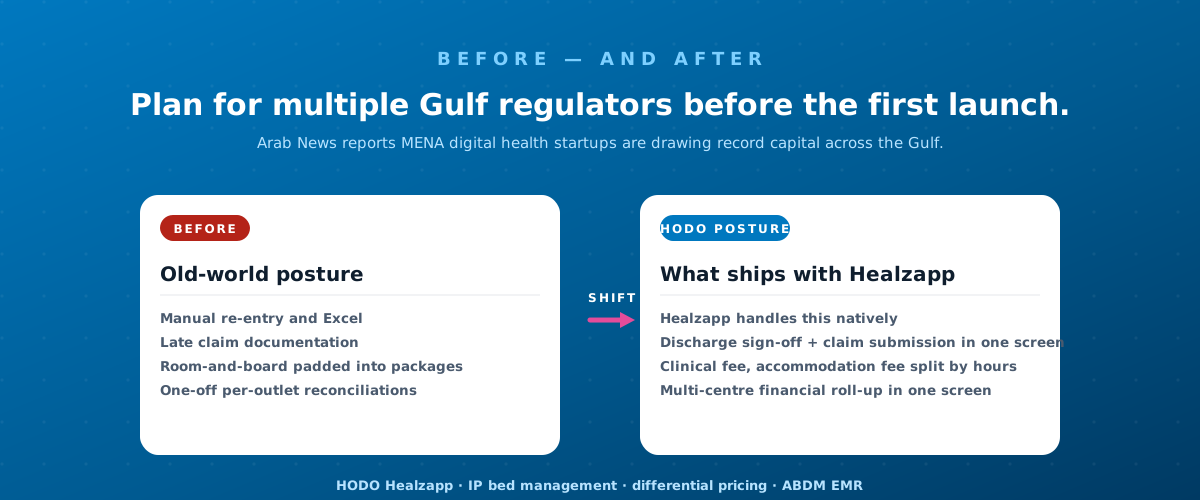
Plan for multiple Gulf regulators before the first launch.
Build, buy, or build on top
The build-versus-buy question deserves a sharper framing than it usually gets. Building the commodity layer, patient registration, appointments, billing, inventory, report delivery, consumes the engineering budget that should have gone into whatever actually differentiates the venture. Buying a rigid legacy system removes that burden but caps the product roadmap.
The middle path that works for most Gulf health ventures is to run a proven clinical and billing platform as the system of record, and build the differentiated layer, routing logic, customer app experience, partner marketplace, pricing intelligence, on top of it. This keeps regulated data in one audited place while leaving the founder free to iterate on the part customers actually choose them for. It also shortens the diligence conversation at the next raise, because clinical records, invoices and audit trails sit in a system a buyer or partner recognises.
What this means for builders
For founders building in the UAE and the wider Gulf, the operating platform is part of the product thesis. Billing (incl. multi-currency / GCC patterns) and Differential pricing in HODO Healzapp cover the payer and corporate rate-card problem that usually triggers a billing rewrite in year two, while Multi-outlet scale-up with one-click new-centre setup makes the second and third location a configuration step rather than a fresh implementation. Ventures built around home visits and virtual care can run Appointments, Teleconsultation and the Patient Health App as the ops spine, and diagnostics-led models can add machine interfacing and automated report delivery on the Labzapp side. The point is not to outsource the product, it is to stop spending scarce engineering time rebuilding the parts of healthcare operations that are already solved.