The Futurum Group reports that FTI Consulting is rebuilding its Middle East practice around what it calls execution-grade AI advisory — engagements that end in systems running inside the client's operations rather than in a roadmap deck. For healthcare founders and operators across the UAE, Qatar, Kuwait, Bahrain and Saudi Arabia, the repositioning is a useful signal about where the market has moved. The scarce commodity is no longer an AI strategy; it is the organisational plumbing that makes an AI-assisted decision survive the week after the consultants leave.
What “execution-grade” is a response to
Advisory firms do not rename a service line without a reason. The reason, visible across the Gulf since the national AI strategies started landing, is that clients stopped paying for the diagnostic phase. Most mid-sized healthcare groups in the region already know which functions are AI-addressable — front-desk triage of enquiries, insurance pre-approval paperwork, report turnaround chasing, recruitment screening, collections follow-up. What they do not have is a way to move a working pilot into standing operations.
The failure pattern is consistent and it is not technical. A clinic group runs a six-week experiment in which someone on the admin team uses a chat assistant to draft insurance appeal letters. The letters improve. The approval rate improves. Then the person who ran the experiment takes annual leave, moves to another employer, or gets pulled onto a licensing renewal, and the capability disappears with them. Nothing was wrong with the model. The problem was that the knowledge — which payer rejects which code, which phrasing gets a resubmission cleared, which consultant's documentation needs a nudge before submission — was never held anywhere except in one person's chat history.
Execution-grade, stripped of the consulting packaging, means the output is a system that keeps working without its author. That is a far harder deliverable than a strategy, and it is the one healthcare operators in the region should be buying.
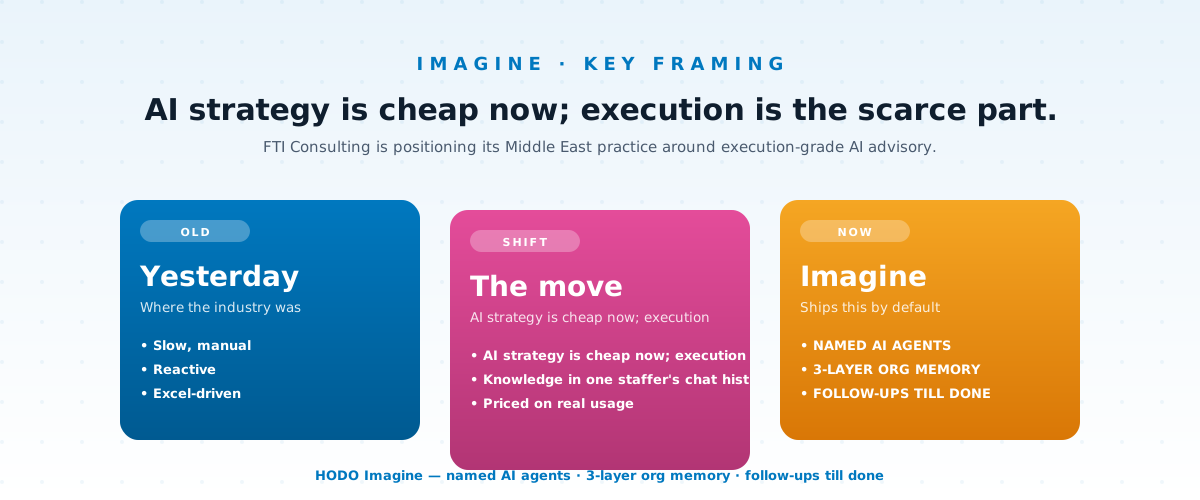
AI strategy is cheap now; execution is the scarce part.
Where this bites hardest in Gulf healthcare operations
Consider a four-branch polyclinic group in Dubai and Sharjah, or a diagnostics operator running centre collections alongside home phlebotomy rounds in Doha. Both carry an unusually high volume of recurring operational judgement: which insurer needs pre-approval for which scan, which doctor's schedule can absorb a walk-in, which home-collection route is already over-committed at 7 a.m., which corporate account is three invoices behind, which licensing document expires next quarter.
None of that is clinical. All of it is institutional. And in most groups of this size it lives in three places: WhatsApp threads, a spreadsheet nobody owns, and the head of operations. Expatriate staff turnover in the GCC makes the third location the dangerous one. When an ops manager with four years of payer-specific knowledge resigns with a month's notice, the replacement rebuilds that knowledge by trial and error over two or three quarters — and the group absorbs the rejections, the idle slots and the missed follow-ups as a cost of doing business.
Generic AI tools do not fix this. A chat assistant with no memory of the organisation gives a competent generic answer to a question whose correct answer is specific to this group, this payer mix and this licence. The gap between those two answers is the gap FTI is selling into.
Institutional memory is the actual deliverable
The useful way for an operator or founder to evaluate any AI transformation proposal — from a global advisory firm or a local integrator — is to ask what the organisation retains after the engagement. Three answers are common, and only one is worth paying for.
The first is a document: an assessment, a maturity model, a prioritised use-case matrix. It has value exactly once, and it decays as soon as the payer rules or the licensing framework shifts. The second is a tool licence: seats on a general-purpose assistant, with training. This improves individual output and retains nothing at the organisational level, because each user's context dies in each user's account. The third is a layer that holds the organisation's accumulated operating knowledge independently of both the staff who generated it and the tools they typed it into. Only the third compounds.
This is the design premise behind imagine, the organisational intelligence layer HODO runs alongside its hospital and lab software lines. Its memory is deliberately structured in three tiers — today, this week, forever — so that transient context (this morning's three cancellations) stays separate from durable institutional knowledge (this insurer requires a prior-authorisation reference on every MRI claim). Operators lose far more to the second category being forgotten than to the first.
Named agents with jobs, not a chat window
The second structural difference worth understanding is ownership. A chat window has no accountability: a question asked and answered leaves no trace of who was responsible for the follow-through. An organisational layer assigns the work.
In imagine, that takes the form of named AI agents with defined jobs, their own memory and a reporting line — the same primitives used to structure a human team. An agent that owns insurance resubmissions knows the payer history, drafts in the group's established language, and keeps chasing the case until it closes rather than until the conversation scrolls away. An agent that owns corporate-account collections knows which contacts respond and which escalate. Because each agent reports somewhere, there is an audit trail of what was decided and on whose authority — which matters when a regulator, an insurer or an investor asks how a decision was reached.
This is also where the Gulf's commercial context earns attention. Polyclinic groups and lab operators bidding for corporate wellness contracts, insurer panels or government tenders are increasingly asked about their digital capability. “The group uses AI tools” is now a weak answer. A defensible one sounds different: operating knowledge is institutional, follow-ups are tracked to closure, and external communication stays consistent in voice regardless of which staff member sent it. That is a Digital USP rather than a line item.
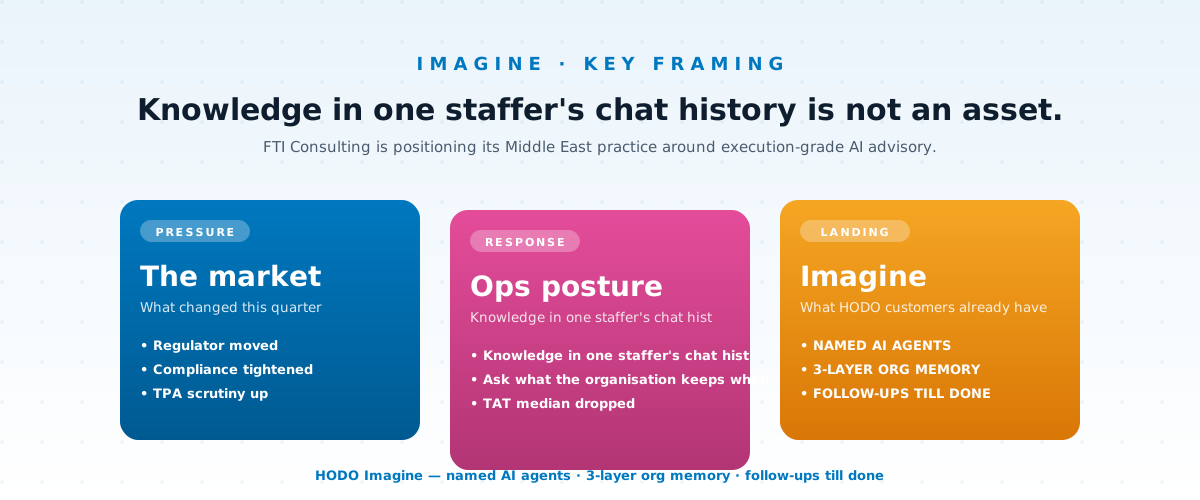
Knowledge in one staffer's chat history is not an asset.
What this means for digital transformation
FTI's bet is that Middle East clients will pay for implementation rather than advice. The corollary for healthcare operators and founders in the region is that the buying question has changed from “what should the AI strategy be” to “where does organisational knowledge live, and will it still be there after this year's staff turnover”. That is an architecture decision, not a procurement one.
Three capabilities carry most of the weight. Named AI agents with jobs, memory and reporting lines convert scattered assistant usage into owned, accountable work. 3-layer memory — today, this week, forever separates daily noise from the institutional knowledge that must outlive individual employees. Follow-ups until tasks close turns intent into completion, which is where most operational leakage in multi-branch clinic and lab groups actually occurs. Brand voice consistency keeps external communication uniform across branches and staff changes. None of this replaces Microsoft 365, Copilot or ChatGPT; the layer connects what a group already uses and gives it memory the organisation owns.
See how imagine turns AI into organisational intelligence — explore imagine.