Zawya reports that the Forbes Middle East Healthcare Leaders Summit in Abu Dhabi is set to welcome 3,000 participants and more than 100 speakers. An event of that scale moves little capital on the day; what it moves is knowledge, vendor shortlists, payer readings, staffing models, pricing benchmarks, AI deployment stories that worked and several that quietly did not. The question for any operator sending three people to Abu Dhabi is narrower than the agenda: where does that live on Monday morning?
A summit is a knowledge transfer event, not a procurement event
Healthcare leaders in the Gulf are not short of forums. Between Abu Dhabi, Dubai, Riyadh and Doha, a mid-sized clinic group or lab network can send staff to half a dozen events a year, plus vendor days and regulator briefings. Each produces the same output: judgements formed by whoever was in the room.
Those judgements are valuable. Someone comes back knowing which analyser vendor has a credible service desk in the UAE, which insurer is tightening pre-authorisation, what comparable operators actually pay per seat for a clinic system, how a peer handled licensing when opening a branch across an emirate border. None of it is public. Most of it never reaches a document.
The gap is structural rather than careless. A summit generates unstructured, conversational, half-verified knowledge, exactly the kind that formal systems reject. A hospital information system stores encounters. A finance system stores invoices. Neither has a field for "the procurement head at a 40-doctor group said their AI scribe pilot failed on Arabic dictation." So it goes into a notebook, a phone note, a WhatsApp message to a colleague, or nowhere at all. Three months later, when the same question comes up in a management meeting, the organisation re-learns it at full price.
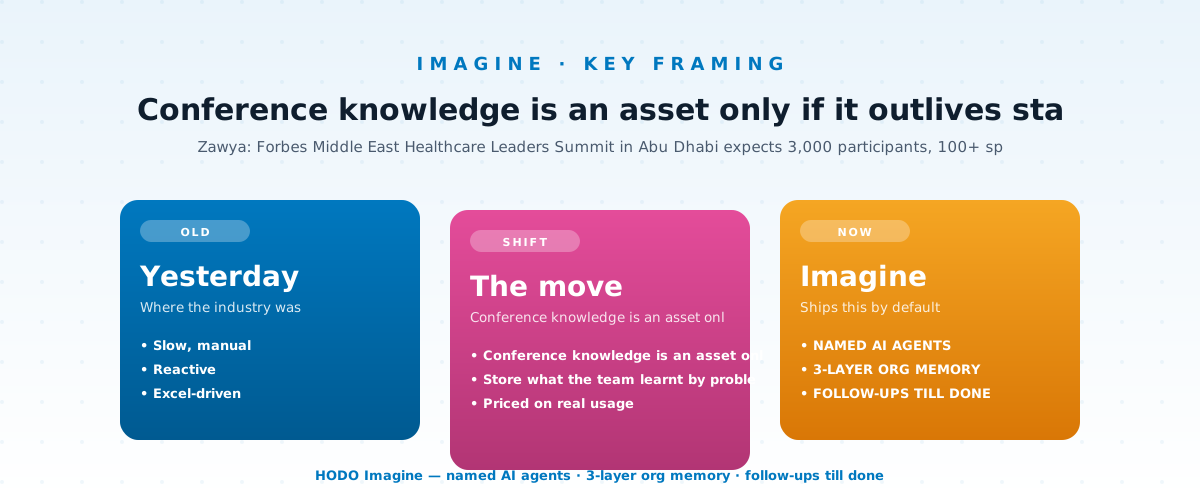
Conference knowledge is an asset only if it outlives staff.
Three places conference knowledge leaks
The first leak is the individual. Knowledge sits with whoever attended. If the operations director went and the clinical director did not, the clinical side works from a summary that loses every caveat, and nobody can interrogate it.
The second leak is storage without retrieval. Slide decks land in a drive folder named after the event. Nobody searches by event name six months later; they search by problem, "insurance denial trends", "second branch setup", "AI transcription". A folder organised by conference answers a question nobody asks.
The third leak, and the expensive one in this region, is churn. Clinic and lab operations across the GCC run on mobile, largely expatriate management teams. A two- or three-year tenure is normal and often planned. When a manager leaves, the organisation does not just lose a role, it loses every vendor conversation, every regulator interpretation, every hard-won workaround that was never written down. A new hire then attends the same summit next year and forms the same conclusions from scratch.
Framed that way, the summit is not the problem. The problem is that most healthcare operators have no layer that holds knowledge independently of the people who acquired it. AI tools are usually bought to write faster. The more durable use is to remember.
Named agents with jobs, not one shared chat window
Most healthcare organisations in the region already have AI in the building, a ChatGPT subscription here, Copilot bundled with Microsoft 365 there, a scribe pilot in one department. What is almost always missing is ownership. A shared chat window has no job description and no accountability, so it produces output nobody owns and nothing anyone builds on.
The alternative is to model AI the way a functioning operation models people: named agents with defined jobs and reporting lines. An agent that owns payer and insurance documentation. An agent that owns vendor evaluation and keeps every quote, demo note and reference check in one place. An agent that owns recruitment follow-through across a multi-branch group. Each has a scope, each reports to a human, each accumulates context in its own lane.
The difference shows up by the second month. A generic assistant asked about an insurer's pre-authorisation behaviour gives a plausible general answer. An agent holding that file since the last summit gives the answer this organisation arrived at, with the reasoning attached and the source named. One is a search engine with good manners; the other is a colleague who was in the room.
Memory in three layers: today, this week, forever
The reason most AI deployments in healthcare operations plateau is that a long context window is not memory. It holds a conversation, then discards it. Anything learnt on Tuesday is gone by Thursday unless a person manually re-enters it, and people do not.
Useful organisational memory separates by time horizon. Today is live working context, what is open right now, who is waiting on what. This week is running work, the vendor shortlist being narrowed, the branch licence being processed, the summit follow-ups still in flight. Forever is institutional: the regulator interpretation, the insurer tariff behaviour, the reason a system was chosen over its competitor two years ago, the conclusion someone brought back from Abu Dhabi.
Conference knowledge belongs in the third layer, and it is precisely the layer that generic AI tools do not have. This is also where the distinction matters commercially: an organisational intelligence layer does not replace Microsoft 365, Copilot or ChatGPT. Those remain the drafting and productivity tools. What sits underneath is the memory that makes their output specific to one organisation rather than generic to the industry, and that memory belongs to the organisation, not to the individual login that created it.
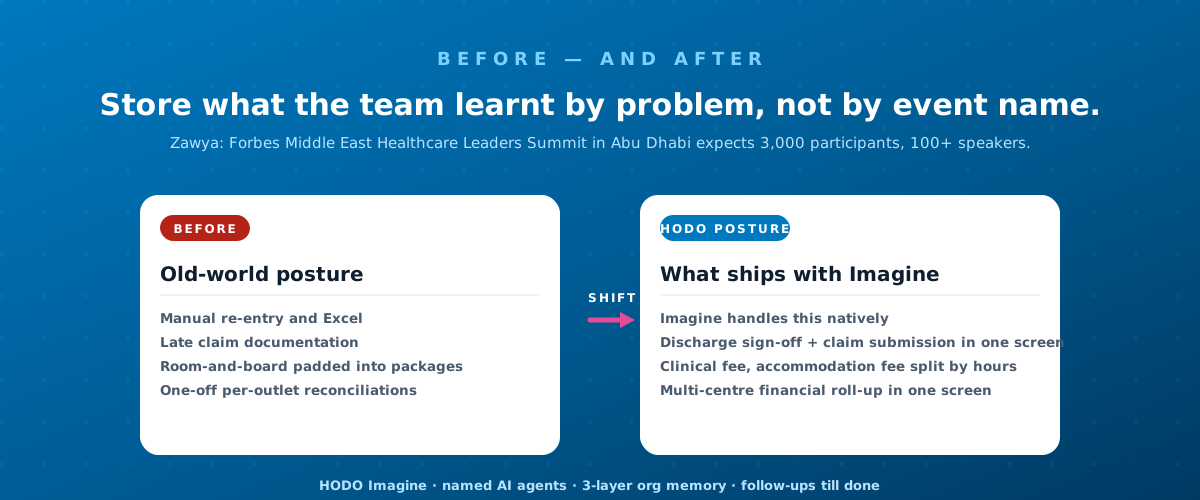
Store what the team learnt by problem, not by event name.
Follow-ups that close, and one voice across the group
Post-summit follow-through is where most of the value is lost. Forty cards, a dozen promised introductions, three demo requests and two regulator clarifications, all competing with a Monday that starts at an understaffed counter. Within a fortnight the list is cold. An agent that chases follow-ups until tasks actually close, not until they are logged, not until a reminder fires once, converts a fraction of that list into outcomes, which is more than most operators currently manage.
Voice matters alongside it. A clinic group writing to insurers, regulators, referring doctors and partners across several emirates benefits from sounding like one organisation. When each manager drafts independently, now with a different AI tool, the register drifts. Consistent brand voice is not cosmetic in a licensing and payer environment where written correspondence is part of the record. The audit trail that comes with it, who asked, what was decided, on what basis, is worth as much as the drafting speed.
What this means for digital transformation
Three thousand people will leave Abu Dhabi with a view on where healthcare AI is going in this region. The operators who benefit will not be those with the best notes; they will be those whose organisations retain the conclusions after the people who formed them move on.
imagine is built for that layer. Named AI agents with jobs, memory and reporting lines give each strand of organisational knowledge an owner instead of a folder. 3-layer memory, today, this week, forever, keeps live work separate from institutional knowledge, so what was learnt at a summit is still retrievable when the question resurfaces a year later. Follow-ups till done close the loop on the commitments an event generates, and brand voice consistency keeps a multi-branch group sounding like one organisation across every insurer, regulator and partner it writes to. Knowledge stays with the organisation and survives staff churn, which, in a market built on mobile management teams, is the difference between compounding and starting over.
See how imagine turns AI into organisational intelligence, explore imagine.