
The Centre is planning a network of model digitalised hospitals across districts, built to a common template for records, workflow and patient movement, as reported by Livemint and carried under the National Health Authority on Google News. The headline reads like a public-sector infrastructure story. For India's ~100-bed private hospitals and lab chains, it is closer to a procurement signal: once a district hospital runs admission-to-discharge on software, that becomes the floor everyone else is measured against.
The consequential part of a model-hospital programme is rarely the capital outlay. It is the specification — what counts as a digital record, how an investigation is ordered and reported back, how bed status is maintained, what a discharge document must contain, and where it is expected to land. Once a template of that kind exists at district level, it travels. TPAs reuse it in empanelment checklists. State scheme authorities reuse it in audit formats. NABH assessors reuse it when asking for evidence instead of assurances.
Patients pick it up fastest of all. Someone who received a discharge summary on their phone at a district hospital will ask, fairly, why a private 100-bed hospital in the same town still hands over a photocopy ninety minutes after the doctor signed the order. In tier-2 and tier-3 markets, upgraded district facilities and private hospitals draw from the same OP catchment, and the difference in waiting-room experience becomes visible within a quarter.
For hospitals running the same HIS since 2015, the question worth asking is narrow and testable: can the system produce, on demand, a structured record of a given admission — orders, results, nursing observations, drugs administered, bill lines, discharge note — without anyone reconstructing it from paper? If the answer requires a phone call to the ward, the hospital is not yet digitalised in the sense the template means.
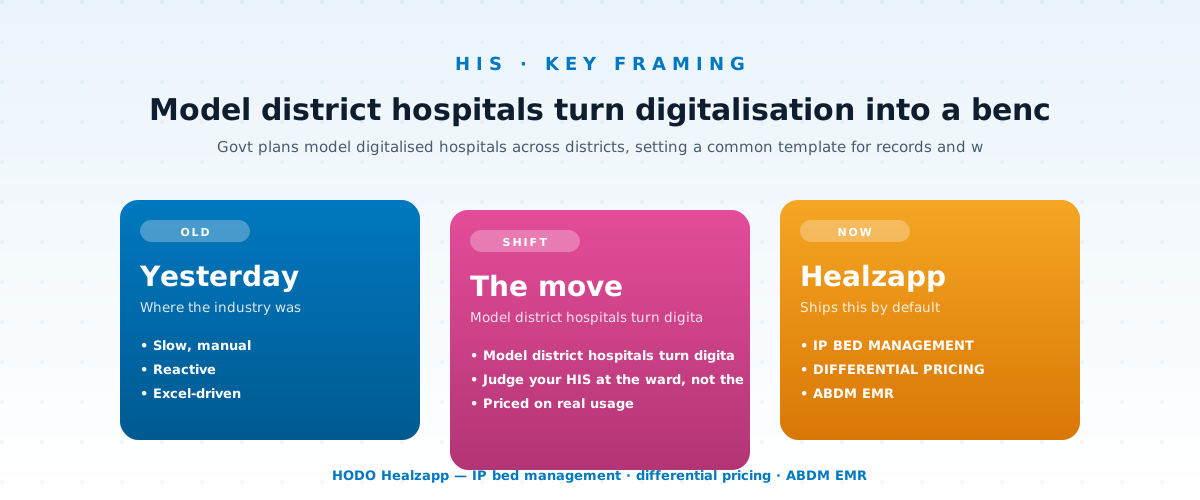
Most 100-bed hospitals already own an HIS. The gap is almost never at registration or billing, which were computerised first because money moves there. The gap sits in the inpatient block: nursing notes on paper, a whiteboard bed board that disagrees with the software by mid-morning, vitals charted on a clipboard and entered later if at all, discharge summaries typed fresh in a word processor by whichever resident is free.
Four numbers expose this quickly. First, the time between a consultant writing the discharge order and the bed physically clearing. Second, how many beds are shown incorrectly in the system at 11am on a Monday — count them physically, once. Third, the share of vitals and drug administration entries captured at the bedside rather than back-filled at shift end. Fourth, how often the bill reaches the patient after the patient is ready to leave.
None of these are clinical metrics, and all of them are what a model-hospital inspection would notice. A hospital that fixes bed-state accuracy alone usually finds an extra one to two admissions a day of effective capacity, because beds were being held by discharged patients whose status nobody had updated. That is occupancy recovered without a single new bed, and it is the cheapest throughput available to a 100-bed facility.
In-house labs and imaging are where inpatient turnaround is actually decided. A ward round at 9am that needs a report which was manually transcribed from an analyser at 11am has already lost the day. Machine interfacing is unglamorous and it removes an entire transcription step along with the error class that comes with it — values reaching the record directly from the analyser, flagged, time-stamped and attributable.
The outsourced portion deserves equal attention. Most 100-bed hospitals send a tail of specialised tests to a reference lab, and that tail is typically tracked on WhatsApp and a register. Partner logins that let the reference lab enter results against the originating sample, instead of emailing a PDF someone retypes, close a gap that otherwise shows up as a missing report on discharge day. The same applies in reverse for hospitals that accept referred samples from smaller labs and clinics — that is revenue which only scales if the handoff is structured.
Report delivery is the last metre. Automated delivery over WhatsApp and SMS removes a recurring queue at the reception counter and, more usefully, removes the phone calls about whether a report is ready. For lab chains running multiple collection points, it is also the only delivery method that scales without adding counter staff per outlet.
PMJAY and TPA cashflow is where weak digitalisation costs real money rather than reputation. Queries and rejections cluster around documentation completeness — missing pre-authorisation attachments, discharge summaries that do not match the procedure billed, investigation reports not linked to the admission, scheme-specific rate variations applied by hand. Each query adds days to realisation, and a 100-bed hospital carrying thirty to forty days of blocked claims is financing the payer's process cycle out of working capital.
The fix is structural, not administrative. Package rates per scheme and per corporate need to be configured once and applied automatically rather than looked up in a printed tariff. Claim documents need to assemble from the same record the ward and lab already wrote into, so there is nothing to collate at submission time. Accounting handoff needs to be automated, because manual re-entry into the books is where reconciliation differences are born.
ABDM linkage belongs in the same conversation. Issuing and linking ABHA records is now routine for empanelment and increasingly for scheme participation, and hospitals that treat it as a separate parallel workflow create duplicate data entry. It should fall out of registration, not sit beside it.
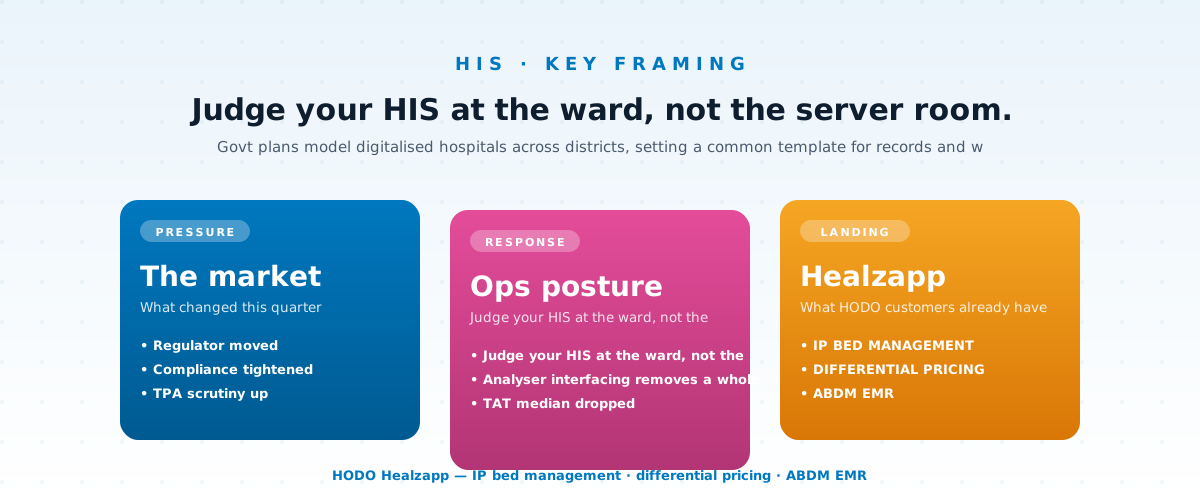
A model-hospital template does not create new work for private hospitals so much as it makes existing gaps measurable. The practical sequence for a 100-bed facility is: fix bed-state accuracy, move nursing documentation to the bedside, interface the analysers, then automate claim assembly. Each step pays for itself in throughput or realisation days before the next one starts.
HODO Healzapp covers this ground directly. IP bed management and the Nursing Station move the inpatient block off whiteboards and clipboards, so bed status and bedside documentation reflect reality rather than last night's handover. Machine Interfacing pulls analyser results into the record without transcription, which is the single largest turnaround saving available in an in-house lab. ABDM-compliant EMR keeps linkage inside the registration flow instead of alongside it, and for groups adding centres, one-click new-centre setup means the second and third units inherit the configuration rather than rebuild it.
See how Healzapp handles this — book a 30-min demo.
See how Healzapp, Labzapp and EReazy fit your speciality in a free 30-minute demo.
Book a Free Demo