Express Healthcare's analysis, Molecular Diagnostics in India: From Metro Monopoly to Indigenous Automation, makes the case that molecular testing is shifting out of a handful of metro reference labs and into smaller cities, carried by indigenously built analysers and automation priced far below imported platforms. For a lab owner in Kozhikode, Nashik or Vijayawada, that reads like permission to stop couriering samples to a national chain. The operational question is narrower than the policy one: can a two- or three-centre lab run PCR and molecular panels in-house without cost per test, turnaround and quality documentation quietly turning the line into a loss?
Why the metro concentration is breaking now
Molecular work concentrated in metros for three reasons that travelled together: capital equipment, a trained molecular biologist, and enough daily volume to amortise both. Indigenous analysers and local automation change the first reason. They do not change the third. A lab that was sending out 25 to 40 molecular samples a day was selling convenience on an outsourced rate card; bringing the same work in-house means owning reagent wastage, kit shelf life, control runs and repeat testing. Part-used kits are the quiet killer. A 96-well plate run at 30 per cent fill has a per-test cost two to three times the brochure figure, and that gap does not show up in a monthly P&L that only tracks revenue per centre. The decision is therefore not whether to buy the platform. It is which test mix, which referral catchment and which batching discipline make the platform pay. Labs that already have clean per-test costing by centre can answer that in an afternoon. Labs that do not will decide on instinct, discover the real number six months later, and then either raise prices in a market that will not carry them or go back to outsourcing with a depreciating asset on the books.
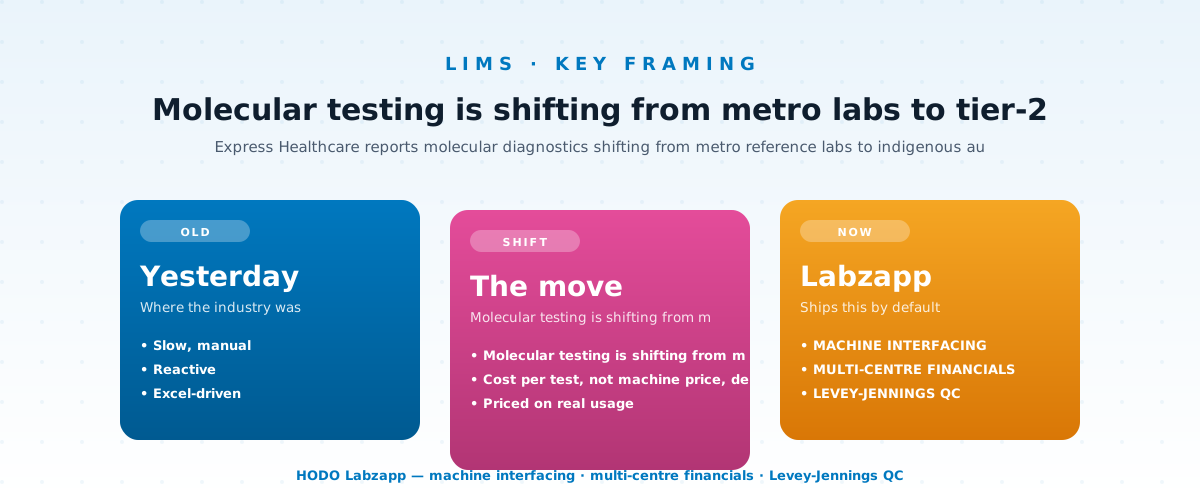
Molecular testing is shifting from metro labs to tier-2 cities.
Cost per test is an accounting problem before it is a procurement one
The honest cost per molecular test has at least seven components: reagent and consumable, daily and shift controls, repeats and invalids, wastage from batching below plate capacity, instrument AMC and service, qualified staff time, and the courier and outsourcing cost that has now disappeared. Most labs can quote the first and the last. The middle five are usually estimates. That matters more in molecular than in routine biochemistry because the absolute numbers are larger, a single invalid run can wipe out the margin on a day's panel volume. Multi-centre labs have a second layer of difficulty: the same test costs different amounts at a hub that batches well and a spoke that runs singles. Reporting that aggregates all centres into one average hides exactly the signal needed, which is that molecular should probably be hubbed at one site with timed sample transport from the rest. The corollary on the revenue side is rate discipline. Walk-in, referral doctor, corporate contract and partner-lab rates for a molecular panel can differ by a factor of three, and if those rates live in a price list that staff override at the counter, the costing exercise is academic. Differential pricing per partner needs to be enforced by the system, not remembered by the billing clerk.
Machine interfacing decides whether automation reaches the report
Indigenous automation is a claim about the instrument. Whether it becomes automation for the lab depends on what happens between the analyser and the released report. If a technician reads cycle threshold values off a screen and types them into a reporting template, the lab has bought a faster machine and kept a manual process, with a transcription risk that is harder to defend in molecular than almost anywhere else, because a positive or negative call is not a number a reviewing pathologist can sanity-check by eye. Bidirectional interfacing matters for the reverse direction too: the worklist should reach the instrument from the order, so that plate position maps to sample identity without a handwritten layout sheet. Sample identity is the whole chain. A barcode generated at registration or at home collection, carried through accessioning, aliquoting and plate loading, is what makes a molecular result auditable three months later when a clinician queries it. Labs expanding molecular scope also tend to add instruments from more than one vendor, which is where single-vendor middleware becomes a trap. The practical test when evaluating any LIMS for molecular work: ask how many analyser models are already mapped, who writes a new driver, how long it takes, and what it costs.
Quality documentation is now part of the product
Extending NABL scope to molecular testing moves quality control from a monthly chore to a daily operating requirement. Controls run per batch, results are plotted, shifts and trends are flagged before they become a reportable error, and all of it is retrievable at audit without a week of reconstruction. Labs that maintain QC in spreadsheets usually pass audits on the strength of someone's memory and a late-night printing session. That approach does not scale past two centres and does not survive the departure of the person who maintained the sheet. Levey-Jennings charting inside the LIMS, with control lots tied to the actual run and the actual instrument, converts the audit from an event into a report. There is a commercial edge to this as well, not only a compliance one. Referring clinicians and corporate contracts increasingly ask for turnaround commitments on molecular panels, and a lab that can show measured turnaround by test and by centre, rather than an assurance, wins contracts against larger chains whose local turnaround is worse than their brand suggests. Measured turnaround also exposes where the delay actually sits: in collection, in transport to the hub, in the run, or in verification and release. Those four fixes are entirely different, and guessing between them wastes quarters.
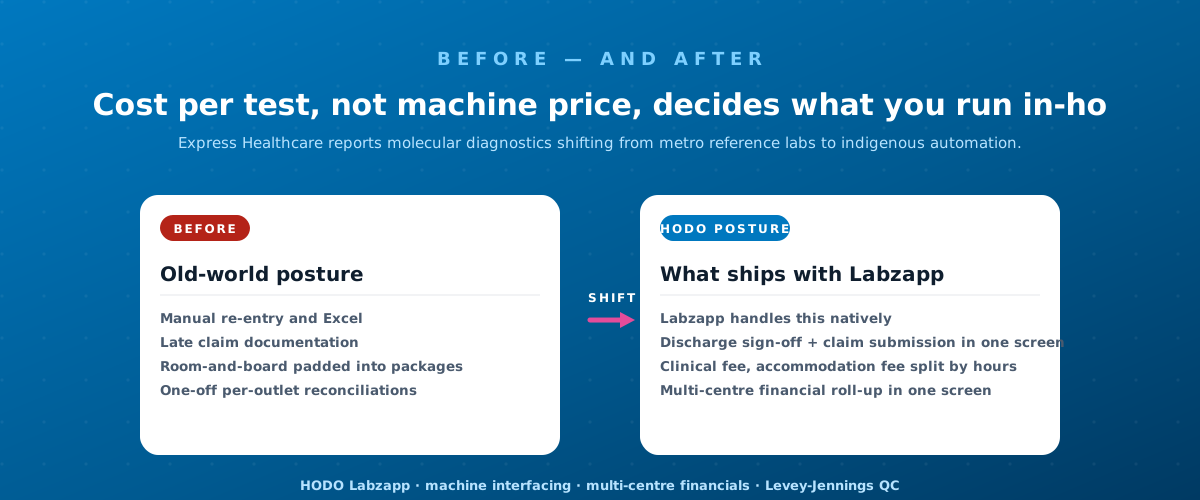
Cost per test, not machine price, decides what you run in-house.
Referral networks get more complex, not simpler
A lab running molecular in-house becomes both a receiver and a sender. It receives samples from smaller labs in its district that will not buy a platform, and it still sends out the rarer panels it cannot justify. Both directions need tracking that does not leak patient identity to a partner who has no business holding it, and both need rate cards distinct from retail. Franchise and partner collection points add a third pattern: samples arriving with incomplete orders, cash collected at the spoke, and reports that must reach the patient and the referring doctor without the franchisee becoming a courier of printouts. Report delivery is where most of the service complaints land, and it is the cheapest part of the chain to fix.
What this means for HODO customers
Labs adding molecular capacity should treat it as a costing and traceability project with an instrument attached. In Labzapp, Machine Interfacing with barcoded samples removes the manual re-entry step between analyser and report, Levey-Jennings QC keeps control data audit-ready for NABL scope extension rather than reconstructed before an assessment, and TAT reporting plus multi-centre financials show where turnaround and cost per test actually differ between hub and spokes. Partner-lab integration with anonymised sample tracking and differential pricing per partner cover the two-way referral traffic that molecular capacity creates. See how Labzapp handles this, book a 30-min demo.