ET HealthWorld has run a piece on how single-specialty nursing homes can grow into multi-specialty units without expanding their physical footprint, adding disciplines rather than floors. For the 30-to-100-bed operator in an Indian tier-1 or tier-2 city, where land is priced out of reach and construction takes three years, this is close to the only growth path that does not need fresh capital or diluted ownership. The operational question it raises is less about clinical scope and more about whether the hospital's information system can run four specialties through infrastructure built for one.
Why the footprint stopped being the growth lever
A 60-bed obstetrics and gynaecology nursing home in Kochi, Coimbatore or Nashik typically runs between 55 and 70 per cent occupancy, with predictable weekday peaks and a long tail of empty beds at night. The beds are not the binding constraint. Demand for one specialty is. Adding orthopaedics, general surgery, paediatrics or a pain clinic inside the same building converts idle bed-days into billable ones without a square foot of construction. A new block needs land, three years and capital; a second specialty needs a visiting consultant contract, a shared theatre slot, a modest instrument set and an information system that can carry two clinical workflows side by side.
What the framing gets right is that the barrier has moved from physical to administrative. Nursing homes that stall during this transition rarely stall because the surgeon was unavailable. They stall because the front office cannot quote an orthopaedic package, the OT register is maintained in a book only the obstetrics team understands, and the pharmacy has no stock logic for implants. Growth without a footprint is, in practice, growth that lives almost entirely inside the software.
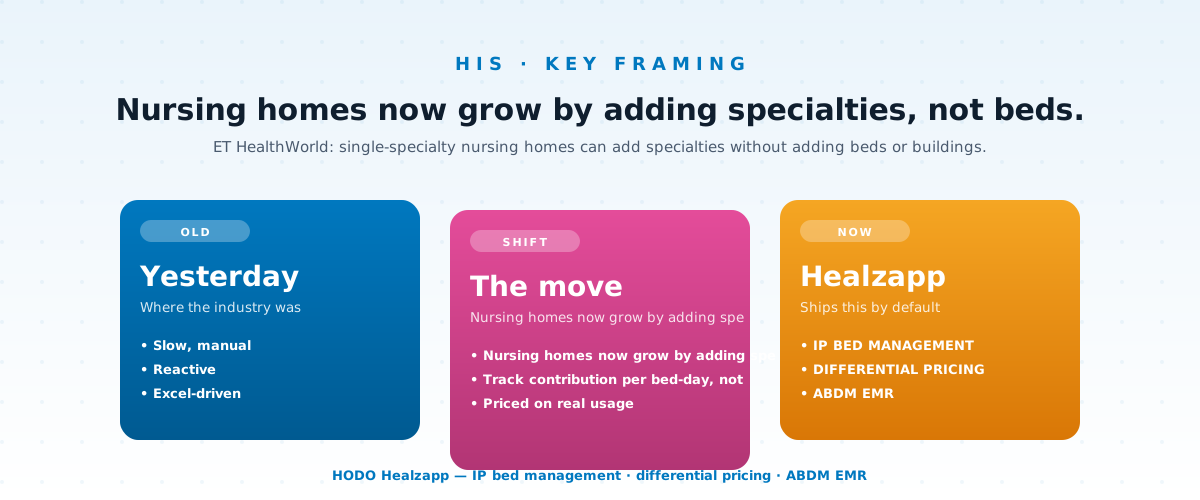
Nursing homes now grow by adding specialties, not beds.
Revenue per bed-day replaces occupancy as the number that matters
Single-specialty units can survive on occupancy percentage as their headline metric because the case mix is uniform. Once a second and third specialty share the same ward, occupancy becomes close to meaningless. An obstetrics admission with an average length of stay of three days and a fixed package price behaves nothing like an orthopaedic case that holds a bed for five days with implant pass-through, or a paediatric admission that turns over in 36 hours. The metric that survives is contribution per bed-day, computed per specialty and per consultant. Two specialties can show identical occupancy and differ by a factor of three once consumables, implant cost and payer discount are netted off.
The same discipline applies to the theatre. Contribution per OT hour, tracked by specialty and session, tells the operator whether the Tuesday morning slot handed to the new orthopaedic consultant is worth more than the caesarean list it displaced. Most nursing homes allocate theatre time by seniority and relationship rather than by yield, then wonder why topline grew 20 per cent while the bank balance did not move. Without per-specialty costing inside the HIS, that question cannot even be asked.
Where a single-specialty HIS begins to crack
Systems bought for one discipline carry assumptions that only surface under load. Registration flows hard-coded for antenatal visits miss the fields an orthopaedic OP needs. Tariff masters built as a single price list cannot hold specialty-specific packages, consultant-wise fee splits, or different rates for a corporate client and a walk-in patient on the same procedure.
Scheduling is usually the first visible failure. One consultant pattern fits in a paper book. Four consultants across three specialties, two visiting twice a week, one operating on alternate Thursdays, is a combinatorial problem a register loses within a month. The cost is not a missed slot; it is the patient who came for an orthopaedic opinion, waited ninety minutes behind an antenatal queue, and did not return.
Inventory is the second crack. Drugs move on consumption logic; implants and prostheses move on case-linked issue, batch traceability and pass-through billing, and a pharmacy module that cannot tell them apart will either leak stock or stall a surgery. Bed allocation is the third, mixed-specialty wards need live bed status, isolation rules and housekeeping turnaround visible on screen, not reconstructed at the nursing counter every shift change.
Diagnostics and theatre are the shared capacity that funds the move
The financial case for going multi-specialty rarely rests on consultation revenue. It rests on raising utilisation of assets the nursing home already owns. An in-house lab running only obstetric panels sits at a fraction of analyser capacity; pre-operative workups, orthopaedic biochemistry and paediatric profiles push fixed-cost recovery up sharply without new machines. The same holds for radiology, the theatre and the pharmacy.
That only works if the lab is genuinely integrated. Analysers feeding results electronically rather than through manual entry keep turnaround stable when volume doubles and keep transcription errors out of a report set that now includes pre-anaesthetic clearances. Tests the in-house lab cannot run need a clean outsourcing route with rate cards and tracked turnaround, not a phone call and a photograph. Referral economics change as well: a unit that adds orthopaedics becomes somewhere neighbourhood GPs can send cases, and those GPs expect report access, share arrangements and case status without chasing reception. That is manageable by hand at 20 referrals a month and impossible at 200, which is exactly the volume the expansion is meant to produce.
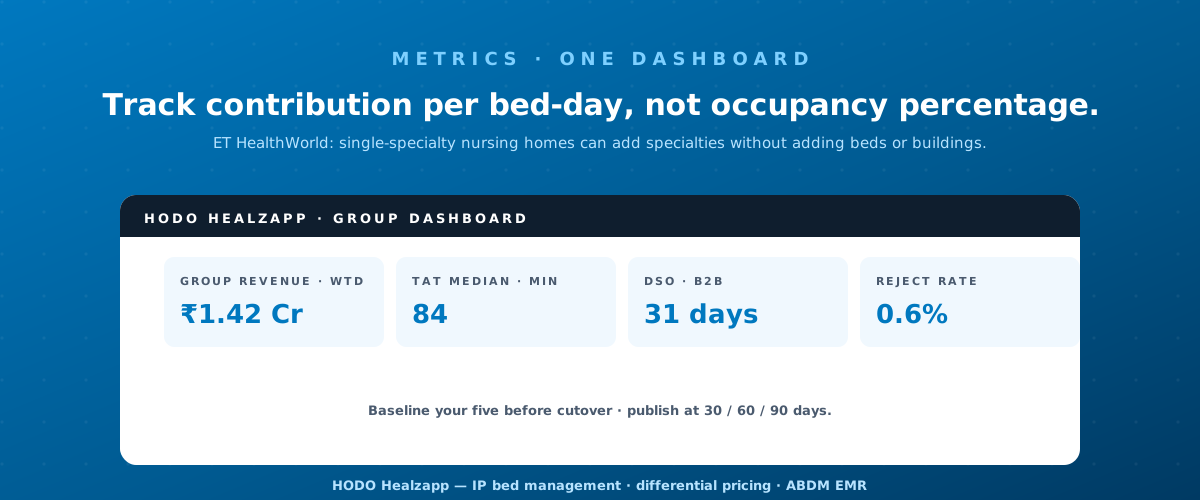
Track contribution per bed-day, not occupancy percentage.
Payer mix shifts before the clinical mix settles
Obstetrics in most Indian nursing homes is heavily cash and package-priced, with short credit cycles and few disputes. Orthopaedics, cardiology and general surgery are not. They bring TPA pre-authorisation, PMJAY and state scheme claims, implant approval cycles and a receivables ageing profile the finance desk has never had to manage. Operators routinely find that the first year of multi-specialty growth lifts revenue on paper and tightens cash on the ground.
Three controls matter from day one. Pre-authorisation has to run as a tracked workflow with owners and deadlines, not a WhatsApp thread. Claims must be raised against a tariff the payer has actually agreed to, which means payer-wise versions of the rate card rather than one list with manual discounts. And denial reasons need structured capture, so the same documentation gap does not repeat across fifty claims before anyone notices. ABDM-compliant record keeping earns its place here too, a patient seen in orthopaedics who delivered at the same unit four years earlier should not need the consultant to reconstruct that history from memory, and NABH assessors ask harder questions once the scope certificate lists more than one specialty.
What this means for HODO customers
Going multi-specialty without expanding the footprint is an information-system project wearing a clinical costume, and three capabilities carry most of the load. IP bed management gives mixed-specialty wards real-time bed status and turnaround visibility, so an orthopaedic admission is not blocked by a bed nobody marked vacant. Differential pricing lets one hospital hold specialty-wise, payer-wise and corporate-wise rate cards without the front office applying discounts from memory. B2B Referral / Outsource Lab / Corporate-partner logins give referring GPs, partner labs and corporate clients their own access, which is what keeps referral volume from collapsing back onto the reception phone line.
Around those, Machine Interfacing holds lab turnaround steady as the test mix widens, and Multi-outlet scale-up with one-click new-centre setup matters for the operator whose next move, two years on, genuinely is a second location. The sequence is the point: fix tariffs, scheduling, bed visibility and payer workflows first, and the second specialty pays for itself before the third is signed.