Madhya Pradesh has told private hospitals that empanelment under the Ayushman scheme now carries an accreditation condition — no NABH, no treatment of scheme patients — and close to 300 hospitals in the state may fall outside the panel as a result, as reported by bhaskarenglish.in. Most of the discussion has gone to the hospitals at risk of exclusion and whether the deadline will hold. The quieter operational story belongs to the hospitals that already hold accreditation, because the scheme caseload those 300 hospitals have been carrying does not disappear on the notification date.
Exclusion is a supply-side event, not a demand-side one
Ayushman demand is created by beneficiary families, not by hospitals. When a hospital loses empanelment, the families in its catchment do not stop needing a hernia repair, a caesarean, a fracture fixation or a dialysis cycle. They travel further and arrive somewhere else. In a district where four or five private hospitals were sharing the scheme load and only two hold NABH certification, those two absorb the difference — at their existing bed count, with their existing nursing roster and the same two-person pre-authorisation desk.
The arrival pattern will also be messier than a clean transfer. Some excluded hospitals will apply for entry-level accreditation and return to the panel within a few months. Some will appeal. Some will keep operating on cash and retail insurance and quietly stop taking scheme cases. So the accredited hospital sees a surge, then a partial reversal, then a new baseline — over two or three quarters, not in one week. Capacity planning built on a single month's numbers will be wrong in both directions.
There is a second-order effect worth watching. Referring doctors and local agents who used to send scheme patients to a now-excluded hospital will redirect that flow, and they will redirect it to whichever accredited hospital answers the phone and confirms a bed fastest. The hospital that wins that flow is usually not the one with the most beds. It is the one that can tell a caller, in under a minute, whether a bed in the right ward is actually free today.
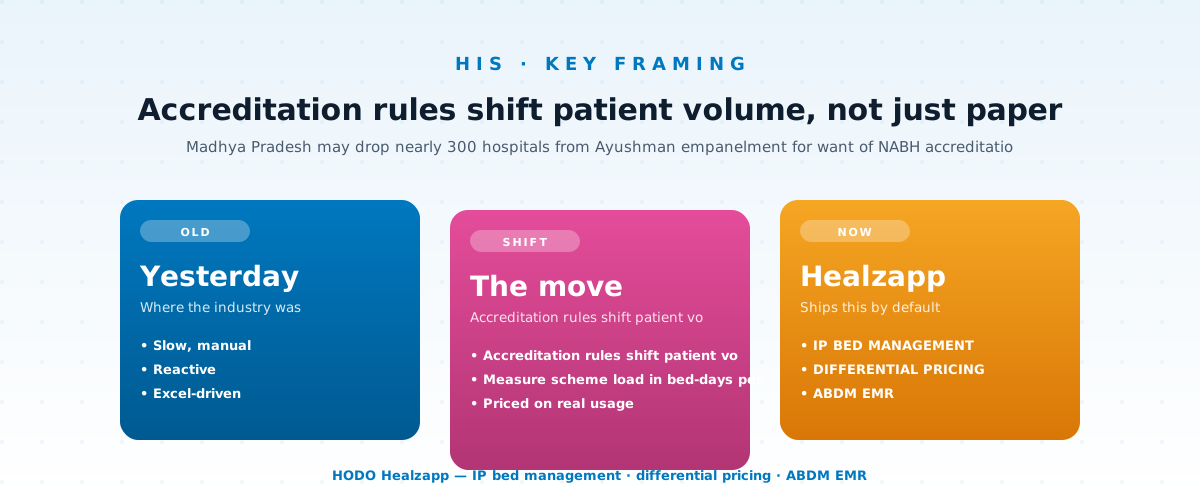
Accreditation rules shift patient volume, not just paperwork.
Read the inbound load before it arrives
Four numbers, computable from the existing admission register, tell a 100-bed hospital what a volume shift will do to it. First, the scheme share of bed-days, not of revenue — a package that pays modestly but keeps a patient for six days consumes far more capacity than its revenue line suggests. Second, average length of stay per package, because fixed-rate packages turn every extra day into a direct margin loss. Third, OP-to-IP conversion for scheme patients, which forecasts how an OP surge translates into admissions. Fourth, the day-of-week and time-of-day arrival pattern, because scheme admissions cluster and the cluster, not the monthly average, is what breaks the ward.
Alongside bed capacity sits administrative capacity, which is usually the first thing to fail. A thirty per cent rise in scheme admissions is a thirty per cent rise in pre-authorisation requests, query responses, document packs and discharge summaries. That work is handled by a small desk, and when it falls behind, the symptom shows up weeks later as query-pending claims and stretched receivables rather than as a visible queue. Hospitals that have tracked the pre-authorisation-to-approval gap and the discharge-to-claim-submission gap already know how much slack their desk has. Hospitals that have not tracked those gaps will discover the ceiling after they have crossed it.
Bed-days are the constraint, not beds
Occupancy stated as a single hospital-wide percentage hides the answer. A hospital running at 68 per cent has headroom only if the headroom sits in the wards the incoming load needs. Scheme volume in a district is rarely spread evenly across specialities — general surgery, orthopaedics, obstetrics and dialysis typically carry most of it — so the useful view is occupancy by ward and by payer category, read daily.
The other lever is turnaround. Between a discharge order and the next admission into that bed sit billing clearance, scheme documentation, housekeeping and the ward's own handover. In most 100-bed hospitals this gap runs for hours, and a few hours per bed per day is a meaningful share of effective capacity — capacity that costs nothing to recover, unlike a new ward. Pushing discharge decisions earlier in the day and tracking bed turnaround as a named metric adds admissions without adding beds. Under fixed packages, where margin per case is already set, recovered bed-days are one of the few remaining levers on contribution.
The hospitals that drop out become partners
An excluded hospital does not shut down. It continues with cash and insurance patients, and it now has scheme patients it cannot treat and investigations it may prefer to outsource. That makes it a referral source and a B2B customer rather than only a competitor — and referral flows built on phone calls and WhatsApp groups leak. The accredited hospital needs a record of who referred each patient, which rate card applies to that partner, what was done, and what report went back, visible to both sides without a reconciliation call at month-end.
The commercial structure matters as much as the workflow. A referring hospital, a corporate partner and a scheme patient should not sit on the same tariff, and maintaining three tariffs through manual overrides at the billing counter produces disputes within a quarter. Rate cards belong in masters, applied automatically by partner and payer, so the counter staff never negotiate. The same discipline applies to outsourced tests coming in from partner facilities: priced per partner, tracked to a result, and invoiced on a statement rather than reconstructed from memory.
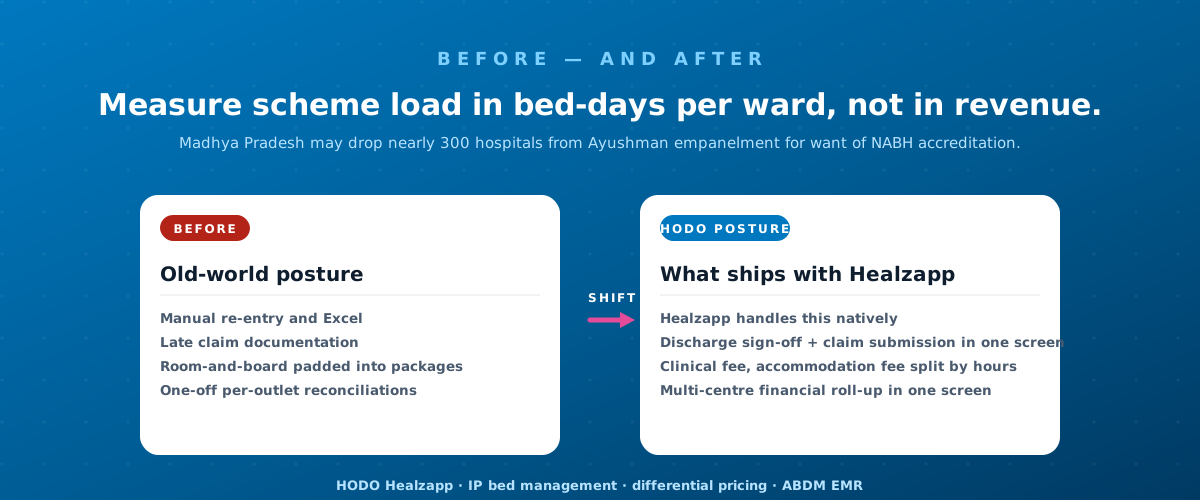
Measure scheme load in bed-days per ward, not in revenue.
Payer mix is a working-capital decision
More scheme volume is not automatically a better business. Each additional scheme admission consumes consumables, pharmacy, implants, OT minutes and bed-days now, and pays in sixty to a hundred and twenty days — sometimes longer, as the pending-dues protests in Bhopal have shown. A hospital that absorbs an excluded competitor's caseload without a view of loaded cost per package and ageing per payer can grow its revenue, its occupancy and its overdraft at the same time.
The practical control is a cap, set deliberately: a target ceiling on scheme share of bed-days, reviewed monthly against receivable ageing and against the cash and insurance mix the hospital needs to fund salaries. Accreditation makes a hospital eligible for more scheme work. It does not make unlimited scheme work affordable. The hospitals that come out of this transition stronger will be the ones that chose their share instead of accepting whatever arrived at the gate.
What this means for HODO customers
A volume shift tests three things at once: whether the hospital knows where its free bed-days are, whether partner and payer rates hold without manual intervention, and whether referral flows are recorded rather than remembered. IP bed management gives ward-wise occupancy and bed turnaround as standing numbers, so an incoming caseload is planned against real headroom rather than a hospital-wide average. Differential pricing keeps scheme, corporate, insurance and partner tariffs in masters and applies them at billing, which removes counter-level negotiation and the disputes that follow. B2B Referral / Outsource Lab / Corporate-partner logins give referring hospitals and corporate partners their own view of cases sent and reports returned, so a new referral relationship starts with a shared record instead of a WhatsApp thread. For groups absorbing load across more than one unit, one-click new-centre setup keeps masters and tariffs consistent as the footprint changes.