Private hospitals in Bhopal have gone public with two grievances at once: pending Ayushman Bharat payments, and the move to make NABH certification compulsory for hospitals that want to stay empanelled. The Free Press Journal reports the protest brought both issues to the same table, which is telling, operators are not objecting to quality standards in the abstract. They are objecting to a fixed, dated compliance cost being added while scheme revenue continues to arrive late and unpredictably.
Why NABH and payment delays landed in the same protest
On paper these are separate subjects. One is a quality framework run by an accreditation body; the other is a claims and treasury problem sitting with the scheme and its implementation agencies. In a 100-bed hospital's monthly review, they are the same line item: cash that has to go out on a calendar, against cash that comes in on someone else's calendar.
Certification carries real outflow, assessment fees, consultant support, documentation work, staff training hours, equipment calibration and maintenance contracts brought up to date, and in many cases physical changes to signage, storage and segregation. Much of it is non-deferrable once a deadline is published. Meanwhile the receivable side offers no matching certainty. A hospital with ninety days of scheme dues outstanding is being asked to fund a compliance programme out of working capital it has already lent to the scheme, interest-free.
That argument is worth separating from whether accreditation is a good idea. Standardised records, calibrated equipment and documented clinical processes reduce disputes, reduce repeat queries on claims, and make a hospital easier to audit. The grievance is about sequencing and cashflow, not standards. So the operational response, for any hospital that intends to stay empanelled, is to drive down the cost of staying audit-ready rather than to treat each certification cycle as a project.
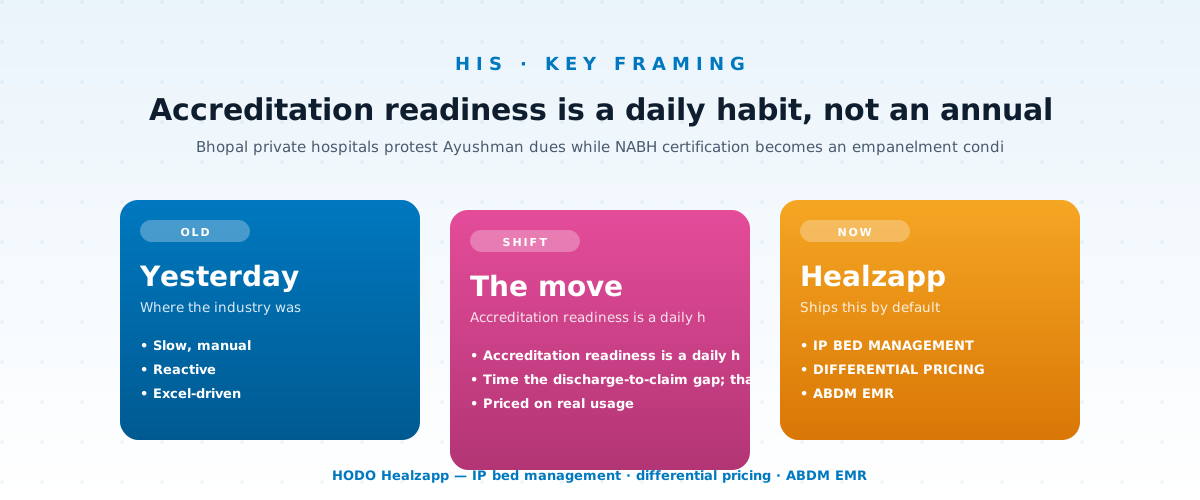
Accreditation readiness is a daily habit, not an annual file.
Accreditation readiness is a daily habit, not an annual file
Hospitals that struggle with an accreditation assessment usually do not fail on clinical capability. They fail on retrieval. The assessor asks for a sample of records and the hospital cannot produce, within the time available, a complete set: nursing assessment and reassessment entries with times, medication orders with the prescriber identified, consent forms matched to the correct procedure, infection-control and biomedical waste logs, equipment service history, incident reports with closure notes.
Every one of those artefacts is generated during ordinary work at the bedside. The problem is that in many hospitals the artefact is created on paper, filed physically, and never indexed against the admission. Three months later, assembling evidence means a clerk walking to the records room. That is why readiness feels like a project, the evidence exists but is not addressable.
The fix is structural. If nursing entries, medication administration, consent capture and equipment maintenance dates are recorded in the system that already runs the admission, the sample the assessor asks for becomes a query rather than a search. Consider the arithmetic: a 100-bed hospital running at 65 per cent occupancy with an average length of stay of four and a half days discharges roughly 430 patients a month. Over a certification cycle, that is several thousand records. No amount of pre-assessment scramble can retrofit structure onto that volume. It has to be captured as it happens, or it is not captured at all.
The discharge-to-claim clock is the cashflow lever hospitals actually control
Payment delay has two components. One sits with the payer and the hospital cannot move it. The other sits inside the hospital and is routinely ignored: the time between a patient walking out and a complete, defensible claim being submitted.
Break that interval into steps and it becomes measurable, discharge summary signed, bill finalised with the correct scheme tariff applied, supporting documents assembled, pre-authorisation and enhancement approvals matched, submission lodged. In hospitals that have never timed this, the interval commonly runs a week or more, and a meaningful share of claims come back with queries that add another cycle. Of those roughly 430 monthly discharges, if 40 per cent are scheme or TPA patients, that is about 170 claims a month. Four avoidable days on each one, at an average claim value of ₹25,000, keeps roughly ₹5.6 lakh of cash parked in the hospital's own process, not with the payer.
This is the part worth attacking first, because it is fully within management control and it does not require a policy change or a protest. It also compounds with accreditation work: the documentation discipline that satisfies an assessor is largely the same discipline that stops a claim being returned for incomplete records.
One dataset, two audits
The useful insight for an operator is that the accreditation assessor and the scheme auditor want overlapping evidence from the same admission. Both want to know what was ordered, by whom, when it was administered, what was charged against it, and whether the record is internally consistent. The assessor reads it as a quality question. The auditor reads it as a payment-eligibility question. The underlying record is identical.
Hospitals that maintain two parallel systems, a clinical record for care, and a separate reconstruction for claims, pay for the same work twice and introduce mismatches between the two. Mismatches are precisely what triggers queries and deductions. When the investigation and drug charge posted on the bill can be traced to the order and administration entry in the clinical record, a query is answered by producing a document rather than by negotiating.
For multi-outlet groups there is a second benefit: records structured once can be extended to a new centre without rebuilding, which matters when empanelment has to be obtained outlet by outlet.
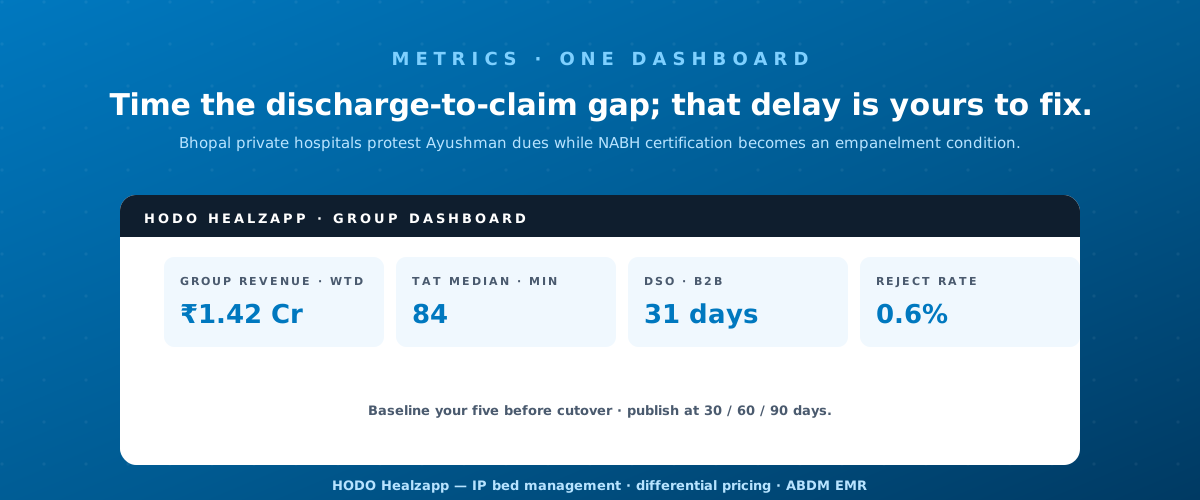
Time the discharge-to-claim gap; that delay is yours to fix.
What to instrument before the next payment cycle
Five numbers make this manageable. First, receivable ageing split by payer: scheme, each TPA, corporate and self-pay, in 0–30, 31–60, 61–90 and 90-plus buckets. An aggregate receivable figure hides which payer is actually funding itself from the hospital.
Second, claim cycle time by step, so the internal delay is separated from the payer's delay. Third, documentation completeness at discharge, measured as the percentage of discharges where the full pack was ready on the day of discharge. Fourth, query and deduction reasons grouped by cause, missing document, tariff mismatch, pre-authorisation gap, clinical justification, because the top two causes usually account for most of the volume and are fixable at the point of capture.
Fifth, an equipment and asset register with service and calibration dates due, which is accreditation evidence and uptime management in the same list. A scan machine out of calibration is both an assessment finding and a day of lost throughput.
What this means for HODO customers
Hospitals caught between a certification deadline and a delayed payment cycle are rarely short of clinical competence. They are short of structured evidence produced at the point of care. HODO Healzapp was built around that gap for Indian hospitals in this bed range.
ABDM-compliant EMR holds the clinical record in a structured form, with AI-condensed history so a consultant or a reviewer reads the relevant case summary instead of scrolling through loose attachments. Nursing Station captures assessment, reassessment and medication administration entries against the admission as they happen, which is the evidence an assessor samples and an auditor questions. Billing holds scheme, TPA, corporate and self-pay tariffs on the same account with differential pricing, so the charge posted traces back to the order rather than being reconstructed later. Warranty+AMC asset tracking keeps service and calibration dates in a register that is already part of daily operations, and IP bed management keeps occupancy and length-of-stay visible against the discharge pipeline that feeds every claim.