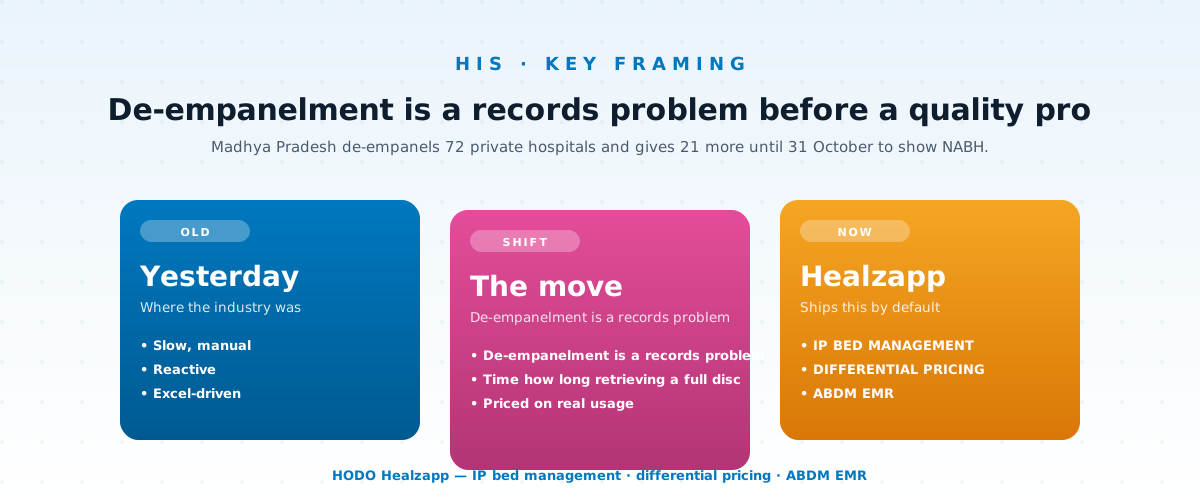
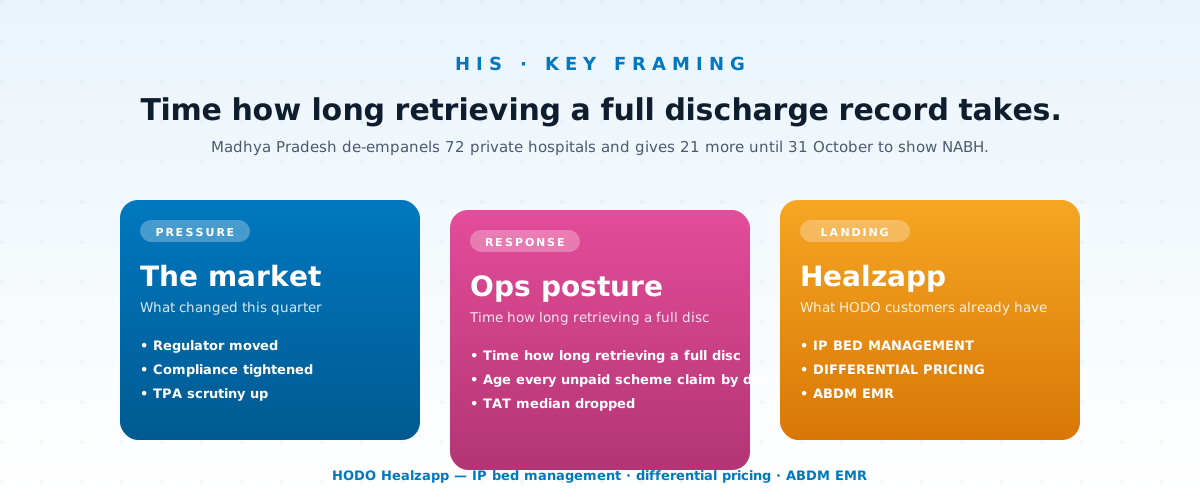
Madhya Pradesh has de-empanelled 72 private hospitals from the state's Ayushman Nirogya Bharat scheme and given another 21 hospitals until 31 October to produce NABH accreditation, as reported by the Free Press Journal. An argument that ran through most of the year has now become a dated administrative fact: one group of hospitals is already outside the panel, and a smaller group has a little over a fortnight to stay inside it. In both situations the work that decides the outcome is the same — producing records on demand — and that is a systems question long before it is a quality-department question.
Two clocks, two very different problems
The 72 hospitals that have already lost empanelment are dealing with a revenue hole that opened on a notification date. Scheme admissions stop, but the consequences of the admissions already made do not. There are patients mid-treatment, pre-authorisations approved but not yet claimed, discharged cases whose documents were still being assembled, and a catchment population that will keep arriving at the gate because nobody told the families anything. Front-office staff end up explaining a policy change they learnt about from the newspaper.
The 21 hospitals holding an October date have a narrower and more tractable problem. Entry-level accreditation is not a clinical transformation; it is a demonstration that the hospital does what it says it does, in writing, retrievably. A fortnight is not enough time to rebuild culture. It is enough time to find out where the hospital's records actually live and whether a second person can retrieve them.
Hospitals in other states should read the order as a schedule rather than a local dispute. The pattern has been consistent: a long notice period, a deadline that slips once, and then a list published with names on it. Treating the next such list as a surprise is a planning failure, not bad luck.
De-empanelment is a records problem before a quality problem.
A dated deadline is an evidence problem
What an assessor samples is narrow and predictable: clinical records with legible entries and timestamps, medication administration records, consent forms matched to the procedures performed, equipment calibration and maintenance history, infection-control logs, staff credentialing files, and the hospital's own documented policies being followed on the ward where the assessor is standing.
In a 100-bed hospital the failure mode is almost never absence of care. It is that the evidence of care is scattered. Nursing observations sit in a paper chart in a cupboard on the first floor. The biomedical engineer keeps service visits in a personal diary. Calibration certificates arrive by email to a procurement inbox nobody has opened since the last assessment. A consent form was signed, scanned, and saved to a desktop folder on a machine that has since been reformatted.
The practical test, therefore, is retrieval time. Pick five discharges from the last six months at random and ask a staff member who was not involved in those cases to produce the full record set — notes, drug chart, investigation reports, consent, bill. If that takes twenty minutes per case, a two-day assessment becomes a scramble and the hospital will fail on documentation while delivering perfectly adequate medicine. If it takes two minutes, the assessment is mostly a conversation. Measuring that number this week is more useful than another round of policy drafting.
The claims tail does not leave with the empanelment
De-empanelment does not void claims for treatment already provided under the scheme, but it does remove the daily routine that used to chase them. The pre-authorisation desk that logged in every morning now has nothing new to file, and the half-finished work quietly stops moving. Months later the hospital discovers that a meaningful share of its last quarter under the panel was never claimed, or was claimed and queried and never answered.
The discipline here is unglamorous and entirely mechanical. Every scheme case from the final months needs a status: claimed, queried, approved, part-paid, or unclaimed. Each status needs an owner by name and a date by which the next action happens. The exposure needs to be counted in two units at once — rupees outstanding and days since the discharge — because a claim that is 180 days old behaves very differently from one that is 30 days old, whatever its value.
Ageing buckets also feed planning. A hospital that knows its scheme receivables ran at 90 to 150 days can model what a cash and TPA mix does to its working capital. One that knows only the gross figure will keep treating a collections problem as a revenue problem.
Rebuilding the payer mix at short notice
In many district private hospitals the scheme accounts for a large share of inpatient bed-days, and surgical specialities carry more of it than medicine. Replacing that volume means pulling on several levers at once: retail outpatient throughput, cash and self-pay surgery, TPA and insurance empanelments, corporate tie-ups, and B2B work such as outsourced laboratory and imaging for smaller clinics in the same town.
Each of those payers carries its own tariff, its own documentation burden and its own collection cycle, which is exactly where hospitals under pressure make expensive mistakes. A discount sheet negotiated in a hurry with a corporate buyer can look like recovered volume while contributing less per bed-day than leaving the bed empty and running a second outpatient session. The arithmetic that matters is contribution per bed-day and per outpatient hour, by payer, reviewed monthly — not the headline tariff.
The same caution applies to re-entry. Most of the 72 hospitals will pursue accreditation and reapply. The ones that return quickly will be the ones that can produce a continuous, retrievable twelve-month record set for the period they spent outside the panel, because that is the evidence an assessor and an empanelment committee both ask for. Record-keeping discipline does not become less important once the scheme revenue stops; it becomes the cost of getting it back.
Time how long retrieving a full discharge record takes.
Making the accreditation file a by-product of the day
Hospitals that pass assessments without disruption are rarely the ones with the thickest manuals. They are the ones where the record is created by the work itself. The nurse records vitals at the bedside into the system, so the observation chart exists with a timestamp and a user against it. The analyser pushes results into the patient's order, so there is no transcription step to audit. The equipment register knows that the defibrillator's service is due in eleven days, so the maintenance record is complete before anyone asks for it.
Built that way, assessment preparation shifts from assembling evidence to reviewing it. The quality team spends its fortnight checking exceptions — the ten charts with missing entries, the three assets with lapsed warranties — instead of hunting for the other ninety per cent.
What this means for HODO customers
Healzapp is built so that the accreditation record and the billing record come from the same day's work rather than from a parallel documentation exercise. EMR (AI-condensed history) keeps clinical notes, orders, consent and investigation reports against the patient episode, so a sampled discharge is retrieved in one place instead of five. Warranty+AMC asset tracking holds equipment service schedules, warranty status and maintenance history, which is the file assessors ask for and the one most often missing. Differential pricing lets a hospital run scheme, TPA, corporate and cash tariffs side by side, so the contribution from each payer is visible before a discount sheet is signed rather than after. Together with pre-authorisation and claim ageing visible in billing, the hospital can answer two questions on the same screen: what is outstanding, and whether it can prove what was done.