A Ground Report investigation this week flags a hard deadline that Madhya Pradesh's private hospital sector has been quietly dreading: NABH accreditation is now a non-negotiable condition for continued empanelment under Ayushman Bharat PMJAY in the state. The Ground Report piece, Mandatory NABH Rule Can Push Private Hospitals Out of Ayushman Scheme in Madhya Pradesh, describes small and mid-sized nursing homes weighing exit from the scheme rather than absorb the cost and staffing burden of accreditation. For owners of 50-500 bed hospitals across India, this is the leading edge of a national trend, and the operational fix is less about paperwork than about how the hospital is run day to day.
What actually changed in Madhya Pradesh
The state health authority has tightened Ayushman empanelment norms so that private hospitals without at least NABH Entry-Level (or full NABH) accreditation face de-empanelment. The rule is not new in principle, NABH has been a stated goal of the National Health Authority for years, but MP has moved from aspiration to enforcement. Ground Report's interviews with hospital owners in Bhopal, Indore and tier-2 towns surface a common complaint: the smaller the hospital, the higher the per-bed cost of compliance, and the tighter the Ayushman package rates. Several owners told the reporter they will let their empanelment lapse rather than invest in the documentation, infection-control audits and quality manuals NABH assessors expect. That decision has second-order effects, Ayushman patient inflow disappears, referral networks reshuffle, and the OP-to-IP conversion funnel breaks. Every state watching MP now has a template for enforcing the same rule, and Tamil Nadu, Karnataka and Rajasthan have signalled similar tightening.
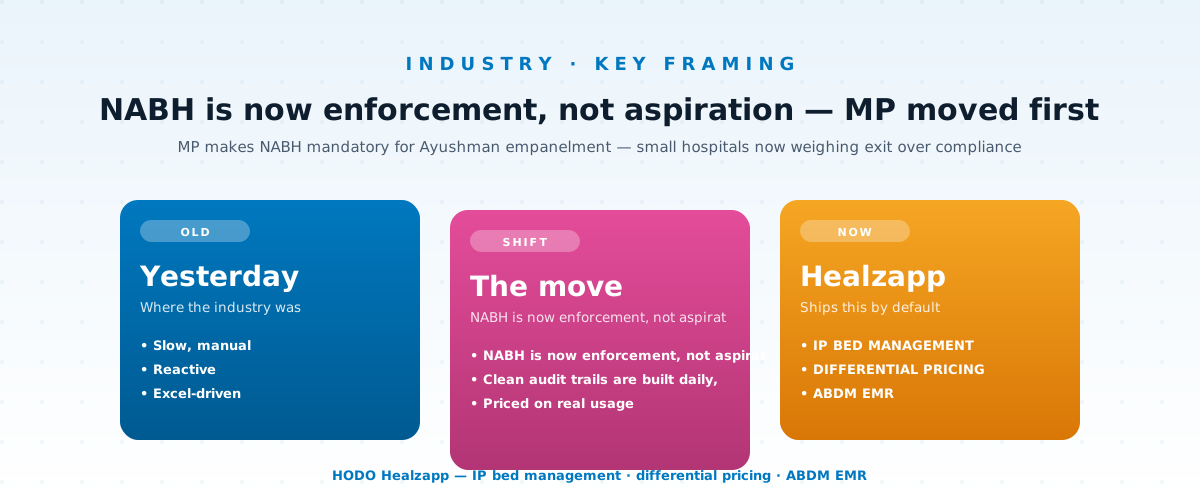
NABH is now enforcement, not aspiration, MP moved first.
Why NABH readiness is an operational problem, not a paperwork problem
Consultants sell NABH as a documentation exercise. In practice, assessors fail hospitals on things that only a well-run HIS can prevent: incomplete consent capture, missing nursing notes at shift change, drug-administration timestamps that do not match pharmacy dispensing logs, and asset registers that cannot produce a preventive-maintenance history for a specific ventilator on demand. A hospital can hire a consultant to write the manuals; it cannot fake three months of clean audit-trail data in the week before assessment. The hospitals that clear NABH on the first attempt tend to be the ones whose day-to-day systems already generate the evidence, every patient interaction timestamped, every drug and consumable barcoded, every asset tagged with a service record. NABH readiness is a byproduct of running the hospital properly, not a project bolted on top of a broken workflow.
The Ayushman cashflow math owners keep getting wrong
For a 100-bed hospital in a tier-2 city, Ayushman typically accounts for 20-40 per cent of IP admissions. The package rates are thin, but the volume underwrites fixed costs, OT utilisation, nursing rosters, pharmacy turnover, radiology throughput. Losing empanelment does not just shrink revenue by the Ayushman share; it degrades the entire cost base because fixed costs redistribute across fewer patients. Owners considering exit typically underestimate this. The alternative, spending Rs 8-15 lakh on NABH readiness plus recurring quality-cell staffing, looks large in isolation, but pencils out favourably when compared with the throughput a hospital loses on de-empanelment. The decision then becomes a systems question: can the existing HIS produce the audit trails NABH wants, or does the hospital need to replace the software stack before it can even attempt accreditation? That question is what makes vendor choice a board-level issue this quarter, not a CIO-level one.
Documentation gaps that fail assessments
The recurring gaps NABH assessors flag are boring, which is exactly why they persist. Nursing stations record vitals on paper and transcribe them the next morning, breaking the chain of custody. Pharmacy issues drugs without linking each dispense to a specific patient encounter and prescriber. Consent forms are signed but not scanned into the EMR, so an assessor asking for the consent for patient X on date Y gets a five-minute file-room search. Machine outputs, ECG, lab analyser, imaging modality, arrive as printouts that a technician re-keys into the system, introducing errors and destroying the raw timestamp. Preventive-maintenance records for critical equipment sit in a paper file in the biomedical office rather than tied to the asset in the HIS. Every one of these gaps has the same root cause: the hospital's software either does not enforce the workflow, or the staff have learned to work around it. NABH assessors are trained to spot workarounds.
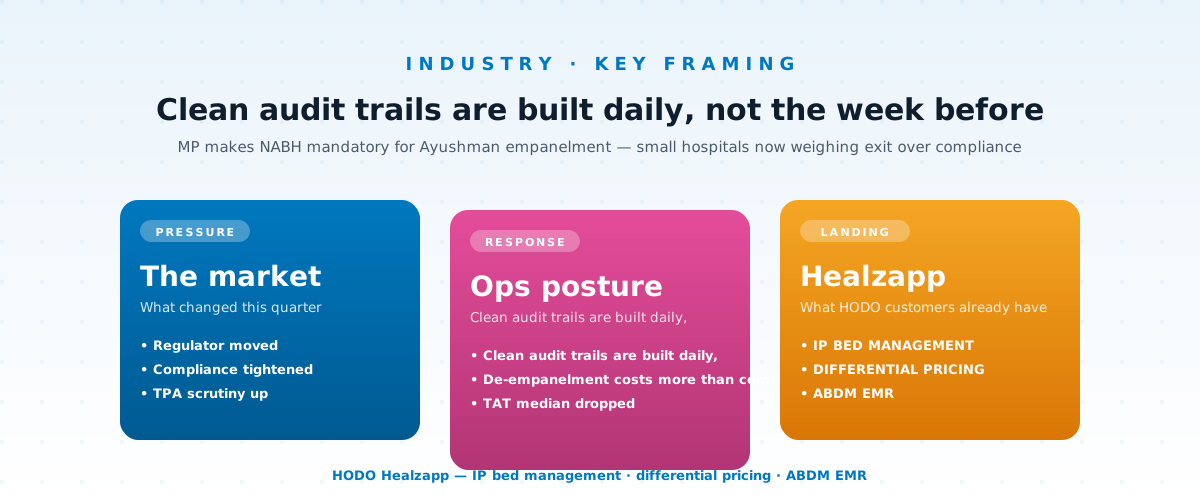
Clean audit trails are built daily, not the week before an assessment.
Multi-outlet chains: the standardisation problem
Chains with 3-20 outlets face a compounding version of the same problem. Each centre has drifted into its own workflow; each has a slightly different consent form, a different billing SOP, a different way of coding diagnoses. When head office decides to pursue NABH at all sites, the quality team spends the first six months just harmonising forms and masters across centres. Chains that started on a single HIS instance with shared masters skip this step entirely. The ones that let each new outlet stand up its own software instance, even the same product, end up rebuilding the standardisation exercise every time an assessor visits a new site. For chains planning to add centres this year, the cost of picking a HIS that supports true multi-outlet operation with shared masters, centralised reporting and one-click new-centre setup is now a NABH question, not just an IT question.
What this means for HODO customers
Hospitals running HODO Healzapp already have several of the audit-trail primitives NABH assessors ask for. The ABDM-compliant EMR timestamps every clinical entry and links it to the treating clinician, so the who-did-what-when question an assessor asks about a specific admission is answered in one screen rather than a file-room dig. Machine Interfacing pulls raw data from lab analysers and imaging modalities directly into the patient record, removing the re-keying step that assessors flag as a data-integrity risk, and it preserves the original timestamp from the modality. For groups scaling across states with variable Ayushman enforcement, Multi-outlet scale-up with one-click new-centre setup means each new hospital inherits the same masters, forms and SOPs as the flagship, so the quality manual applies uniformly instead of being rewritten per site. NABH is not the destination; it is a floor that a well-configured HIS clears as a side effect of daily use.