
The National Health Authority has launched the National Health Terminology Service (NHTS), a central catalogue that aims to end the medical data chaos plaguing Indian hospitals, diagnostic chains and payers, according to a Medical Buyer report citing the NHA. The service standardises how diseases, procedures, drugs and lab tests are named across HIS, LIMS and insurance platforms, pulling ICD-11, SNOMED CT, LOINC and India-specific vocabularies under a single lookup layer. For hospital owners, MDs and administrators, this is less a clinical story and more a plumbing decision that will shape claim reject rates, TAT reporting and outlet-level scaling for the next five years.
NHTS is a terminology-as-a-service layer, not a new EMR standard bolted on top of ABDM. It exposes a versioned API that maps any local term a hospital uses — 'sugar test', 'FBS', 'fasting glucose' — to a canonical code (LOINC 1558-6, in that case). It also maintains India-specific extensions where global vocabularies fall short, such as AYUSH terminology, indigenous drug names and regional disease patterns. The catalogue is maintained centrally by the NHA, meaning hospitals do not have to license or update SNOMED CT internally.
Practically, this means three things for an operator. First, any HIS or LIMS that consumes NHTS APIs will produce data that is machine-readable across the ABDM ecosystem without custom mapping tables. Second, claim submissions to insurers and TPAs can carry codes the payer already recognises, cutting the rejection-rework cycle. Third, multi-site chains no longer have to reconcile master data every time a new outlet spins up — the master is external, versioned and free to consume.
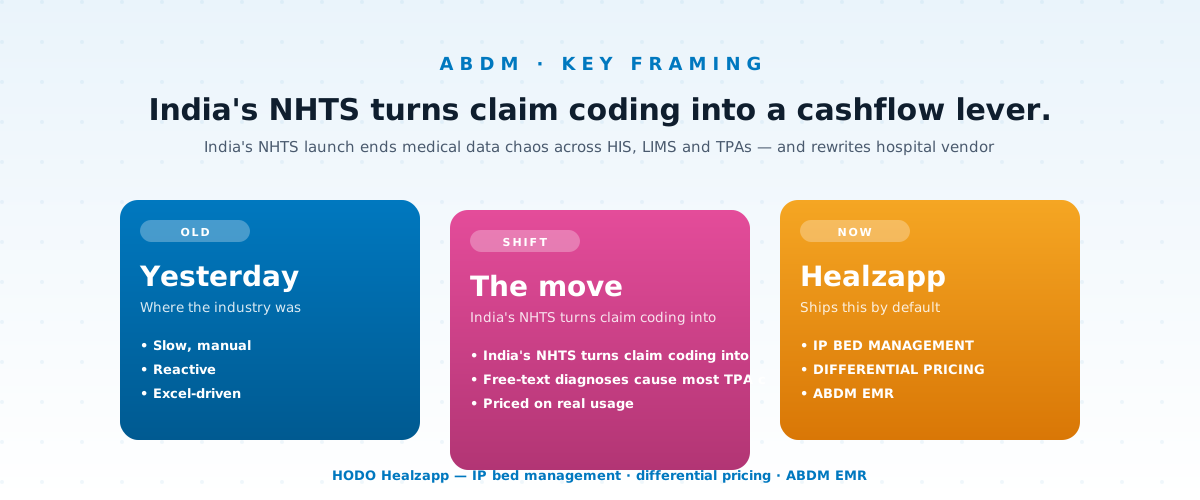
Ask any hospital finance head where cashflow leaks and they will point to insurance claims. A large share of rejects is not medical — it is coding. A pathology report that says 'Hb' instead of the LOINC term the TPA expects, or a discharge summary with a free-text diagnosis instead of an ICD code, becomes a rework loop. Each rework adds three to seven days to the receivables cycle, and every additional day is working capital sitting in a claim queue instead of a bank account.
Terminology chaos also breaks TAT reporting. When one outlet in a chain calls a test 'CBC', another 'Hemogram' and a third 'Complete Blood Count', the group-level TAT dashboard is guesswork. Consolidated MIS pulls become a manual mapping exercise every month. Corporate empanelment audits, which increasingly ask for coded data extracts, force the finance team to build one-off scripts. NHTS removes the excuse to keep this chaos, and once payers start rewarding compliant submissions with faster settlement, operators still on free-text will pay the price.
The insurance regulator has already signalled that cashless settlement timelines will tighten. NHTS-compliant claim submissions are the mechanism to actually hit those timelines. When the diagnosis, procedure and pharmacy line items in a claim carry NHTS-mapped codes, the TPA's adjudication engine can auto-approve high-confidence cases without a human touch. The industry benchmark for TPAs running coded workflows is 40-60% touchless settlement; free-text claims run under 10%.
For a 200-bed hospital doing four to five crore of monthly TPA business, moving from a 45-day to a 25-day receivables cycle is worth roughly 80 lakh to 1.2 crore of freed working capital — money that can fund a new scan machine or an additional outlet without borrowing. That is the real business case for NHTS adoption, and it is why HIS vendor conversations need to be revisited in the next two quarters, before payers start scoring submissions on code quality.
Diagnostic and clinic chains scaling from five to fifty outlets have historically hit a wall at master-data reconciliation. Each new outlet either inherits the head-office master (rigid, hard to localise) or builds its own (fast to launch, painful to consolidate). NHTS breaks this trade-off. New outlets can be spun up with a thin local master that references NHTS codes, and consolidation is automatic because every term ultimately points to the same national catalogue.
For pathology and scan chains, the payoff is bigger. A referring doctor sending samples across three collection centres wants a single report format with consistent test names. A corporate client with employees across cities wants one MIS extract, not three. NHTS-compliant LIMS deliver both without a custom integration. Partner labs and franchisees also benefit — anonymised sample tracking between a franchise centre and the parent lab works only if both sides speak the same vocabulary, and NHTS makes that guarantee cheap.
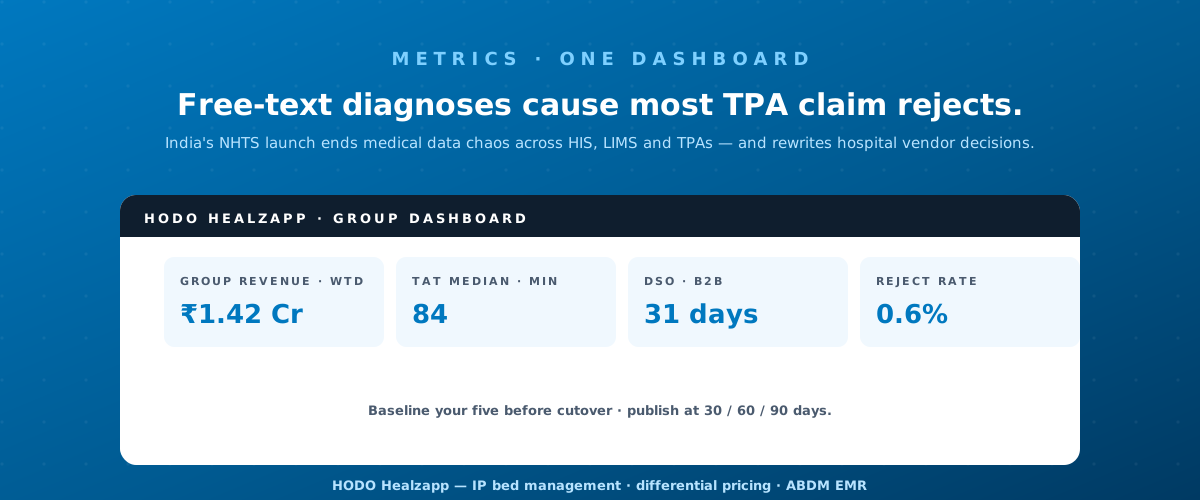
Three actions matter. First, ask the current HIS and LIMS vendor for a written commitment on NHTS API consumption — timeline, version support and whether it will require a new module fee. Vendors that cannot answer this in writing are a scaling risk that will show up in an audit two years from now. Second, audit claim rejection reasons for the last six months and classify them into coding, clinical and documentation buckets. The coding bucket is what NHTS fixes; that number is the ROI calculation.
Third, brief the medical records and lab supervisors. Terminology standardisation is not a software switch — it needs staff who understand that 'capillary blood glucose' and 'random blood sugar' are different LOINC codes for a reason. Training budgets in the coming quarter should include a short NHTS module. Hospitals that treat this as a compliance chore will lag; those that treat it as an operating discipline will compound the gains across billing, MIS and audit.
HODO Healzapp is already ABDM-integrated and among the first 20 ABDM-listed HealthTechs in India, which means the terminology plumbing to consume NHTS is architecturally in place. Three features do the heavy lifting. The ABDM-compliant EMR module carries the coding layer through from OP consultation to discharge summary, so downstream claim submissions are coded, not free-text. Machine Interfacing maps analyser output to canonical codes at the point of capture, cutting the reconciliation the lab supervisor does today. And Multi-outlet scale-up with one-click new-centre setup means a new clinic or scan centre inherits the NHTS-linked master on day one, so consolidation MIS works from the first patient.
See how Healzapp handles this — book a 30-min demo.
See how Healzapp, Labzapp and EReazy fit your speciality in a free 30-minute demo.
Book a Free Demo