
The National Health Authority has renewed its call for AI adoption and interoperability across Indian healthcare, according to a recent Medical Buyer report on the NHA's digital health transformation agenda. For hospital owners, MDs and administrators, the sub-text is unambiguous: ABDM is no longer a compliance nicety, it is becoming the baseline on which vendor decisions, TPA reimbursements and multi-outlet expansion will be judged.
The NHA's messaging repeats a familiar theme, but the tone has shifted. Where earlier communications framed ABDM as a voluntary opportunity, the current push treats AI and interoperability as pre-conditions for participating in India's public and private digital health economy. For a 200-bed hospital in a tier-2 city, that translates to concrete operational pressure: HIS vendors that cannot register facilities, generate ABHA-linked encounter records or exchange FHIR bundles are becoming procurement risks. The Medical Buyer report signals the NHA's intent to accelerate this transformation, and administrators should read it as a shortening runway. Payers, empanelled TPA networks and government insurance schemes are gradually aligning their audit workflows around ABDM identifiers. Hospitals still running standalone billing systems, or HIS software that treats ABDM as an optional export, will find that audit queries take longer, claim disputes drag out and cross-outlet reconciliation moves to manual work. The operational cost of non-alignment is not a fine — it is time, and time paid at the level of billing executives, TPA coordinators and MRD staff. That is a running expense, not a one-off.
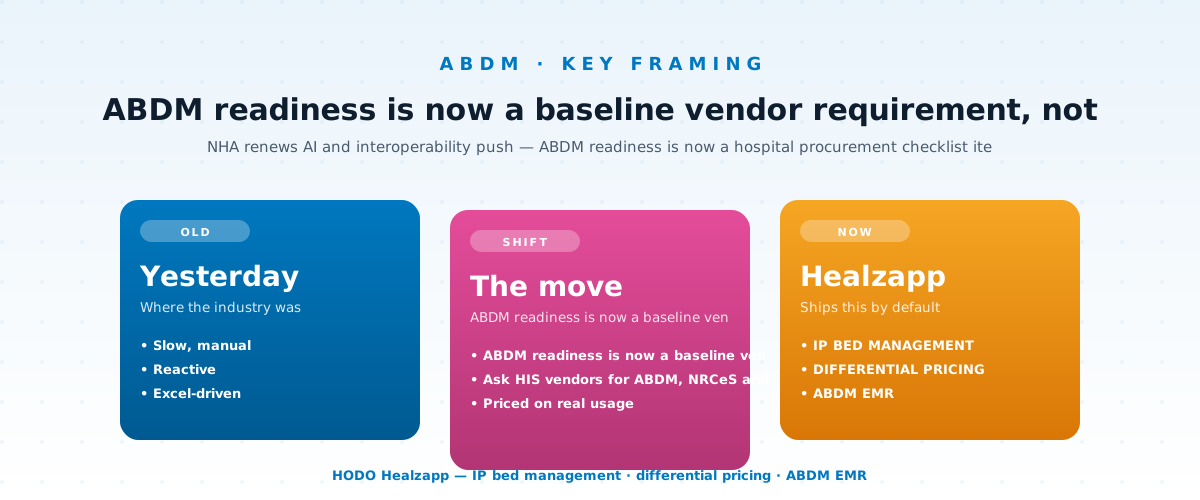
Interoperability used to sit at the bottom of RFP scoresheets, below UI, module coverage and price. That order is inverting. A HIS or LIMS that cannot expose lab results, discharge summaries and radiology reports as ABDM-compliant records now creates downstream drag: referring doctors cannot pull the report into their EMR, corporate clients cannot ingest results into occupational health databases, and diagnostic chains cannot federate reports across outlets without duplication. For administrators evaluating new systems in 2026, three questions should now appear at the top of every vendor scorecard. One, is the vendor on the NHA's list of ABDM-integrated HealthTechs and NRCeS listed? Two, can the system generate care context on demand for existing patient records, not just fresh registrations? Three, how does the vendor handle machine interfacing so that lab and imaging data flow into the EMR without manual re-entry, which is where most interoperability projects quietly die. The gap between vendors who can answer these cleanly and those who present slide decks is widening. Hospitals with 50-500 beds have limited IT bandwidth, and the vendor who can execute facility onboarding in weeks — including HPR, HFR and ABHA-linked billing — is the one who will hold the account for the next five years.
AI in hospital software gets used loosely. For a hospital owner, the useful lens is: does this AI reduce staff hours per patient encounter, reduce TAT, or reduce revenue leakage? Anything else is a demo feature. Three narrow applications currently pay back. First, an AI-condensed history — a summary generated from prior encounters, discharge summaries and lab trends — cuts consultant review time from minutes per patient to seconds, which compounds meaningfully across an OPD day of 200 patients. Second, AI-assisted coding and denial prediction sits between billing and TPA claims, flagging documentation gaps before the claim goes out. This is the single biggest lever on cashflow for insurance-heavy hospitals. Third, AI-driven triage and bed prediction, particularly in ER settings, smoothens the erratic handoffs between reception, triage nurse and consultant that eat up patient time-to-treatment. The NHA's push implicitly encourages this class of applied AI, because it is compatible with ABDM's data structures and produces measurable outputs. Administrators should be sceptical of AI features that require additional data entry from clinicians. Those never survive contact with a busy OPD. AI that reads existing data and produces a shorter output is the pattern that sticks.
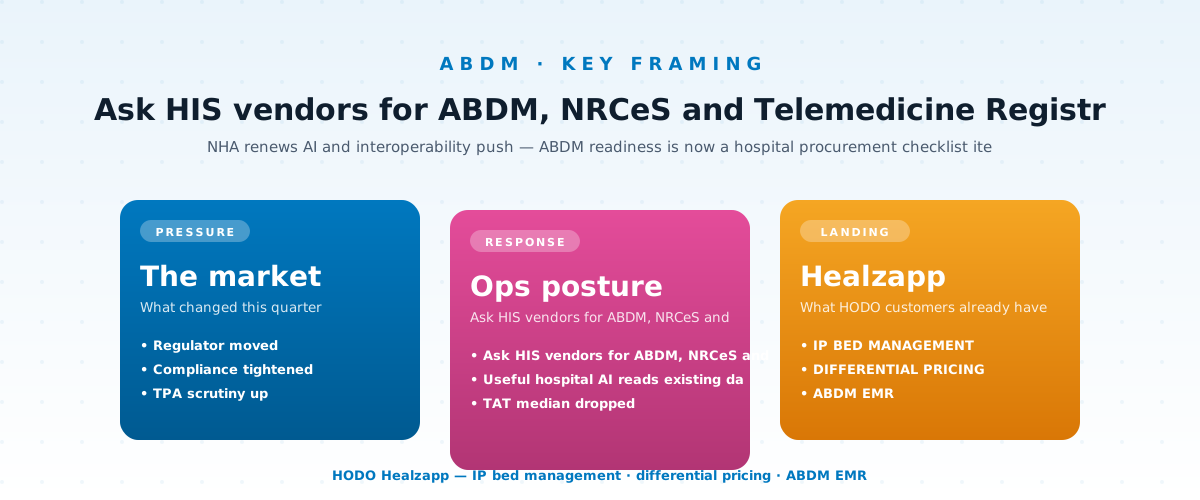
Three lists now matter for vendor due diligence. ABDM integration confirms the software can register facilities and exchange care context. NRCeS listing confirms that the EMR meets national standards for electronic health records. Telemedicine Registry listing confirms the platform is cleared for consultations under the 2020 Telemedicine Practice Guidelines. For a hospital administrator, requiring vendors to appear on all three is a low-effort filter that eliminates a large share of shortlist candidates. HODO sits among the first 20 ABDM-integrated HealthTechs in India, is NRCeS listed and appears on the Telemedicine Registry — the point here is not the badge, but that these lists exist and are enforceable during audits. Beyond the lists, administrators should look at how a vendor handles compliance drift. Regulations change: ABDM specifications evolve, PMJAY documentation requirements shift, state IT rules add layers. A vendor with 500+ client outlets processing 11M+ patient visits absorbs those changes centrally and pushes them to every deployment. A single-tenant deployment or a legacy system requires the hospital's own IT team to interpret each circular. That difference determines whether the compliance function is a background cost or a recurring project.
Clinic chains, diagnostic networks and multi-city hospital groups feel the NHA agenda most acutely. Every new outlet adds another facility to register, another set of staff to enrol on HPR, another billing workflow to reconcile with corporate clients and TPA networks. Manual onboarding does not scale past 5-6 outlets before the finance team starts losing days each month to inter-outlet reconciliation. Operators that scale cleanly are those who standardise on one HIS or LIMS with differential pricing per outlet, consolidated multi-centre financials and one-click new-centre setup. That configuration compresses the launch time for a new branch from months to weeks, and keeps the head office view accurate without daily manual work. For diagnostic chains specifically, the interoperability piece is doubly important because sample flow across outlets — send-outs, partner-lab work, franchisee samples — must maintain a single patient record with a single ABDM identifier. Anything less produces duplicate records, missed follow-ups and audit trails that break under scrutiny. Owners planning to add 3-5 outlets in the next 18 months should evaluate current systems against this scale case now, not after the expansion has started.
For operators on HODO Healzapp, the NHA's push is a tailwind rather than a scramble. The ABDM-compliant EMR already handles care context exchange and ABHA-linked encounters, so administrators do not need a separate integration project to align with the current NHA agenda. The EMR (AI-condensed history) gives consultants a short readable summary of prior visits, which is the class of applied AI the NHA push implicitly favours — output that reads existing data rather than demanding new entry work from clinicians. And for chains adding outlets in the next 12-18 months, Multi-outlet scale-up with one-click new-centre setup keeps facility onboarding, HPR enrolment and consolidated reporting inside a single workflow, so growth does not translate into head-office overhead.
See how Healzapp handles this — book a 30-min demo.
See how Healzapp, Labzapp and EReazy fit your speciality in a free 30-minute demo.
Book a Free Demo