
The Economic Times reported this week that the National Health Claims Exchange (NHCX) — the single-window platform being built by the National Health Authority in coordination with IRDAI — is beginning to shorten the cashless claim cycle for policyholders. For hospital owners, the bigger operational story is what the exchange expects from your billing desk, EMR and TPA reconciliation flow before you can plug in and actually get paid faster.
Most coverage of NHCX has focused on the policyholder benefit: less waiting at the discharge counter, quicker approvals, standardised claim formats. That is real. For a 200-bed hospital or a diagnostic chain, the cashflow arithmetic is more consequential than the patient-experience talking point.
Today, a typical Indian hospital carries 45-90 days of TPA and insurer receivables on its books. Each insurer maintains its own portal, its own pre-auth form and its own document checklist. Every mismatch — a wrong ICD code, a missing signature, a pharmacy line item that does not reconcile with the discharge summary — sends the claim back for rework. Finance teams spend more time chasing paperwork than closing books.
NHCX standardises the transaction. Once a hospital is plugged in, a single format carries pre-auth, enhancement, discharge and final claim across every empanelled insurer and TPA. The receivables clock gets shorter — but only if the HIS produces clean, structured claim data at the point of billing. Hospitals still relying on Excel-based claim tracking will not benefit; they will fall further behind chains that have already digitised the claim lifecycle.
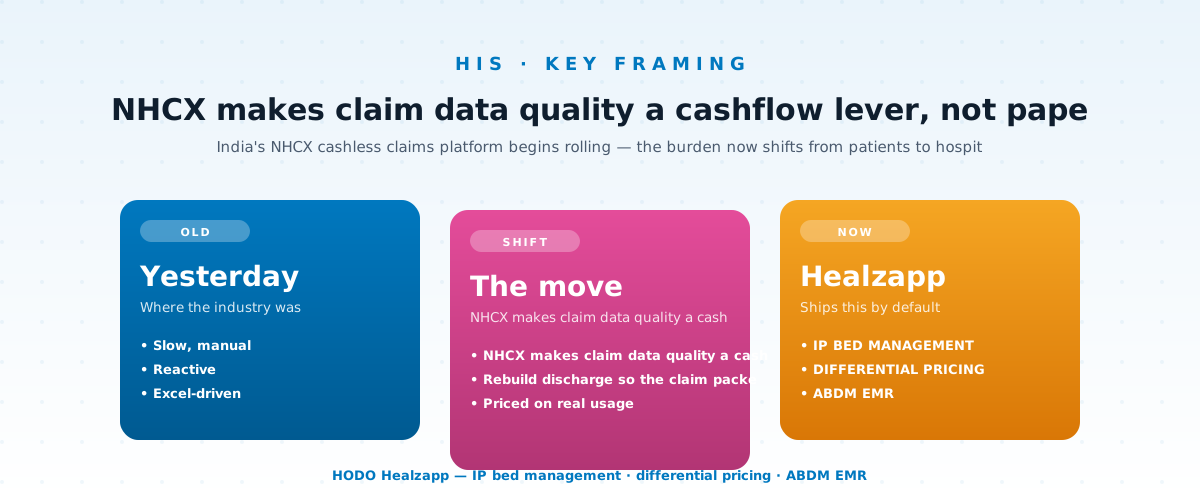
NHCX is a plumbing upgrade. It moves claims faster between hospital, TPA and insurer. It does not clean bad data. The uncomfortable truth for many operators is that their existing HIS produces claim packets that are functionally acceptable to insurers today only because human coders manually stitch them together at the back end.
Once the pipe is standardised, the exchange will reject non-conforming packets automatically. That means every discharge summary must map to a defined clinical vocabulary. Every billing line item must reconcile with EMR entries. Every diagnostic report must carry a machine-readable identifier. Hospitals whose EMR still runs on scanned PDFs and free-text notes will see their initial rejection rate spike — not fall — in the first three months of NHCX onboarding.
The fix is upstream. Structured order entry, coded diagnoses and a billing engine that draws directly from the clinical record rather than from a duplicate data-entry sheet. This is a compliance job, not a marketing job, and the hospitals treating it as such will save themselves a painful transition later.
Under NHCX, pre-authorisation moves closer to real-time. Insurers can query the exchange, pull the treating hospital's proposed line items and respond within hours rather than days. For elective admissions this is a straightforward win. For emergency and IP admissions, the operational demand is heavier: the treating consultant's provisional diagnosis, the ward assignment and the initial billing estimate must all be in the system within an hour of admission, not by end-of-shift.
Discharge is the second squeeze point. The final claim packet must be complete at the moment the patient physically leaves the hospital. Any delay — a pending investigation report, an unsigned discharge summary, a pharmacy return not yet posted — holds up the entire claim. A ward clerk chasing signatures on a paper file no longer works when the exchange expects the digital packet within the hour.
Operators need to redesign the discharge workflow now. Nursing station handovers, pharmacy reconciliation and consultant sign-off need to happen in parallel, not sequentially, all inside the HIS.
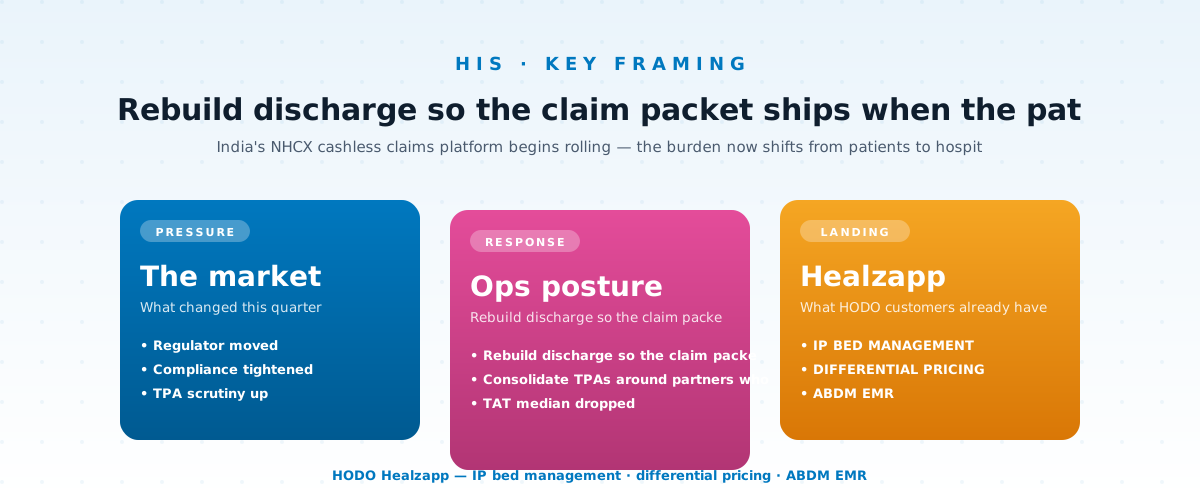
A common concern from hospital finance heads is that NHCX will erode their negotiating position with individual TPAs. In practice, the opposite is likely. Once claim formats are standardised, the only differentiator between TPAs becomes turnaround time, denial rates and settlement discipline. Hospitals will consolidate their TPA relationships around the two or three partners who actually move money on time.
For chains running multiple outlets, the reconciliation problem gets more visible before it gets simpler. Each outlet will produce a stream of NHCX claim IDs, each linked to a payout that may arrive from a different insurer at a different date. Finance will need a central ledger that can match NHCX claim IDs to invoices, to payments received and to the outlet where the treatment happened. Chains that do this centrally will spot leakage — and payer delays — that individual outlet managers cannot see.
The winners here are chains that have already integrated their HIS billing engine with their accounting stack. The losers are chains where each outlet still exports claims to a spreadsheet at month-end.
NHCX rides on the same ABDM rails as the Health ID and the personal health records network. If the EMR is not ABDM-compliant, NHCX onboarding will be a longer, more manual process. The two are being knit together by design.
For hospitals that have been treating ABDM registration as a checkbox exercise — HFR listing, HPR IDs for doctors, but no real EMR integration — this is the moment to close the gap. NHCX is the first ABDM-linked programme that directly affects cashflow. That is the internal business case administrators have been waiting for.
For hospitals running HODO Healzapp, three modules cover the ground NHCX is about to demand. Billing draws line items directly from EMR entries and IP/OP records, which removes the manual reconciliation step between clinical documentation and the claim packet. ABDM-compliant EMR means the discharge summary, diagnostic reports and prescriptions already carry the structured identifiers the exchange requires — HFR, HPR and ABHA linkages are in place, not bolted on later. Tally integration lets multi-outlet chains reconcile NHCX claim IDs against actual receipts across every centre in one ledger, which is where the real cashflow visibility gets built.
None of this makes NHCX onboarding automatic. But it removes the failure modes — bad data, sequential discharge, disconnected outlet ledgers — that will drag on hospitals still stitching claims together by hand.
See how Healzapp handles this — book a 30-min demo.
See how Healzapp, Labzapp and EReazy fit your speciality in a free 30-minute demo.
Book a Free Demo