
The National Medical Commission has directed every medical college in India to implement the Ayushman Bharat Digital Mission (ABDM) framework, with patient registration to be routed exclusively through ABHA IDs, according to Medical Dialogues. For teaching hospitals — most of which run 500 to 2,000 beds across OP, IP, casualty and specialty blocks — this is not a policy tweak but an operating-model change that touches every intake counter, ward register and discharge summary.
Until now, ABDM adoption at medical colleges has been patchy. Some created ABHA IDs opportunistically at the OP counter, others left it to a token screen that patients quietly ignored. The NMC's position removes the discretion: an ABHA ID becomes the primary key for the encounter, not an optional field.
Operationally, this means the registration clerk's script changes. Instead of asking for name, age and phone number as the starting handshake, the clerk now has to trigger ABHA creation or lookup on the very first click. Patients without an Aadhaar-linked mobile — a real segment in tier-2 and tier-3 catchments — need a fallback workflow that still ends in a valid ABHA. Colleges creating 800 to 1,200 new registrations a day now have to redesign the counter flow to keep TAT under two minutes, or the queue will collapse into the corridor.
The downstream effect is bigger than the front desk. Every module that consumes patient identity — billing, pharmacy dispensing, radiology order entry, IP admission, casualty triage — has to accept ABHA as the reference identifier and stop treating the local MRN as authoritative.
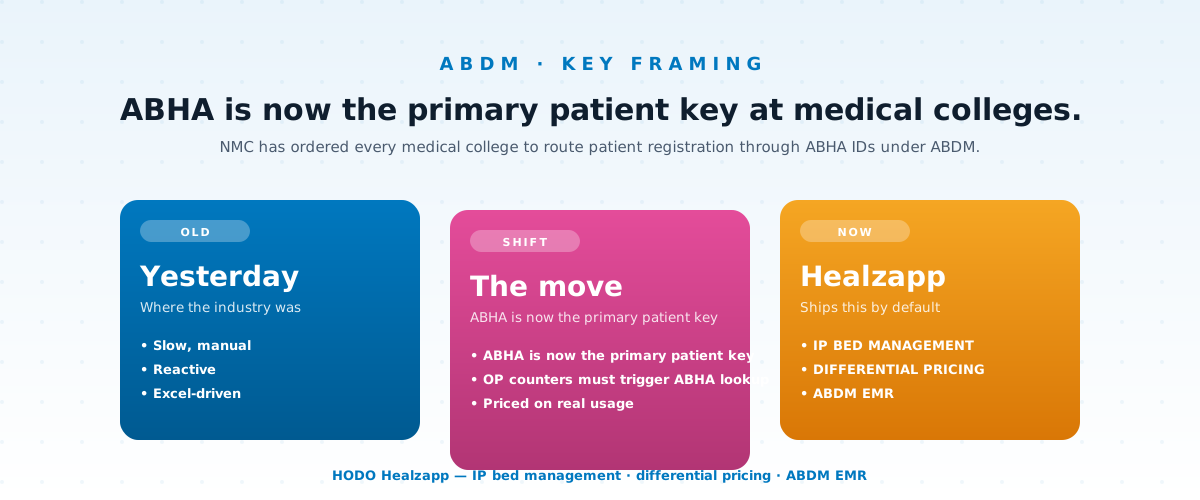
Most hospital information systems in Indian medical colleges were built around a local MRN that has been in circulation for years. When ABHA becomes mandatory, two things break simultaneously. First, returning patients who have an MRN but no ABHA — or an ABHA that was never linked — create duplicate records: one under the old MRN, one under the new ABHA lookup. Second, patients who present at outreach camps or peripheral clinics of the same college with a different intake counter create a third variant.
Deduplication is the boring, expensive work that decides whether ABDM compliance becomes an asset or a liability. Colleges that do not have a merge-and-link workflow — where the registration clerk can search across ABHA, mobile number, Aadhaar last-four and existing MRN in one screen — will spend the next twelve months cleaning up parallel records instead of running research. Administrators should demand a live demo of this specific screen before signing any HIS renewal in 2026.
An ABHA-only intake regime pulls in the rest of the ABDM stack whether the hospital planned for it or not. Once patient records are linked to an ABHA number, the college becomes a Health Information Provider in the ecosystem, which triggers three obligations: consent capture for every data-sharing event, immutable audit logs of who accessed what, and the ability to respond to consent-manager requests from ABDM gateways within defined SLAs.
For a 1,000-bed college running eighteen departments, this is a non-trivial administrative load. The consent artefact is not a paper form scanned into a folder — it is a structured record that must be linkable to a specific encounter, timestamped, and retrievable on demand. Without HIS-level support, the compliance officer ends up maintaining a spreadsheet, which fails the first NMC audit. The audit trail requirement also affects role-based access controls: interns, PGs, consultants and administrative staff each need distinct log signatures.
Private hospital chains have had a two-year head start on ABDM, largely because their billing and TPA pain forced them to clean up patient identity early. Medical colleges — especially government and government-aided ones — face a harder transition for three reasons.
One, patient volumes at teaching hospital OPDs are usually two to three times higher than a comparable private facility, and the registration staff-to-patient ratio is worse. Two, teaching hospitals rotate junior staff every few months, so training a new counter clerk on ABHA capture becomes a recurring cost rather than a one-time exercise. Three, medical colleges have to serve as both a clinical facility and an academic institution — the same patient record has to feed teaching case files, research databases and, now, the ABDM ecosystem, without leaking identifiers into the wrong compartment.
The workaround is not more staff. It is a HIS that treats ABHA capture as a background process rather than a foreground decision point, and that ships with department-specific views so a PG in medicine does not see the same identifiers as a billing clerk.
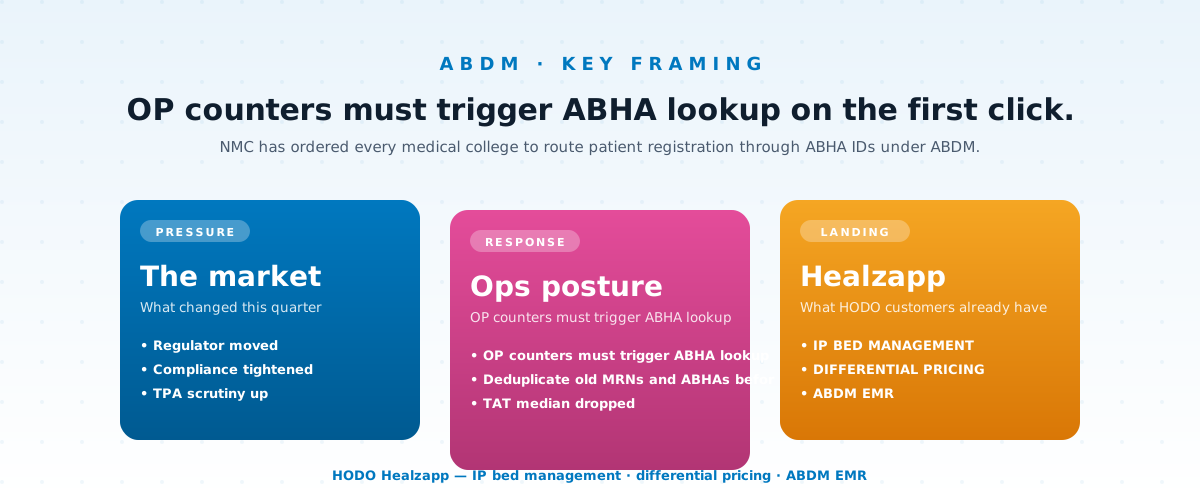
For an MD or hospital administrator evaluating HIS vendors this quarter, the shortlist criteria have shifted. It is no longer enough to ask, "are you ABDM-compliant?" — every vendor will say yes. The sharper questions are: does the intake screen handle ABHA creation, lookup and linkage in a single flow? Is there a consent-artefact module built in, or is it a manual bolt-on? How does the system deduplicate records when the same patient walks in with two different ABHA-linked encounters? Can the discharge summary be pushed to the ABDM gateway without a manual export?
Vendors that were built ABDM-first, rather than ABDM-retrofitted, will show these workflows without a slide deck. Ask for a live demo on a test ABHA sandbox — not screenshots, not architecture diagrams.
HODO Healzapp was designed with ABDM as a first-class citizen, not a compliance retrofit. The ABDM-compliant EMR handles ABHA creation and lookup at the intake counter as a single-click flow, and links the resulting record to the college's existing MRN without creating duplicates. The Patient Management module carries the ABHA reference through every downstream event — OP consultation, IP admission, pharmacy, billing — so no department has to re-key patient identity. For colleges that run peripheral outreach centres and satellite camps, Multi-outlet scale-up with one-click new-centre setup keeps the ABDM configuration consistent across every new location, so a camp registration never becomes a compliance gap.
See how HODO Healzapp handles this — book a 30-min demo.
See how Healzapp, Labzapp and EReazy fit your speciality in a free 30-minute demo.
Book a Free Demo