The NTR Vaidya Seva Trust has levied penalties of Rs 34.39 crore on 203 network hospitals in Andhra Pradesh, as reported by The New Indian Express and carried on Google News. For a 100-bed hospital, the headline number matters less than the mechanism behind it: a scheme regulator reviewing claim records months after discharge and recovering money that was already counted as revenue. That is a cashflow event, and it is almost always traceable to how the hospital kept its records.
A penalty is a cashflow event, not a news item
Scheme business is attractive because volume is predictable. It is fragile because the money moves in two directions. A claim approved today can be reversed eighteen months later after a desk audit, a field visit or a beneficiary call-back, and the recovery is usually adjusted against pending payments rather than invoiced separately. The hospital therefore discovers the penalty as a shortfall in a settlement it had already budgeted for.
Across 203 hospitals, Rs 34.39 crore averages roughly Rs 17 lakh per facility. For a 100-bed hospital running 40 to 60 per cent of its inpatient volume on scheme packages, that figure sits uncomfortably close to a full month of scheme receipts. Finance teams that model scheme revenue as a single receivable line tend to miss this entirely, because the deduction arrives inside a netted settlement and gets written off as a reconciliation difference.
The operational reading is straightforward. Scheme revenue should be tracked with a provision for audit recovery, and that provision should be sized by claim category rather than applied as a flat percentage. High-value surgical packages, ICU stays and implant-linked procedures carry far more audit exposure than a routine medical admission, and a hospital that cannot segregate its scheme receivables by package type cannot see where the risk is concentrated.
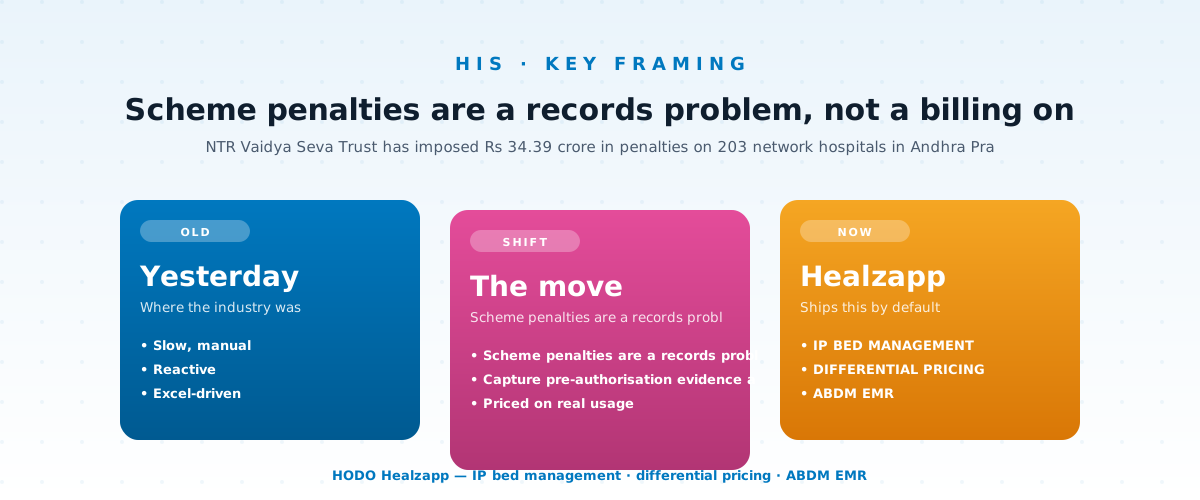
Scheme penalties are a records problem, not a billing one.
Most deductions are documentation failures, not fraud
Public reporting on scheme audits across states consistently points to a similar mix of findings: admissions that could not be substantiated as inpatient care, package upgrades without matching clinical justification, missing or unsigned clinical notes, investigations billed but not evidenced, and discharge summaries that do not reconcile with the pre-authorisation that was approved. Only a small share of recoveries involves deliberate misuse. The larger share involves care that was actually delivered but inadequately recorded.
That distinction decides how a hospital should respond. If the problem were fraud, the answer would be governance. Because the problem is evidence, the answer is capture discipline, and capture discipline is a systems question. A hospital where the consultant dictates notes on paper, the nurse maintains a separate vitals chart, the billing desk keys package codes from a slip, and the scheme coordinator assembles a PDF bundle a week after discharge will fail audits no matter how good the clinical care was. Four disconnected records cannot be made to agree retrospectively.
The practical test for any ~100-bed hospital is simple: pick five scheme discharges from six months ago and try to assemble the complete audit file in under ten minutes. If that exercise needs phone calls to a consultant, a trip to the records room, or a reprint from a machine's local storage, the hospital is carrying unpriced audit risk on every scheme claim it files.
The pre-authorisation trail is where margin leaks
Pre-authorisation is treated as a clearance step, get the approval, admit the patient, move on. In audit terms it is the contract. Every later document is judged against what was claimed at pre-auth: the diagnosis, the proposed package, the expected length of stay, the implants or consumables declared. Deviations are normal in clinical practice; undocumented deviations are what get recovered.
Three leaks recur. First, the package billed at discharge differs from the one approved, because the clinical course changed and nobody filed the revision. Second, the length of stay exceeds the package norm without a daily clinical rationale on record, which invites the finding that the bed was occupied for non-clinical reasons. Third, investigations and procedures performed by an outsourced partner, a referral lab, an imaging centre, a visiting surgeon, appear in the bill without a traceable result document attached to the same patient episode.
Each of these is a workflow gap rather than a clinical one. A hospital that forces the pre-auth package, the running bill and the clinical record to live in the same patient episode closes all three by default, because a mismatch becomes visible at the point of billing instead of at the point of audit. Multi-outlet groups need this at centre level too, since a recovery against one unit is typically adjusted against the group's consolidated settlement.
Build the audit file while the patient is still in the bed
The only reliable version of audit readiness is concurrent. Hospitals that survive scheme audits treat the claim file as something that accumulates during the stay, not something that gets assembled after it. In practice that means a short daily discipline: pre-auth approval and package code recorded against the admission on day zero; nursing vitals, intake-output and medication administration entered at the bedside each shift; consultant notes timestamped daily with a one-line justification for continued stay; investigation reports pulled directly from the analyser or modality into the patient record rather than pasted in later; and the discharge summary generated from those same entries instead of being typed fresh.
Concurrent capture also changes the economics of scheme audits in the hospital's favour. When the record is complete, a disputed claim can be defended with evidence rather than negotiated, and appeal success rates improve sharply. Hospitals should also run an internal pre-submission check on scheme claims, a coordinator reviewing a short checklist against each file before it leaves the building. The cost is a few minutes per claim. The alternative is a recovery eighteen months later against money already spent on salaries and consumables.
Bed-level visibility belongs in the same conversation. Audit findings on unjustified occupancy and on length-of-stay overruns are both really findings about whether the hospital knows, in real time, which bed is carrying which package and for how long. That is an occupancy management problem that doubles as a compliance one.
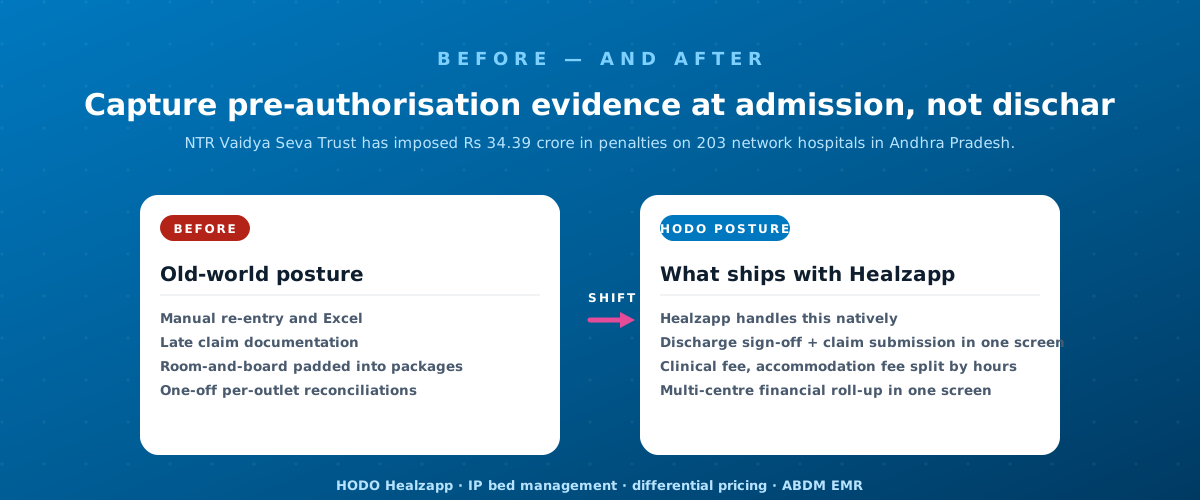
Capture pre-authorisation evidence at admission, not discharge.
What this means for HODO customers
HODO Healzapp is built so the audit file assembles itself as care is delivered. ABDM-compliant EMR (India) keeps clinical notes, orders and reports inside one patient episode with timestamps, so a pre-auth package and a discharge summary are read from the same record rather than reconciled afterwards. Nursing Station captures vitals, medication administration and shift notes at the bedside, which is precisely the evidence scheme auditors ask for and paper charts rarely supply. IP bed management gives real-time occupancy and length-of-stay visibility against the approved package, so overruns surface while the patient is still admitted. Machine Interfacing pulls analyser and modality results straight into the episode, closing the gap between a billed investigation and a filed result. For groups, Multi-outlet scale-up with one-click new-centre setup applies the same capture discipline at every new centre instead of rebuilding it unit by unit.