The Odisha State Health Assurance Society has directed every hospital empaneled under Biju Swasthya Kalyan Yojana (BSKY) and the Ayushman Bharat Pradhan Mantri Jan Arogya Yojana to run a 24×7 patient help desk and complete Ayushman Bharat Digital Mission (ABDM) integration by 31 August, according to a report in Pragativadi. For hospital owners and administrators, this is not a paperwork exercise. It is a fresh operating cost, a fresh staffing decision, and a fresh technology decision landing inside a two-week window.
What the Odisha order actually mandates
Two distinct obligations sit inside the same circular. First, each empaneled facility must run a physical help desk staffed round the clock, positioned to assist patients arriving under BSKY or PMJAY. Second, each facility must complete the standard ABDM steps, facility registration on the Health Facility Registry (HFR), practitioner registration on the Healthcare Professionals Registry (HPR), ABHA-linked patient records, and consented push of clinical documents to the Personal Health Records (PHR) locker. The consequence for missing 31 August is not ambiguous: empanelment can be suspended and pending BSKY reimbursements can be held back until the facility is compliant. For a mid-sized district hospital, that is the difference between a solvent month and a stressed one, and administrators should be planning around it now rather than after the deadline.
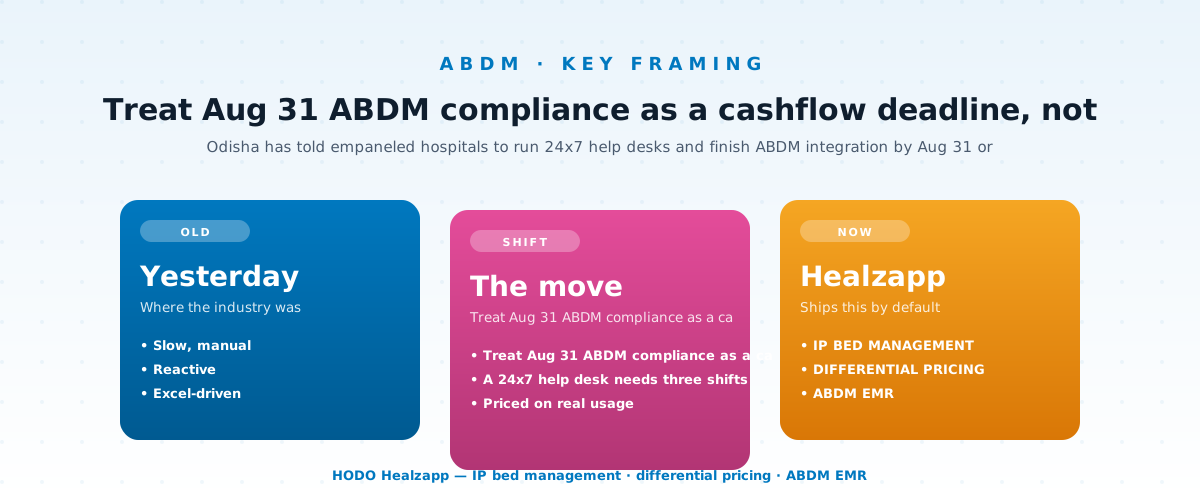
Treat Aug 31 ABDM compliance as a cashflow deadline, not paperwork.
Why the 24×7 help desk is the operationally hardest part
ABDM integration is a project with a defined finish line. A 24×7 help desk is a permanent operating change. Running one properly needs at least three shifts of trained personnel, a defined physical location near the OP entry, escalation paths into the insurance and TPA cells, and, this is the part most hospitals underestimate, live visibility into what is actually happening across the facility. A help desk agent who cannot see current OP queue length, IP bed occupancy, appointment status for the patient in front of them, or the state of a pending BSKY pre-authorisation is not really helping the patient. They are just fielding complaints and passing them along.
The order is being read narrowly in some circles as "put a table and a chair near the entrance". Regulators visiting on audit will look for a lot more than that: a logbook, response and resolution KPIs, a documented SOP for the empanelled-patient flow, and evidence that the desk actually reduces friction rather than adding another queue. Getting that right in two weeks needs the HIS to feed the desk, not the desk to phone around the hospital.
ABDM compliance: the checklist most hospitals still miss
Facility and practitioner registration is now well understood, and most empaneled hospitals in Odisha have at least started HFR/HPR onboarding. Where audits keep finding gaps is downstream. ABHA IDs should be created or linked at the point of registration, every single OP and IP admission, not just the ones the front-desk clerk remembers to ask about. Consent artefacts need to be recorded and retrievable. Discharge summaries, prescriptions, and lab reports need to be pushed to the patient's PHR locker in a standard FHIR bundle, not just printed and handed over at the billing counter.
Two operational habits separate compliant hospitals from the rest. First, ABHA linking is baked into the registration screen, the clerk cannot proceed without either linking an existing ABHA or offering to create one. Second, document push happens automatically at discharge, not as an afterthought at the end of the week. Both habits are software-enforced, not memo-enforced. Any hospital still relying on a monthly "compliance drive" to catch up on ABDM linking will fail the first serious audit.
Staffing and SOPs for the help desk
Three shifts of two agents each is the practical floor for a 200-bed hospital that sees meaningful BSKY volume. Night shift can run leaner if OP is closed, but the ER-facing role remains. Each agent needs a defined script for the top ten queries, pre-auth status, empanelment scope for a specific procedure, referral pathway, bed availability, TPA queries, ABHA creation, PHR access, complaint intake, discharge document collection, and grievance escalation. First-response time and resolution time need to be tracked; even a simple daily report tabulating volumes by query type will pay for itself the first time a regulator asks how the desk is performing.
The desk also needs a direct line into the insurance and TPA cell for pre-authorisation issues, and into the pharmacy for stock queries on BSKY-covered drugs. Where hospitals fail is treating the help desk as a cosmetic add-on. Where they succeed is treating it as the single point of accountability for the empanelled patient's journey through the facility, with the HIS providing the underlying visibility that makes accountability possible.
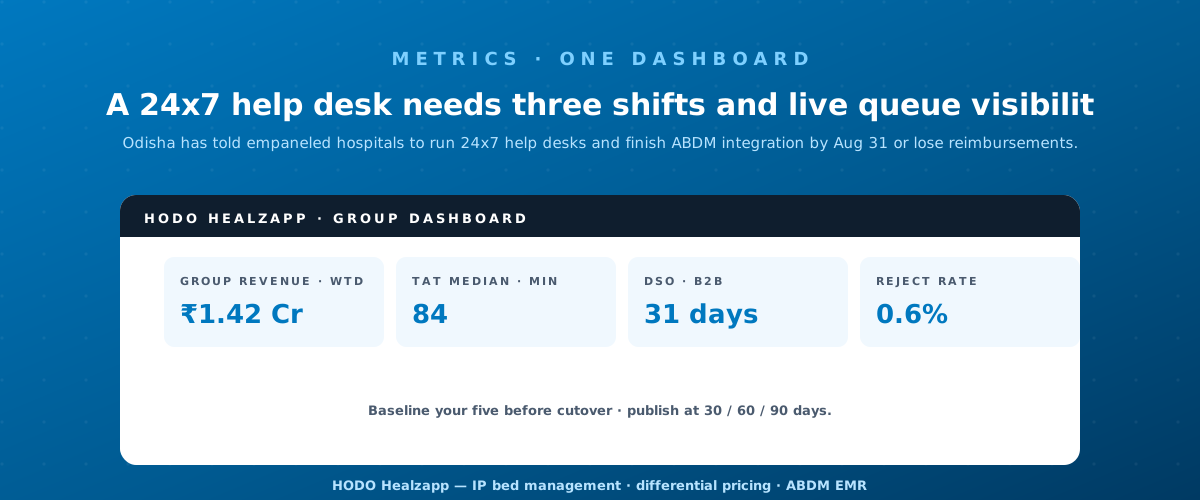
A 24x7 help desk needs three shifts and live queue visibility to work.
Cashflow risk: what happens if you miss Aug 31
BSKY reimbursements form a meaningful share of receivables for empaneled hospitals in Odisha, for some district players, north of a third of monthly cashflow. Suspension of empanelment is not just a reputational hit; it stops that inflow while fixed costs continue. Reinstatement after suspension is not automatic and typically involves fresh document submission, audit, and delay measured in weeks, not days. The rational move for any hospital not already compliant is to treat the Aug 31 date as a hard project milestone, allocate a single compliance owner, and use the next fortnight to close the gaps in a defined sequence: HFR/HPR first, ABHA linking at registration second, discharge document push third, help desk staffing and SOPs running in parallel throughout.
What this means for HODO customers
Hospitals already running HODO Healzapp have most of the technical scaffolding in place. The ABDM-compliant EMR handles ABHA linking at registration, consent capture, and standards-compliant document push to PHR lockers, so the software side of the Odisha order is largely a configuration exercise rather than a build. Patient Management together with Appointments gives the help desk agent a single screen for OP queue status, appointment history, and eligibility, the live visibility the desk needs to actually resolve queries rather than route them. And the TV Token Display, paired with WhatsApp/SMS report delivery, reduces the queries hitting the desk in the first place, because patients are not walking up to ask where their report is or what their token number is.