
Enterprises are spending more on AI every quarter and still cannot show what the money bought. A TechGig report surfaced on Google News this week describes the pattern plainly: budgets keep climbing while finance teams struggle to trace AI outlay to a measurable business outcome. For clinic groups, labs and healthcare founders across the Gulf and India, that gap is not a boardroom abstraction — it decides whether the AI line item survives the next budget review.
Healthcare operators were among the fastest adopters of general-purpose AI, because so much of the work is text. A three-branch polyclinic group in Dubai has receptionists drafting insurance pre-approval notes in a chat tool. A lab-at-home operator in Bahrain has a coordinator rewriting report-delivery messages for WhatsApp. A founder building a doctor-at-home platform in Sharjah runs competitor research, investor updates and job descriptions through the same window. All of that output is real, and none of it is an asset. It lives in individual chat histories, tied to individual logins, phrased slightly differently every time. When the receptionist's contract ends or the coordinator moves to a competitor, the work leaves with them. Meanwhile the invoice is institutional: per-seat licences, usage tiers, an annual commitment. Spend is pooled; value is personal. That asymmetry is the whole of the value gap the TechGig piece describes, and in small multi-outlet healthcare businesses it shows up within a quarter rather than after three years. The test is simple. If the AI tool were switched off tomorrow, what would the organisation still own? For most clinic and lab operators the honest answer is a folder of exported chats nobody has read.
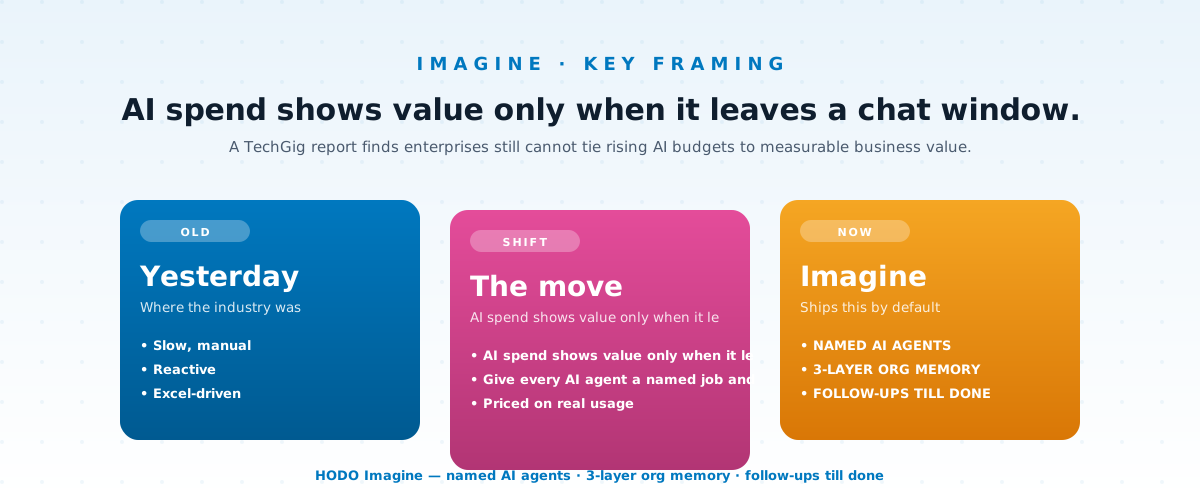
The instinct when AI output disappoints is to buy a better model or write longer prompts. The constraint is usually upstream of both. A general assistant starts every conversation with no knowledge of which insurer rejects which code, what the lab's 90th-percentile turnaround looks like on a Monday, which referring doctor demands a phone call before a critical result, or how the group names its packages. Staff compensate by pasting context back in each time — unpaid labour, and inconsistent by definition. Organisational intelligence is the alternative framing: the useful unit is not a smarter answer but knowledge the organisation keeps. imagine is built on that premise, with a three-layer memory — today, this week, forever — so operational detail settles into the right horizon instead of evaporating at the end of a session. Today holds the live queue. This week holds the patterns worth acting on. Forever holds what should outlive whoever learned it: insurer quirks, pricing rules, escalation paths, the phrasing that works with patients in two languages. Memory, not model choice, is what moves recurring AI spend onto the asset side of the conversation.
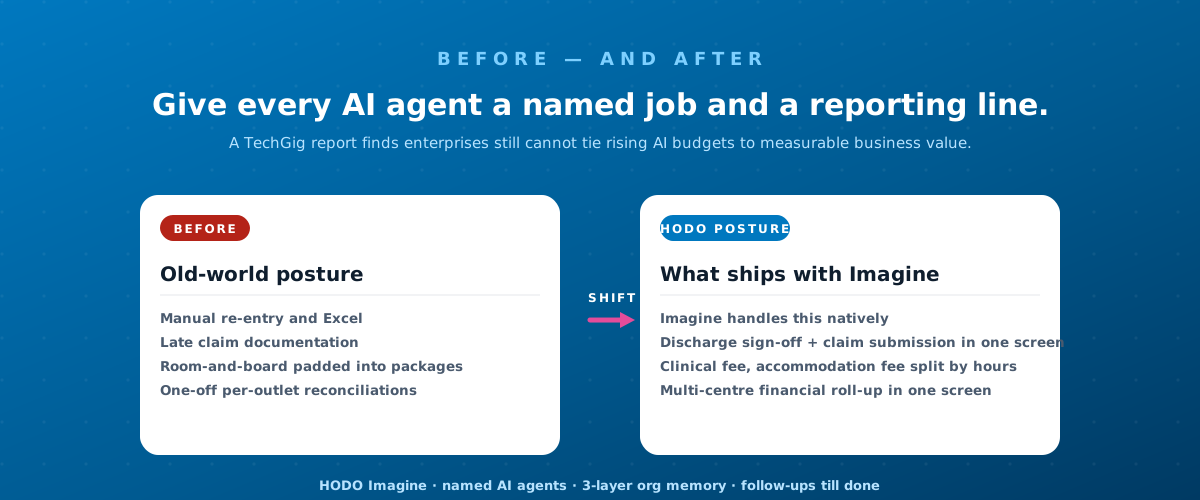
A shared chat window has no owner, no scope and no accountability. Named agents do. In imagine, an agent is given a job, a memory and a reporting line, which makes it reviewable the way a staff role is reviewable. For a polyclinic group that might be one agent owning insurance pre-approval follow-up across branches, another owning no-show and recall outreach, a third owning monthly MIS summaries for the managing partner. For a lab chain it might be an agent tracking turnaround exceptions by centre and an agent handling referring-doctor and corporate-partner correspondence. For a lab-at-home or doctor-at-home operator, an agent chasing unconfirmed bookings and incomplete home-collection paperwork. The structural difference is that each agent accumulates its own context. The pre-approval agent gets better at pre-approvals because it remembers last month's rejections, not because someone wrote a cleverer prompt. Reporting lines matter for the same reason they matter with people: a human reviews the output, corrects it, and the correction sticks. That is also what makes the spend defensible at review time. An agent with a job description can be assessed against that job description. A subscription cannot.
Most AI metrics operators are shown are activity metrics: messages sent, drafts generated, hours notionally saved. Few survive scrutiny. The one that does is closure. Operational work in clinics and labs is a long tail of items that need chasing until they end — a pre-approval sitting with an insurer, a critical result not acknowledged, a home-collection visit booked but not confirmed, a partner invoice disputed, a report delivered but never opened. Every one of those has a date it should have closed by. The design point in imagine is follow-ups until tasks close, which makes two numbers available without translation: the share of items that closed without a human chasing them, and the median days to close. Baseline both before the tool arrives. A polyclinic group that cuts average pre-approval closure from nine days to five has changed its cashflow, and that arithmetic stands independently of any claim about AI. The same logic applies to a lab measuring report-delivery confirmation, or a home-visit operator measuring booking confirmation rate per route. Closure is auditable. Enthusiasm is not.
Two further controls separate spend that can be justified from spend that cannot. The first is voice. Clinic groups in the UAE, Qatar and Bahrain communicate across languages and channels, and licensing authorities take a close interest in how healthcare services are described to the public. Output assembled ad hoc by different staff in different chat tools drifts, and drift is a compliance exposure as much as a branding one. Brand voice consistency held at platform level means patient messages, report covers and campaign copy read as one organisation. The second control is the audit trail. If an agent drafted a recall message or a partner escalation, there should be a record of what it saw and what it sent. Founders raising money face a version of the same question from investors: what in this business is institutional rather than personal? It is also worth being clear about what imagine is not. It does not replace Microsoft 365, Copilot or ChatGPT — it connects them with memory, so existing licences keep earning. Operators evaluating a purchase should therefore ask what the platform retains, not which model sits behind it.
The AI value gap is a bookkeeping problem with an operational fix: stop buying capability and start accumulating an asset. For healthcare founders and operators, the practical sequence is to pick two or three recurring chase-and-close workflows, baseline their closure numbers, assign them to agents with names and owners, and review the output monthly like any other role. Three things in imagine do the load-bearing work. Named AI agents with jobs, memory and reporting lines turn diffuse tool use into reviewable roles. 3-layer memory (today / this week / forever) keeps insurer rules, turnaround patterns and escalation paths with the organisation rather than with whoever happened to learn them — which matters most in markets where staff turnover is structural. Follow-ups until tasks close converts AI activity into a closure rate and a days-to-close figure that hold up in a budget review. Digital transformation, in this reading, is not one more tool in the stack. It is knowledge the organisation owns and compounds, with an audit trail to show for it.
See how imagine turns AI into organisational intelligence — explore imagine.
See how Healzapp, Labzapp and EReazy fit your speciality in a free 30-minute demo.
Book a Free Demo