Metropolis Healthcare has acquired Kolhapur-based Ambika Pathology Laboratory, adding a regional pathology brand to its pan-India network, per BioSpectrum India. The deal continues a pattern that owners of standalone labs and small chains should read carefully: national players are buying reach in Tier-2 and Tier-3 markets, and the ability to fold an acquired lab into a single operating stack has become the price of entry for both sides of any such transaction.
The consolidation curve is steepening
Indian diagnostics has moved from a fragmented cottage industry to a barbell, a handful of national chains at one end, and thousands of standalone labs at the other. Metropolis has publicly stated its intent to grow non-organically in cluster markets, and the Ambika deal fits that thesis. Kolhapur is not a metro; it is a well-populated Tier-2 hub with a captive doctor referral base and a diagnostic footprint that a national player would take years to build on its own.
For lab owners watching this, the take-home is not sell tomorrow. It is that the valuation multiple you get in any conversation with a national buyer is largely a function of two things: your top-line credibility, referral doctor loyalty, corporate contracts, and how quickly your operations can be plugged into a buyer's system. Owners who have run for a decade on a mix of Excel sheets, a home-grown LIMS, and one loyal biochemist typically discount 20-30% on integration friction alone.
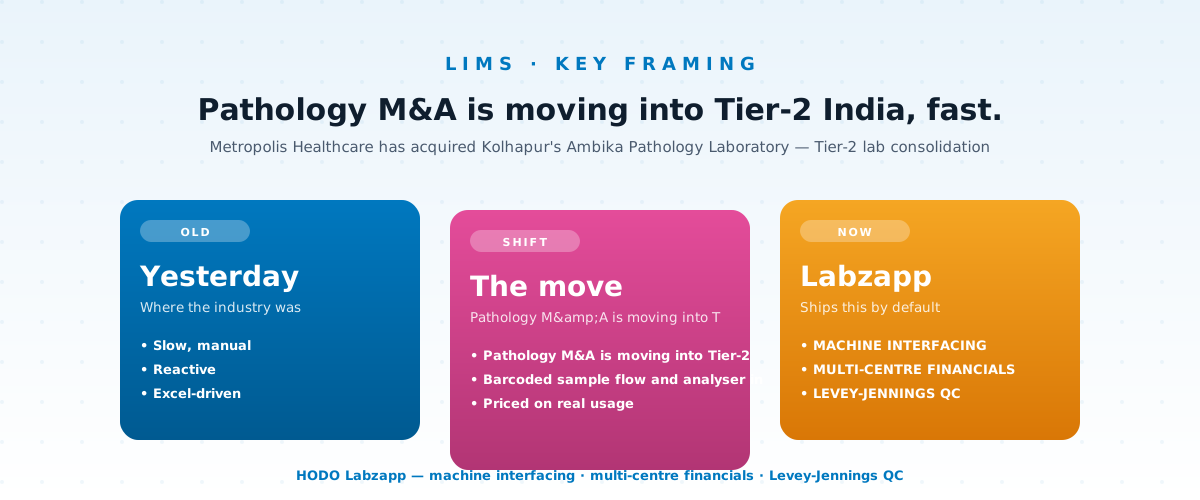
Pathology M&A is moving into Tier-2 India, fast.
What integration actually looks like on day one
When a national chain acquires a regional lab, the first ninety days are dominated by three questions. Can every sample in the acquired centre be barcoded the same way as in the flagship? Can reports be routed through a single dispatch pipeline so the acquired lab's patients start receiving reports under the acquirer's brand? And can financial reporting be consolidated so the acquired lab's daily revenue rolls up into the parent P&L without a month-end reconciliation nightmare?
Each of these is a LIMS question. Barcoding is table stakes, samples with printed barcodes at accession, scanned again at each analyser, mean the acquirer can enforce the same chain-of-custody across a newly-added centre from week one. Report routing means the same test done at Kolhapur and at Mumbai must generate a report with identical structure, disclaimers, and NABL footer. And multi-centre financial rollups mean the CFO can see gross margin per test per centre by day two, not by day sixty.
Why the smaller lab's LIMS choice matters
Standalone labs often underestimate how much their software choice affects both operating margins today and exit valuation tomorrow. A LIMS that cannot output structured data, that hard-codes test menus, or that stores results in a proprietary format the acquiring chain cannot read, becomes a landmine in due diligence. The buyer will either discount for the migration cost or insist on a data-migration warranty in the SPA.
Beyond M&A, the same features that make a lab acquisition-ready also make it profitable on a standalone basis. Automated report delivery through SMS, WhatsApp, and email cuts front-desk workload by a measurable margin, a mid-sized lab running 400 tests a day typically spends 10-15 person-hours a week just on report dispatch when done manually. Levey-Jennings QC charts, run daily on control materials, catch analyser drift before it produces a clinical incident that costs the lab both money and reputation. Differential pricing per referral doctor or corporate partner, when handled inside the LIMS instead of in a spreadsheet, prevents the leakage that most labs discover only during an annual audit.
TAT, franchisees, and the multi-outlet reality
Metropolis operates hundreds of collection centres and dozens of processing labs; Ambika's centres now feed into that hub-and-spoke. For any chain running this model, turnaround time is the single most-watched metric, because every hour of TAT slippage translates into either a phone call from a referring doctor or a report delivered after the patient's follow-up appointment. Reporting TAT at the test, department, and centre level is what allows a national COO to see which sample-to-report leg is bleeding time, collection to receipt, receipt to accession, accession to result, or result to dispatch.
Franchisee management adds another layer. A collection centre run by a franchisee needs its own login, its own daily settlement, and its own commission working, but the samples still flow into the parent lab's processing queue and reports still come out of the parent's dispatch pipeline. A LIMS that treats franchisees as an afterthought forces the parent to run two ledgers in parallel, which is exactly the problem a national acquirer wants to avoid inheriting.
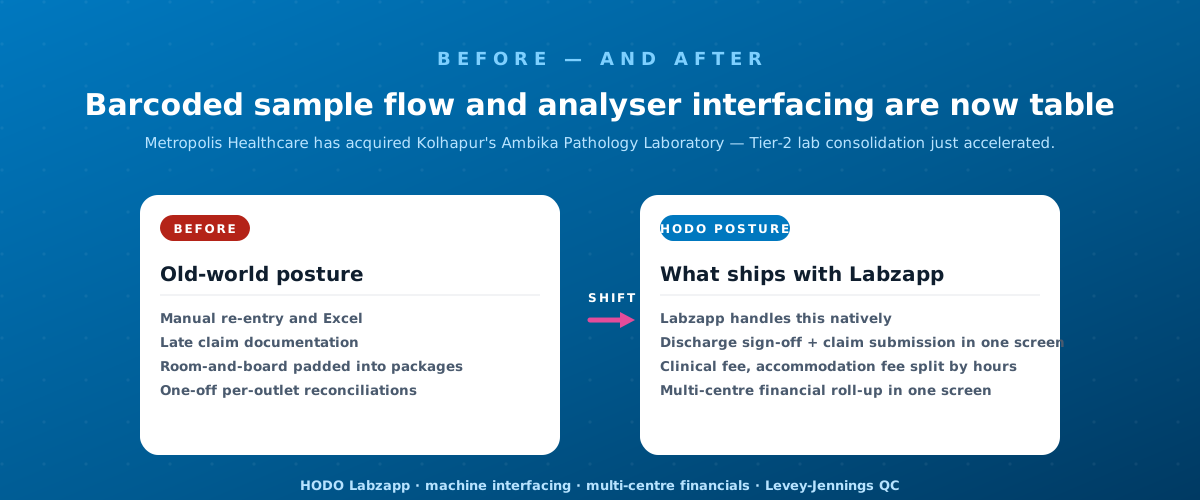
Barcoded sample flow and analyser interfacing are now table stakes.
What smaller lab owners should do this quarter
Independent of any acquisition conversation, three actions raise a lab's operating floor and its ceiling valuation. First, get every sample under a barcode-driven workflow with machine interfacing to the analysers already on the floor, this alone typically removes 30-40% of transcription errors and shaves 20-30 minutes off average TAT. Second, publish TAT and QC metrics internally on a weekly basis; the labs that get bought at premium multiples are the ones whose founders can produce these numbers on demand. Third, move from centre-level P&Ls to a consolidated multi-centre view, even if the lab operates a single centre today, structuring the books this way from the start means the second centre, or the acquirer's fiftieth, plugs in without a rewrite.
What this means for HODO customers
Labzapp is built for exactly the operating model the Metropolis-Ambika deal illustrates: multi-centre, referral-driven, and increasingly consolidated. Barcoded samples + machine interfacing gives every centre, flagship or newly-added, the same sample-tracking discipline from day one. Multi-centre financials means the CFO of a two-centre lab or a two-hundred-centre chain sees the same rolled-up numbers without waiting for month-end. And Differential pricing per partner, combined with the referral-doctor and corporate-partner portals, means commercial arrangements with doctors, hospitals, and corporates are enforced by the software rather than remembered by the billing clerk. For labs planning an acquisition, a sale, or simply the next franchisee, the same feature set is what turns operational hygiene into a valuation lever.