NITI Aayog has called for uniform patient safety standards across Indian hospitals, in a recommendation reported by Bold News and carried on Google News. The call points squarely at the gap between large corporate chains that already run structured incident reporting and the mid-sized hospitals that deliver most of India's inpatient volume. For a 100-bed hospital, the operational question is not whether safety matters — it is whether the hospital can produce evidence of it on demand.
From advisory to measurable standard
Uniform standards are, in practice, a data request. The moment safety expectations become common across hospital categories, they arrive as a format: how many falls, how many medication errors, how many hospital-acquired infections, how many critical results acknowledged within how many minutes, per 1,000 patient days. NABH accreditation already imposes this discipline, but accredited hospitals remain a minority of the country's bed capacity. A uniform baseline extends the reporting obligation to hospitals that have never been asked to compile it.
That changes the nature of the work. Safety committees in mid-sized hospitals usually meet after an event, review what happened, and record a decision in a minute book. A uniform standard assumes continuous measurement — a denominator that is always available and a numerator that is captured as care happens, not reconstructed later. Hospitals that depend on registers and photocopies will find the compilation effort grows faster than the clinical work. Hospitals whose HIS already timestamps clinical events will find most of the reporting is a query, not a project.
The second shift is comparability. Once numbers are uniform, they can be ranked, and payers notice rankings. TPAs and state PMJAY implementation agencies already use empanelment conditions as leverage. Safety indicators are the obvious next column in that spreadsheet.
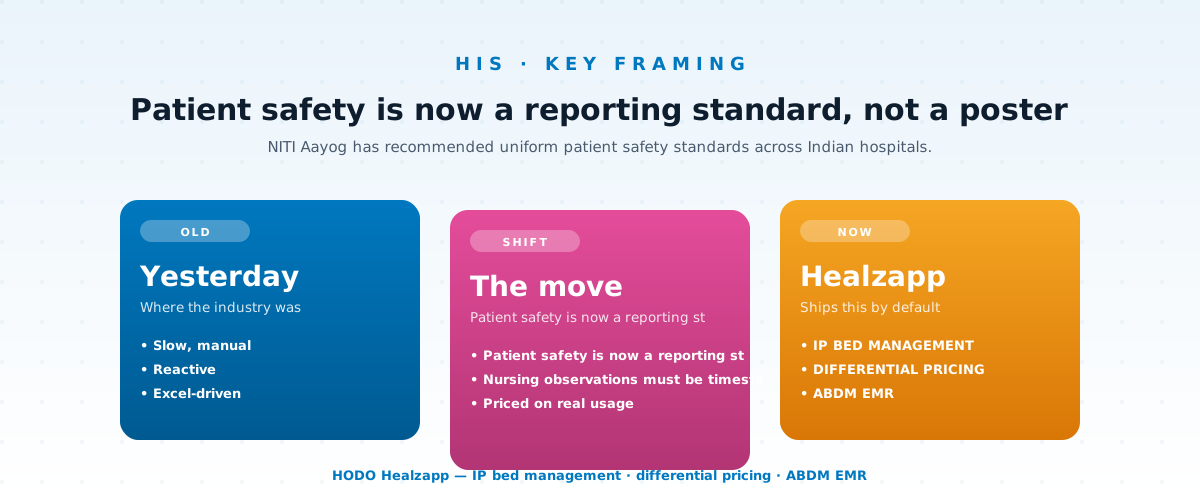
Patient safety is now a reporting standard, not a poster.
Safety is a documentation problem before it is a clinical one
Most 100-bed hospitals in India do the clinical work competently. What fails is the record. Nursing observations sit on a bedside paper chart. Handover happens verbally at shift change. Drug administration is ticked on a printed sheet that may or may not match what pharmacy issued. Lab results are phoned to the ward and the acknowledgement is never written down. None of this is negligence; it is simply a system that cannot be queried.
The consequences are practical. A paper record cannot tell a matron that vitals on bed 14 were charted four hours late, so escalation happens only when a patient deteriorates visibly. A paper drug chart cannot be reconciled against pharmacy issue, so a dispensing mismatch surfaces at month-end stock count rather than at the bedside. And when an insurer or an accreditation assessor asks for a six-month trend, a staff nurse is pulled off the floor for three days to count entries by hand — which is itself a safety cost.
Timestamp integrity is the part operators underestimate. Any trail entered retrospectively, in a batch, at the end of a shift, is worth very little in an audit and nothing clinically. Capture has to happen at the point of care, on a screen that is faster than the paper it replaces. If the nursing workflow adds minutes per patient, staff will route around it, and the hospital will own a system of record that records fiction.
The four trails a mid-sized hospital usually cannot produce
Strip the safety conversation down and four trails do most of the work.
The bedside observation trail. Ordered frequency of vitals versus actual charted frequency, and what happened when a reading crossed a threshold. This is the single most predictive safety dataset a general ward produces, and it is almost always on paper.
The medication trail. Prescribed, dispensed, administered — with who, when, dose, and batch at each step. The common failure is not a wrong drug; it is an unreconcilable gap between what the pharmacy issued and what the nurse recorded as given.
The diagnostic trail. Order placed, sample collected, result verified, result seen by a clinician. Critical-value acknowledgement is the standard break point in Indian hospitals: the lab calls the ward, the ward writes it in a notebook, and no one can later prove the treating consultant was informed. Where the lab analyser pushes results into the HIS directly, transcription error disappears and the clock is machine-stamped.
The device trail. Which equipment produced which reading, when it was last serviced, whether its AMC is live. An out-of-calibration analyser or a ventilator that failed mid-case is a safety event with a procurement root cause, and the paperwork for it usually lives in a biomedical engineer's drawer.
Medication and equipment: where audits break first
Two areas account for a disproportionate share of adverse findings, and both are inventory problems as much as clinical ones.
On medication, the controllable variables are batch and expiry visibility at the point of issue, a single prescription record that pharmacy and nursing both read from, and a daily reconciliation between issue and administration. A 100-bed hospital running pharmacy on a separate billing-only package will not get this, because the prescription and the issue live in two databases that agree only on the invoice total.
On equipment, the controllable variable is a live asset register with warranty and AMC dates attached, mapped to the department that depends on the machine. The cost of getting this wrong is visible: an OT case postponed because a sterilised instrument set was unavailable, a scan repeated because the machine drifted, an analyser down on a Monday morning with 60 samples queued. Each of these is an operational loss before it is a safety statistic, which is why it is worth fixing regardless of what NITI Aayog finalises.
Both areas also carry a cashflow angle. Claim queries from TPAs frequently turn on administration records and consumable justification. A hospital that can export a timestamped administration trail against a claim closes queries in days rather than weeks, which shows up directly in days-sales-outstanding.
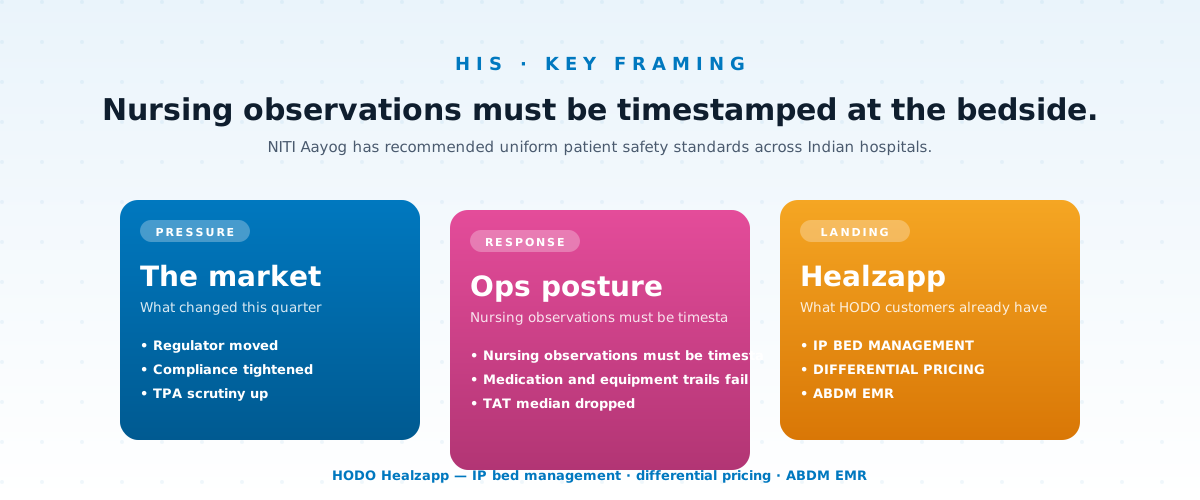
Nursing observations must be timestamped at the bedside.
Costing the shift honestly
Uniform standards will add work. Someone has to own safety data, staff need training on structured capture, and the first three months of any change slow the ward down. Budgeting for a part-time quality role at 100 beds is realistic; pretending the data compiles itself is not.
Against that sit measurable returns. Avoidable complications extend length of stay, and in a bed-constrained hospital every extra inpatient day is revenue displaced rather than revenue earned. Repeat investigations caused by sample or device problems are pure cost. Defensible records shorten payer query cycles. And for a group running multiple outlets, a common safety protocol with a common data format means a new centre inherits the standard on day one instead of inventing its own register.
What this means for HODO customers
HODO Healzapp was built around exactly these trails for Indian hospitals in the 50–150 bed range. Nursing Station moves observation charting, drug administration and shift handover onto a timestamped record captured at the bedside, which is what turns a safety claim into a safety trail. Machine Interfacing pushes analyser and device output straight into the patient record, removing the transcription step where diagnostic errors and lost critical values originate. Warranty+AMC asset tracking keeps service and calibration status against each asset, so a device-related safety finding has an owner and a date rather than a drawer. Combined with ABDM-compliant EMR and IP bed management, the reporting that a uniform standard will eventually demand becomes a query against existing data rather than a quarterly scramble.