The Legal Affair reports that the Allahabad High Court has upheld a hospital's removal from Ayushman Bharat empanelment over treatment protocol lapses, holding that empanelment under a publicly funded scheme is a privilege rather than an enforceable right. The ruling is Indian, but the principle travels: a payer that funds care may set conditions on how that care is delivered and documented, and may withdraw the contract when those conditions are not met. For polyclinics in Dubai, Abu Dhabi, Doha, Kuwait City and Manama, where most revenue sits inside insurer and TPA networks rather than a state scheme, that is the practically useful reading of the judgment.
What the court actually decided, and why it travels
The hospital challenged its removal as arbitrary and asked to be reinstated. The court declined, reasoning that participation in a funded scheme is an administrative arrangement granted on terms, not a property-like entitlement that survives a breach of those terms. Review in such matters turns on whether the removal followed a fair process, notice, an opportunity to respond, a reasoned order, rather than on whether the provider believes its clinical conduct was defensible in hindsight.
That distinction is where the operational lesson sits. If the questions a reviewer will ask are limited to whether due process was followed and whether the provider's own records support its account of the episode, then the defence is built long before any show-cause notice arrives. It is built in the consultation note, the order trail, the dispensing log and the claim file. A clinic that has to reconstruct a six-month-old episode from memory, loose paper and a billing spreadsheet has already conceded the argument, regardless of how good the care was. Legal exposure here is a records problem wearing a legal costume.
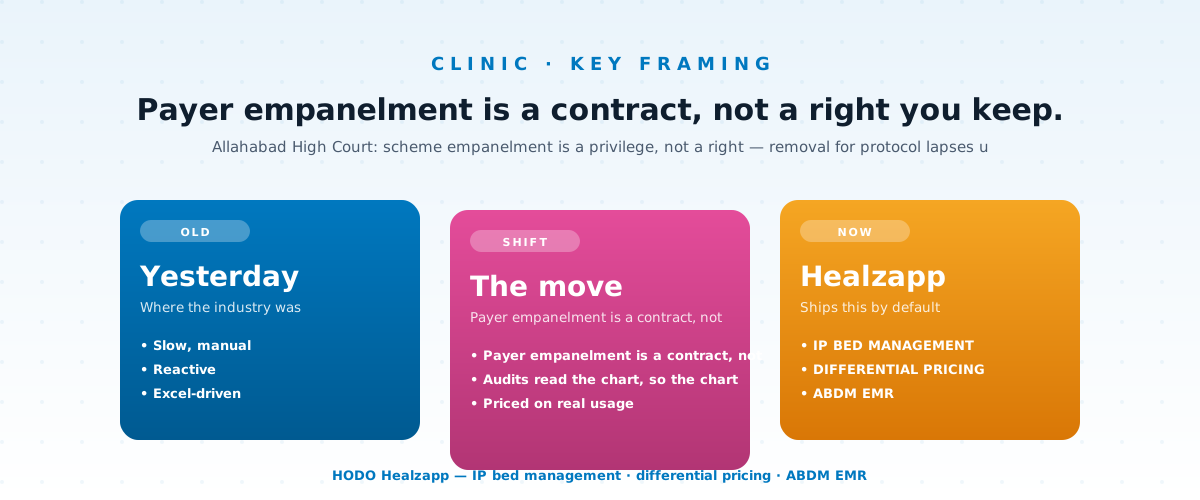
Payer empanelment is a contract, not a right you keep.
Insurer networks in the Gulf run on the same logic
Licensing and network participation are two separate things in the GCC, and operators sometimes conflate them. A DHA, DOH or MOHAP licence establishes the right to practise. Inclusion on a payer's provider list, a Daman or Thiqa panel, or a TPA network run by NAS, Nextcare, MedNet or GlobeMed, is a commercial agreement with clinical, coding and record-keeping clauses attached. Nothing about holding a licence guarantees that the agreement is renewed.
Removal from a network does not require a court at all. It requires an audit finding, a pattern of rejected claims, or a medical-necessity dispute the clinic cannot answer with documents. The intermediate penalties bite before the extreme one does: a higher prior-approval threshold, a tariff renegotiation, retrospective recovery of paid claims, or quiet removal from the insurer's app-visible provider list. For a multi-doctor polyclinic whose insured footfall is concentrated in two or three networks, losing one of them can remove a quarter of monthly volume with sixty days' notice. Cash patients do not arrive to replace them.
Protocol lapses are usually documentation lapses
Audit teams never see the consultation. They see the chart, and they judge the consultation by it. The recurring findings across GCC clinic audits are predictable: a recorded diagnosis that the history and examination notes do not support; investigations ordered with no indication written anywhere; medication dispensed without a traceable prescription behind it; absent vitals on visits where the billed service assumes them; missing consent for a minor procedure; a treatment summary authored days after discharge with no amendment trail; and claim lines that no clinician in the clinic can map to a specific order.
In most of these cases the clinician did the right thing. The record simply cannot prove it. That gap is the entire exposure, and it is not closed by training staff to be more careful. It is closed by making the compliant path the only path through the software, the note cannot be left half-finished, the billing line cannot exist without a parent order, and the author and timestamp of every entry are not editable after the fact. A clinic that treats documentation as an administrative afterthought is carrying an unpriced liability on every insured visit.
The four artefacts a clinic should produce within a day
A useful internal test: pick any insured episode from the last twelve months at random and see how long it takes to assemble four things. First, the per-visit clinical record, history, examination, diagnosis, orders, outcome, with author identity and timestamps intact. Second, the claim-to-chart trail, showing which billed line maps to which clinical order and which consumable left inventory against it. Third, tariff provenance: which network rate card applied on that date, which approval reference was obtained, and who authorised any variance. Fourth, where the clinic runs its own lab or imaging, the trail from raw machine output to the signed report that influenced the decision.
If that takes an afternoon, the clinic is audit-ready. If it takes a week of chasing WhatsApp messages, scanned paper and a departed receptionist's folder structure, the clinic is exposed, and the exposure grows with every new branch, because unwritten local practice does not replicate cleanly. Running this test quarterly, on a random episode nobody prepared for, is a cheaper form of assurance than any post-notice scramble.
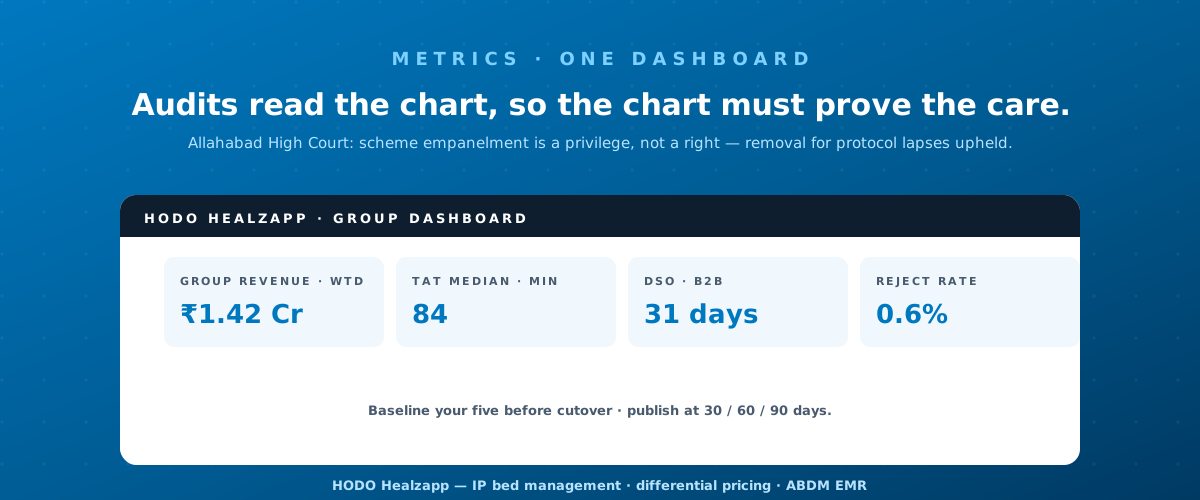
Audits read the chart, so the chart must prove the care.
Build the evidence into the visit, not into the response
The design principles are unglamorous and they work. Use structured, specialty-specific note templates rather than open text boxes. Make a defined set of fields mandatory before a visit can be billed, so the record closes ahead of the claim. Attach orders to indications at the point of ordering. Route dispensing through pharmacy and inventory so that stock movement and prescription agree. Keep an immutable audit log of who wrote, edited and approved each entry. Hold tariffs and approval rules in the system rather than in a branch manager's head.
For multi-branch groups, enforcement has to be central. One template library, one rule set, one tariff structure replicated across every outlet, so that a new centre inherits a configuration that already survived an audit instead of inventing its own conventions in month one. That is also what makes growth cheap: compliance configuration becomes a copied asset rather than a project repeated per location.
What this means for HODO customers
Healzapp is built so the audit trail is a by-product of normal work. EMR (AI-condensed history) keeps structured, timestamped clinical records with a condensed episode view, so a year-old visit can be reconstructed in minutes instead of days. Billing (incl. multi-currency / GCC patterns) with Differential pricing ties every claim line to an order and an agreed network tariff rather than to a manual entry. And Multi-outlet scale-up with one-click new-centre setup carries the same templates, rules and price structures into each new branch, so protocol discipline does not dilute as the group grows. Empanelment may be a privilege, but keeping it is an engineering choice.