Punjab Kesari English reports that Ayushman Bharat PM-JAY has crossed its eighth anniversary, having funded 13.25 crore hospital admissions since launch. The headline is usually read as a coverage milestone. For a 100-bed hospital that is already empanelled, or still weighing it, the more useful reading is operational: 13.25 crore admissions is also 13.25 crore pre-authorisations, package selections, discharge summaries and claim files, each with its own clock.
Eight years in, PM-JAY is a volume business, not a CSR line item
When the scheme began, many mid-size private hospitals treated empanelment as goodwill, a few beds set aside, a designated Ayushman Mitra, and a monthly reconciliation that somebody did on a spreadsheet. At 13.25 crore cumulative admissions, that posture no longer matches the load. In several districts, scheme patients are now a double-digit share of inpatient volume for private hospitals, and in speciality-heavy blocks such as ortho, ophthalmology, general surgery and dialysis, the share runs higher still.
That changes what the hospital has to measure. A cash or corporate admission is priced per line item, so under-recording a consumable costs a little margin. A PM-JAY admission is priced by package, so the revenue is fixed at the moment the package is chosen. Everything the hospital does after that, length of stay, implant choice, repeat investigations, an extra day in ICU, moves cost, not revenue. A hospital that cannot see cost per PM-JAY case by speciality and by treating consultant is effectively running a fixed-price business with variable-price instincts.
The first discipline, then, is not billing. It is costing. The package rate should be compared against the hospital's own loaded cost for that procedure, bed-day, OT time, consumables, implants, pharmacy, diagnostics, before the case is accepted, not after the claim is settled.
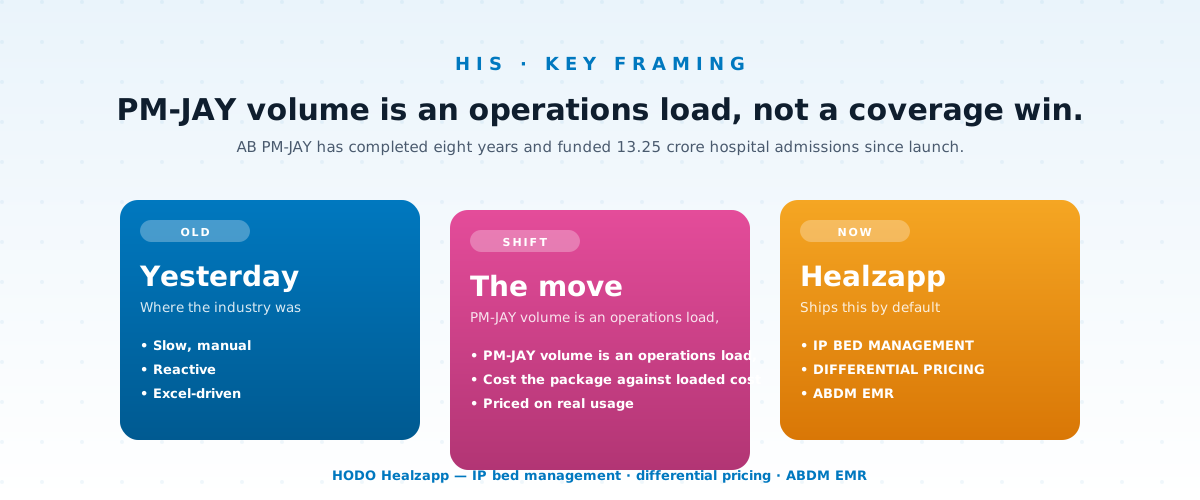
PM-JAY volume is an operations load, not a coverage win.
Package rates put the margin in the front office
Under a package regime, the two decisions that determine whether a case makes money are taken in the first hour: is the beneficiary correctly identified and eligible, and is the right package selected for the presenting condition. Both happen at registration and admission, typically by staff who are not clinicians and are handling a queue.
Getting identity and eligibility wrong is expensive in a specific way, the treatment still happens, the cost is still incurred, and the claim is rejected weeks later with no recourse. Getting the package wrong is subtler: an under-specified package means the hospital delivers a higher-acuity episode at a lower-acuity rate, and the difference is absorbed silently.
Practically, this argues for three things at the counter. One, beneficiary verification and scheme selection should be part of the same registration screen that captures demographics, so no patient reaches the ward with the payer field still blank. Two, the package or procedure code should be attached to the admission record itself, so that the bed, the pharmacy indent and the lab orders all inherit the correct payer context from the start. Three, the patient's out-of-pocket liability, non-covered items, non-scheme add-ons, should be known and communicated before admission rather than argued about at discharge. Pushing this conversation to the discharge counter usually ends in a write-off.
Pre-authorisation and documentation are the real turnaround time
The clinical turnaround time of a PM-JAY case is rarely the constraint. The documentation turnaround time usually is. Pre-authorisation requires the case sheet, the relevant investigation reports, and in many states photographic and clinical evidence; query responses have to be filed within a window; the claim book needs the discharge summary, the final bill and the treatment records assembled without gaps.
In most 100-bed hospitals, this work is done by one or two people who chase consultants for notes and the lab for reports. That is a single point of failure, and it is where claims quietly age. Rejections and long-pending queries almost never trace back to a clinical disagreement, they trace back to a missing report, an unsigned note, a mismatch between the package claimed and the procedure documented, or a discharge summary written three days after discharge.
The fix is structural rather than heroic. If the EMR, the lab and the billing system are one record, the claim file assembles itself as the episode progresses: investigation reports are already attached, nursing notes are timestamped, and the discharge summary is generated from the same record the consultant has been writing into. If they are three systems, somebody has to be the integration layer, and that person is the bottleneck. A useful internal metric is days from discharge to claim submission, tracked by ward and by consultant. Anything beyond 48 hours is a process problem, not a staffing one.
The settlement gap is a working-capital problem
Scheme revenue is real revenue, but it arrives late and in tranches. A hospital with a meaningful PM-JAY share is, in cashflow terms, extending credit to the state, while paying salaries, pharmacy vendors and implant distributors on ordinary commercial terms.
The operational answer is ageing visibility at the payer level. Total receivables is a useless number for this purpose. What a promoter needs on a weekly basis is: how much is pending with the scheme versus each TPA versus corporates; how much of the scheme pending is awaiting query response from the hospital itself; how much has crossed 60 and 90 days; and which specialities are generating the slowest-settling cases. A surprisingly large share of ageing receivables in mid-size hospitals is not stuck with the payer at all, it is stuck internally, waiting for a document nobody has been assigned to produce.
Once that split is visible, the follow-up work becomes assignable and measurable. It also changes case-mix decisions: if a particular package settles reliably in 30 days and another routinely takes 120, that difference belongs in the conversation about which services to scale.
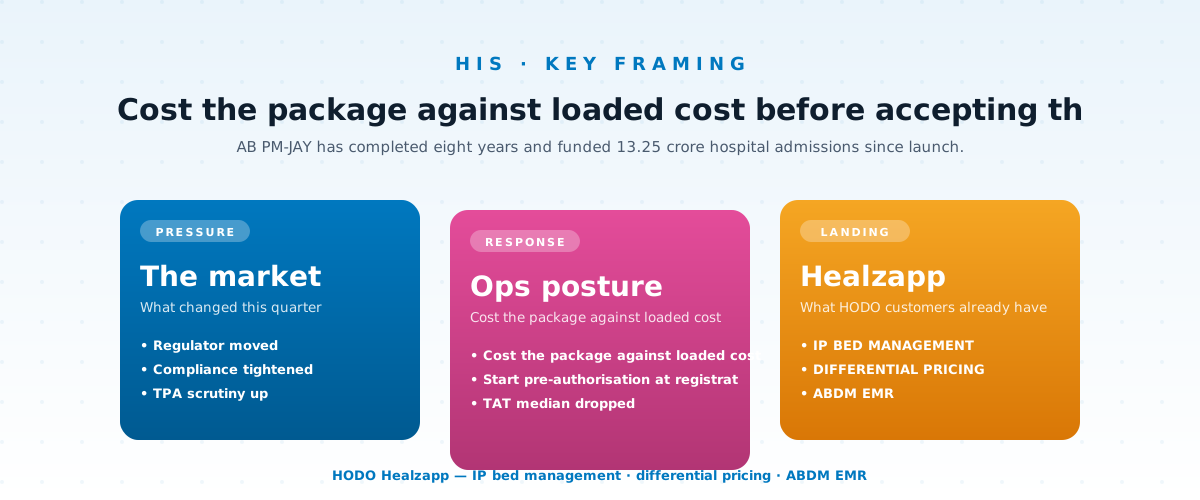
Cost the package against loaded cost before accepting the case.
One patient, many payers
Very few hospitals are PM-JAY-only. The same 100 beds serve scheme patients, TPA-covered patients, corporate empanelment, government employee schemes and cash patients, often on the same floor, on the same day, with different rate cards and different documentation obligations for identical clinical work.
A billing system that holds one price list cannot handle this without manual overrides, and manual overrides are where leakage lives. Each payer needs its own tariff, its own approval workflow and its own claim format, applied automatically from the payer captured at registration. Equally, the clinical record has to stay consistent across all of them, the same discharge summary standard, the same investigation trail, because scheme audits, insurer audits and NABH assessments all read the same file. Hospitals that maintain a separate 'scheme paperwork' process alongside their normal records end up maintaining two truths and defending both.
What this means for HODO customers
Eight years of PM-JAY have turned scheme admissions from an occasional case into a standing share of inpatient volume, and the systems most 100-bed hospitals run were not designed for fixed-price, document-heavy episodes at that scale. Healzapp addresses this at three points. Differential pricing lets each payer, scheme, TPA, corporate, cash, carry its own rate card, applied from the payer captured at registration rather than by manual override at the billing counter. IP bed management ties the admission, the payer context and the length of stay to the same record, so cost per case is visible against the package rate while the patient is still in the bed rather than after settlement. ABDM-compliant EMR keeps the clinical record, investigation reports and discharge summary in one place, so claim files assemble from the episode itself instead of being reconstructed by one overworked coordinator after discharge.